![Cover image for Top 6 Industrial Plastic Storage Bin Systems [2026 Guide]](https://file-host.link/website/sourceequipment-4q4q99/assets/blog-images/6b935da9-2259-44ce-b30b-c390d491f515/1772056871417607_5ddbadcff31a4a4aab5c5ea04591b379/360.webp)
Introduction
In high-throughput industrial environments — warehouses, distribution centers, and manufacturing floors — disorganized storage directly impacts labor costs, order accuracy, and floor safety. A recent study found that the global plastic container market reached $113.9 billion in 2025, reflecting how critical standardized storage has become to modern operations.
Industrial plastic storage bin systems address this by standardizing inventory storage, enabling faster pick-and-put-away cycles, and supporting lean workflows. Facilities using organized bin systems report 20-30% improvements in order fulfillment speeds and measurable reductions in labor costs.
Choosing the right system isn't straightforward — material grade (HDPE vs. polypropylene), load capacity, modular compatibility, and compliance certifications vary significantly across products. This guide breaks down the top 6 systems for 2026 so procurement and operations teams can match the right bin system to their facility's specific requirements.
Key Takeaways
- Industrial plastic storage bins range from shelf bins to stackable bulk containers, each suited for specific load weights and facility types
- Selection hinges on material grade, load capacity, stack rating, and whether you need food-safety or ESD compliance
- Six systems reviewed: Akro-Mils, Quantum Storage, Rubbermaid Commercial, SSI Schaefer, Orbis, and Uline Industrial
- Modular, color-coded systems support measurable improvements in pick accuracy and fulfillment speed
- Talk to a material handling specialist before buying — the right fit depends on your workflow, not just bin size
Overview of Industrial Plastic Storage Bin Systems
Industrial plastic storage bins are heavy-duty, resin-molded containers — typically HDPE (high-density polyethylene) or polypropylene — designed for repetitive handling, racking integration, and high-load environments. Unlike consumer totes or household storage products, these bins are engineered to defined stack ratings, load capacities, and dimensional tolerances.
The storage bins and totes segment grew from $9.9 billion in 2021 to $11.3 billion by 2025, driven by e-commerce fulfillment growth and tighter inventory accuracy requirements in automated distribution centers.
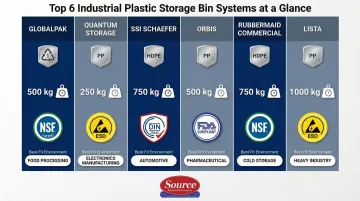
The six systems reviewed below were evaluated on load capacity, system modularity, material durability, compliance certifications, and fit across warehouse, food service, manufacturing, and distribution environments.
Top 6 Industrial Plastic Storage Bin Systems
Selection note: These six systems were evaluated based on load capacity, material grade, system scalability, shelving/racking compatibility, industry certifications, and overall value for industrial operations.
Akro-Mils
Akro-Mils is a U.S.-based industrial storage manufacturer offering a broad product range including shelf bins, stacking bins, and attached-lid containers used widely in manufacturing and distribution. The company's wide SKU range maintains consistent bin sizing standards, ensuring compatibility with both proprietary and third-party shelving systems.
The standout feature is depth of specialization — ESD-safe and antimicrobial variants cover demanding environments like electronics manufacturing and medical facilities that standard bins can't serve.
| Feature Category | Specifications |
|---|---|
| Key Features | Shelf bins, stacking bins, KeepBox ALC; HDPE/PP construction; color-coding options (red, blue, yellow, stone); ESD-safe variants available |
| Load & Capacity Specs | 10-300 lbs per bin; stack up to 6 deep; size range from 5½" × 4" × 3" to 29" × 18" × 12" |
| Best Fit | Light-to-medium parts storage, electronics manufacturing (ESD), pick-and-pack operations |
Quantum Storage Systems
Quantum Storage Systems manufactures industrial bins and integrated shelving solutions, known for Q-Bins and complete shelving + bin packages used in retail backrooms, warehouses, and light manufacturing. Their integrated bin-and-shelving systems are sold as complete units, simplifying procurement.
A wide color palette (9 options) supports visual inventory management, and the all-in-one kits offer competitive pricing for mid-scale operations.
| Feature Category | Specifications |
|---|---|
| Key Features | Q-Bins, dividable grid containers, bin shelving kits; multiple color options (9 colors); lid compatibility; FDA 21 CFR 177 compliant materials |
| Load & Capacity Specs | ~50 lbs per bin (varies by model); 600-800 lbs per shelf unit when using integrated kits; lengths from 11" to 24" |
| Best Fit | Retail inventory backrooms, mid-size warehouses, facilities needing color-coded SKU segregation |
Rubbermaid Commercial Products
Rubbermaid Commercial Products, a division of Newell Brands, focuses on professional-grade material handling equipment including BRUTE containers and heavy-duty storage totes deployed in foodservice, janitorial, and distribution settings. Their BRUTE series features structural ribbing for extreme load tolerance.
NSF/ANSI 2 certification for food-contact surfaces and FDA compliance make Rubbermaid the default choice for food processing and regulated environments. Broad distributor availability is a practical bonus.
| Feature Category | Specifications |
|---|---|
| Key Features | BRUTE totes, storage containers; NSF/ANSI 2 and FDA compliant; lid and dolly compatibility; structural ribbing design |
| Load & Capacity Specs | 10-55 gallon capacities; stackable and nestable when empty; reinforced handles for heavy-duty use |
| Best Fit | Food processing and foodservice, janitorial supply storage, heavy-duty tote applications in distribution |
SSI Schaefer
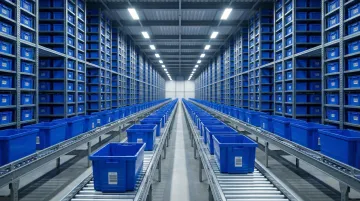
SSI Schaefer is a German-engineered global leader in warehouse automation and storage systems, offering Euro bins and plastic containers designed for automated storage and retrieval systems (AS/RS) and manual racking. Their products adhere to DIN-standard Euro bin sizing for cross-system compatibility.
The defining advantage is precision engineering: DIN 15155 standard Euro bin dimensions ensure cross-system compatibility, stack ratings reach 600 kg (1,320 lbs), and conveyor-ready bases make these the go-to for AS/RS environments.
| Feature Category | Specifications |
|---|---|
| Key Features | Euro bin dimensions (200×150mm to 800×600mm standard sizes); PP/HDPE construction; AS/RS compatible; lid/divider options; IEC 61340-5-1 ESD compliance |
| Load & Capacity Specs | 20-70 kg (44-154 lbs) per bin; stack rating up to 600 kg (1,320 lbs); reinforced bases for conveyor systems |
| Best Fit | Automated warehouses, high-density racking, facilities standardizing on Euro bin footprints |
Orbis Corporation
Orbis Corporation, a Menasha Corporation subsidiary, specializes in reusable plastic containers (RPCs) for supply chain and bulk storage, with products used heavily in food, beverage, automotive, and retail distribution. Their containers feature nesting and stacking capability to reduce return freight volume.
Orbis stands out for supply chain economics: a 2.6:1 nesting ratio slashes return freight costs, pooling programs reduce capital outlay, and FDA-compliant HDPE covers direct food contact requirements.
| Feature Category | Specifications |
|---|---|
| Key Features | Bulk bins, stack-n-nest totes; FDA 21 CFR 177 compliant; pooling program availability; HDPE construction; collapsible designs |
| Load & Capacity Specs | 1,500-2,000 lbs weight capacity; 3-5 bins high stack rating (static); 2.6:1 nesting ratio (collapses from 34" to 13") |
| Best Fit | Bulk raw material storage, food and beverage supply chains, automotive parts distribution |
Uline Industrial Bins
Uline is one of North America's largest distributors of shipping, packaging, and industrial storage products, offering a wide range of private-label and branded plastic bin systems with next-day delivery across most U.S. regions. Their catalog consolidates multiple bin types under one ordering system.
The core advantage is operational convenience: next-day fulfillment, a broad size range under one catalog, and volume pricing make Uline the practical choice for facilities that need fast restocking without managing multiple vendor relationships.
| Feature Category | Specifications |
|---|---|
| Key Features | Stack & Nest, shelf bins, dividable bins; PP construction; lid availability; 7 color options (red, blue, yellow, etc.); FDA-compliant materials |
| Load & Capacity Specs | 30 lbs per bin (standard shelf bins); 50 lbs bottom bin load for stacking; sizes from 11" × 4" × 4" and larger |
| Best Fit | High-turnover facilities needing fast restocking, mixed-use warehouses, operations sourcing bins alongside packaging supplies |
How We Chose the Best Industrial Plastic Storage Bin Systems
Each bin system was evaluated across five criteria:
- Material grade and durability (HDPE vs. PP, wall thickness)
- Load capacity and stack ratings
- Shelving and racking compatibility
- Compliance certifications (NSF, FDA, ESD)
- System scalability and reorder availability
Common buyer mistake: Selecting bins based on unit price alone without accounting for system-level fit, stack stability, or compatibility with existing infrastructure. A $5 bin that doesn't fit your rack opening or can't stack safely creates more problems than it solves.
Certification Weighting
Industry certifications and use-case specificity were weighted heavily:
- Food processing facilities need NSF-certified, FDA-compliant bins
- Electronics manufacturers need ESD-safe containers meeting ANSI/ESD S20.20 standards
- Automated warehouses need DIN-standard Euro bin footprints with precise dimensional tolerances
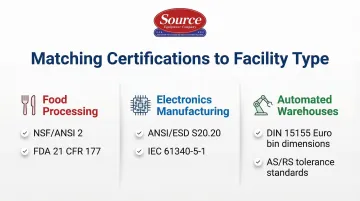
The right certification for your environment matters far more than brand recognition — a mislabeled "food-safe" bin in an FDA-regulated facility is a compliance liability, not a cost savings.
Total Cost of Ownership
We factored replacement rate, compatibility with dividers and lids, and availability for reorder alongside upfront per-unit cost. HDPE bins can last 30-50 years indoors but only 10-20 years outdoors without UV stabilization — a critical consideration for facilities with outdoor storage areas.
Conclusion
Choosing the right industrial plastic storage bin system depends on load requirements, facility type, compliance needs, and whether the system integrates with existing shelving, automation, or color-coding workflows. A bin that works for 500 SKUs must still work at 2,000 SKUs.
Evaluate scalability and reorder availability before committing. Supply chain disruptions affecting a specific bin model can halt operations if no alternative fits your existing infrastructure.
Source Equipment Company Inc. has been helping warehouses, distribution centers, manufacturers, and food service operations across the U.S. configure industrial storage solutions since 1989. Their team can assess your facility's space, inventory volume, and workflow to match you with the right bin system. Reach them at 1-800-743-5545 or contact them online to get started.
Frequently Asked Questions
What is the difference between industrial plastic storage bins and regular storage containers?
Industrial bins are engineered for repetitive handling with defined stack and load ratings, designed to integrate with racking or shelving systems. Consumer totes are built for light, infrequent household use without structural load standards or dimensional tolerances required for commercial operations.
What material is best for industrial plastic storage bins?
HDPE (high-density polyethylene) is the most common choice for durability and impact resistance. Polypropylene (PP) is preferred where lighter weight or chemical resistance is needed, and it tolerates higher temperatures (up to 160°C), making it autoclavable for medical and food processing applications.
How do I choose the right size industrial storage bin for my operation?
Bin sizing should be driven by SKU dimensions, average pick frequency, and shelf or rack opening dimensions. Standardizing on one or two bin footprints — rather than mixing sizes — simplifies slotting and replenishment workflows while reducing training complexity.
Are industrial plastic storage bins compliant for food service or food manufacturing use?
Compliance depends on the specific product. Bins intended for food contact must be made from FDA-approved resins (21 CFR 177.1520) and ideally carry NSF/ANSI 2 certification — always verify the manufacturer's documentation before deploying in food processing or foodservice environments.
Can plastic storage bins be used with automated storage and retrieval systems (AS/RS)?
Bins designed to DIN or Euro standard footprints (such as SSI Schaefer Euro bins) are engineered for AS/RS compatibility with defined tolerances for conveyor and crane handling. Standard commercial bins are typically not suitable for automated systems without dimensional validation and may cause jams or equipment damage.
How long do industrial plastic storage bins typically last under regular warehouse use?
Service life varies by material, load conditions, and UV or chemical exposure. Well-maintained HDPE bins in standard indoor warehouse environments can last 30–50 years. Track bin condition through routine equipment audits and build replacement cycles into procurement planning.