Introduction
The warehousing and storage sector reported 4.8 nonfatal occupational injuries and illnesses per 100 full-time workers in 2024 — and warehouse environments consistently rank among the most hazardous in American industry. Even more striking: OSHA estimates the annual cost of pallet rack collapse incidents in the United States at $36 billion, a figure that includes repair costs, inventory loss, and business interruption.
Most warehouse operators invest heavily in the rack structure itself but overlook the accessories that prevent the most common failure points: forklift collisions, push-through accidents, falling loads, and overloading. These accessories are engineered safeguards — and skipping them is where most preventable incidents begin.
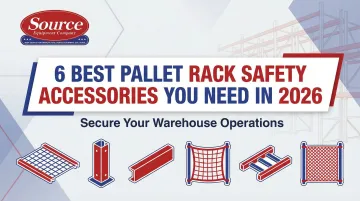
This guide covers the 6 most critical pallet rack safety accessories warehouse managers should have in place for 2026 — from column protectors that absorb forklift impacts to load capacity signs that keep OSHA inspectors satisfied.
Key Takeaways
- Pallet rack safety accessories protect both rack structure and personnel from documented failure modes
- The 6 essential accessories: upright column protectors, wire mesh decking, safety netting, pallet backstop beams, end-of-aisle row protectors, and load capacity signs
- Each accessory addresses a specific risk — impact damage, load spillage, falling inventory, or overloading
- OSHA and ANSI standards cover rack safety broadly — the right accessories make compliance straightforward
- The right accessories depend on your rack setup, forklift traffic, and the specific hazards in your facility
Why Pallet Rack Safety Accessories Matter
Pallet rack safety accessories are add-on components installed on or around a rack system to prevent structural damage, load failures, and worker injuries. They differ from the core rack structure itself—beams, uprights, and bracing—and serve as targeted interventions against specific failure modes.
These accessories address three core risk categories:
- Impact damage from forklifts and equipment
- Load instability and push-through accidents
- Falling inventory in pedestrian or work zones
Unaddressed risks in any of these categories can trigger a cascade of rack damage or collapse — forklift impacts alone are among the most common causes of rack damage.
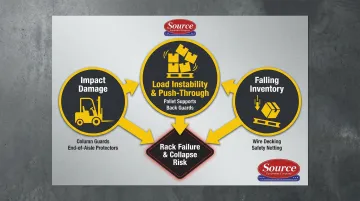
The six accessories below cover all three categories and are the most practical additions for warehouses, distribution centers, and manufacturing facilities heading into 2026.
6 Best Pallet Rack Safety Accessories for 2026
Each of the following accessories addresses a specific failure point—impact damage, falling loads, overloading, or fire code gaps—and is compatible with standard teardrop and bolted rack systems common in US warehouses and distribution centers.
Upright Column Protectors (Rack Post Guards)
Upright column protectors—also called post guards or post sleeves—are impact-absorbing covers that wrap around the base of rack uprights, the most vulnerable point of any pallet rack system. A single forklift strike to an unprotected upright can reduce its load capacity significantly and often goes unreported until visible damage appears.
Key differentiators:
- Bright safety yellow finish for high-visibility in high-traffic zones
- Bolt-free floor-mounted designs that absorb repeated impacts without requiring rack disassembly for replacement
- Steel or heavy-duty polyethylene construction options depending on impact frequency
| Attribute | Details |
|---|---|
| Best For | High-traffic aisles with frequent forklift or pallet jack movement near rack ends and column bases |
| Key Feature | Impact-absorbing construction with bolt-free installation; available in steel or heavy-duty polyethylene |
| Compliance Relevance | Supports ANSI MH16.1 requirements for rack protection in facilities with powered industrial truck traffic |
Wire Mesh Decking
Wire mesh decking replaces solid decking to provide a load-bearing surface between beams while maintaining open airflow and allowing overhead fire suppression (sprinkler) systems to function effectively. This is a key distinction in warehouses subject to fire code inspections—solid decking can block sprinkler water distribution, a compliance risk in many jurisdictions.
Key differentiators:
- Waterfall edge design that locks into step beams for a secure fit
- Weight capacity ratings that should be matched to pallet loads
- Open wire design that also improves light penetration and inventory visibility at lower levels
| Attribute | Details |
|---|---|
| Best For | Facilities requiring fire code compliance, mixed pallet storage, and improved visibility at lower rack levels |
| Key Feature | Open wire construction supports sprinkler water flow; waterfall edge provides secure beam fit and added strength |
| Compliance Relevance | Required in many fire-code-regulated facilities; supports NFPA 13 sprinkler distribution requirements |
Pallet Rack Safety Netting
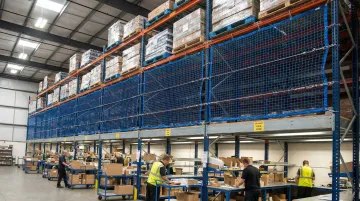
Safety netting is installed along the back or sides of rack bays—particularly above pedestrian walkways, pick zones, and workstations—to catch falling inventory before it reaches the floor or a worker below. Netting differs from rigid wire panels in that it provides flexible resistance, giving forklift operators tactile feedback when a pallet is pushed too far back.
Key differentiators:
- Available in modular and fixed configurations for different bay widths
- Capacity ratings ranging from 2,500 lbs to over 6,000 lbs depending on load type
- Ability to install on extenders above the top beam level to catch loads falling off the highest tier
| Attribute | Details |
|---|---|
| Best For | Single-row bays overlooking pedestrian aisles, workstations, or pick zones with overhead fall risk |
| Key Feature | Flexible design provides driver feedback on pallet depth; capacity-rated to match load specifications |
| Compliance Relevance | Directly supports OSHA General Industry Standard 1910.176 requirements for safe material storage |
Pallet Backstop Beams and Beam Load Stops
Pallet backstop beams are specialized beams or brackets installed at the rear of each rack bay to physically stop pallets from being pushed through to the next aisle or off the back of a single-row system.
Two main forms exist: rear stop beams (bolted to uprights at the back of the bay with a built-in flue space offset) and beam-mounted load stop brackets (fitted over existing front beams for each pallet position).
Key differentiators:
- Backstop beams with 6-inch flue space offsets maintain required fire code spacing in double-row systems automatically
- Beam-mounted stops are highly adjustable and can be repositioned as rack configurations change
- Both provide a rigid hard stop that forklift operators feel through the resistance of the load
| Attribute | Details |
|---|---|
| Best For | Double-row rack systems, three-wide bays, and any area where push-through accidents have occurred or are at risk |
| Key Feature | Rigid stopping point with built-in flue space offset; beam-mounted stops are repositionable without tools |
| Compliance Relevance | Helps maintain required flue space as specified by NFPA 13 and supports ANSI rack loading compliance |
End-of-Aisle Row Protectors and Guard Rails
End-of-aisle row protectors are heavy-duty steel guards installed at the exposed ends of rack rows—the highest-impact zone in any warehouse—to absorb forklift collisions that would otherwise directly strike uprights. Guard rails extend this protection to define clear pedestrian corridors and equipment pathways throughout the facility.
Key differentiators:
- Floor-anchored designs that do not attach to the rack frame (so impact force is transferred to the floor, not the rack structure)
- Bright yellow powder-coat finish for visibility
- Modular guard rail systems that can be configured to match aisle widths and traffic patterns
| Attribute | Details |
|---|---|
| Best For | Aisle ends near dock doors, high-traffic turns, and any zone where forklifts approach rack ends at an angle |
| Key Feature | Floor-mounted anchor transfers impact load to the slab, not the rack upright; modular guard rail configurable to layout |
| Compliance Relevance | Supports OSHA 1910.178 powered industrial truck traffic separation requirements |
Load Capacity Signs
Load capacity signs—also called rack load plaques or capacity placards—display the maximum allowable load per beam level and per bay. They are both a legal requirement in most jurisdictions and a frontline defense against overloading. Overloading is one of the leading causes of rack collapse, and signs must reflect the original manufacturer's engineering specs or a current licensed engineering assessment if the rack has been modified.
Signs must be posted at each row entrance at eye level and updated whenever rack configuration or beam levels change. Facilities that cannot produce current load placards during an OSHA inspection face direct citation risk—this isn't a documentation formality, it's an enforcement trigger.
| Attribute | Details |
|---|---|
| Best For | All pallet rack systems—required in facilities subject to OSHA inspection or operating under local building permits |
| Key Feature | Displays max load per level and per bay; must reflect current configuration and manufacturer engineering specs |
| Compliance Relevance | Required under ANSI MH16.1 and referenced in OSHA General Industry standards for storage rack safety |
How We Chose These 6 Accessories
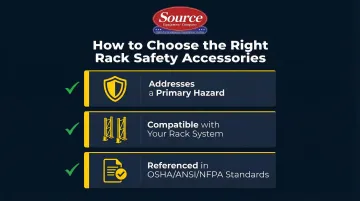
Each accessory on this list was selected against three criteria:
- Directly addresses a primary rack hazard category — impact, push-through, or falling load
- Compatible with the most widely used teardrop and bolted rack systems
- Referenced in recognized safety standards (OSHA, ANSI, NFPA)
Warehouse managers often make the mistake of treating accessories as optional add-ons rather than engineered components. An unprotected upright or unlabeled rack bay is a liability in progress, not a cost savings. The right accessories prevent cumulative damage that shortens rack lifespan and creates collapse risk.
Source Equipment Company Inc. has worked with warehouses, distribution centers, and manufacturers since 1989. Their team can assess which accessories are most critical based on your rack layout, traffic patterns, and compliance requirements — so you're spending where the actual risk is.
Conclusion
The right pallet rack safety accessories do more than prevent accidents. They extend rack system life, reduce repair and downtime costs, and keep facilities compliant with OSHA and ANSI standards heading into 2026.
Selecting accessories should start with an honest hazard assessment: where does forklift traffic concentrate, where are pedestrian zones at risk, and is every bay properly labeled and contained? Once you've mapped those risks, the right accessories become obvious choices rather than guesswork.
Contact Source Equipment Company at 1-800-743-5545 or visit sourceequipment.com to get expert guidance on the right safety accessories for your facility.
Frequently Asked Questions
Frequently Asked Questions
Is it safe to work under pallet racking?
Working near or below racking is safe when racks are properly loaded within capacity limits, show no visible damage, and have adequate protective accessories like safety netting installed above pedestrian zones. Regular inspections keep that baseline intact.
What is a mesh backing for pallet racking?
Mesh backing (also called wire mesh back panels or rigid wire guards) consists of welded wire panels bolted to the rear of rack uprights. They contain loads within the bay and provide more rigid, full-bay coverage than straps or netting.
What is the life expectancy of pallet racking?
Pallet racking can last 20-25 years or more under proper conditions, but that lifespan is significantly shortened by forklift impacts, overloading, and deferred maintenance. Safety accessories like column protectors and backstop beams directly contribute to maximizing rack lifespan.
Are pallet rack safety accessories required by OSHA?
OSHA requires storage racks to be maintained safely and loads kept within design capacity, but does not mandate specific accessories by name. Load capacity signs are explicitly referenced in ANSI MH16.1 — the standard OSHA inspectors commonly use as the compliance benchmark.
How often should pallet rack safety accessories be inspected?
Visual inspections of accessories should be conducted during routine rack inspection cycles—typically monthly by trained staff and annually by a qualified rack inspector. Damaged accessories should be replaced immediately.
![Best Pallet Rack Manufacturers in the USA [2026 Guide]](https://file-host.link/website/sourceequipment-4q4q99/assets/blog-images/5dce1de7-5314-4f9f-8d64-3cc82628ff96/1772061141216628_2ef8fa7a4181457b983c1fdb365c3991/1080.webp)