This guide covers the top 5 drive-in racking systems by manufacturer, key selection criteria, and what to look for based on your facility type—whether you're managing a temperature-controlled warehouse, bulk distribution center, or manufacturing operation with homogeneous inventory.
Key Takeaways
- Drive-in racking eliminates aisles between rack blocks, supporting LIFO or FIFO flows with up to 75% more storage density
- Best for high-volume, low-SKU operations: cold storage, food and beverage, manufacturing, bulk distribution
- Top systems covered: Mecalux, Steel King, Frazier Industrial, Unarco, and Ridg-U-Rak
- Match load capacity, lane depth, forklift clearance, and ANSI/RMI compliance to your specific operational needs
- Use this guide to compare configurations, then consult Source Equipment Company to match the right system to your facility
What Is Drive-In Racking and Why It Matters for High-Density Storage
Drive-in racking is a high-density pallet storage system where forklifts drive directly into rack lanes to load and unload pallets stored on continuous side rails rather than cross beams. The system comes in two configurations: drive-in (single entry point, LIFO inventory flow) and drive-through (dual entry points, FIFO inventory flow).
By eliminating individual pick aisles between every row, drive-in systems dedicate the majority of floor space to storage. This directly reduces the cost-per-pallet-position — a critical metric for any facility running tight on square footage.
Research from Ridg-U-Rak shows that while selectivity can drop to approximately 13% in deep configurations (8 deep x 4 high), the trade-off delivers up to 75% more storage density versus selective racking.
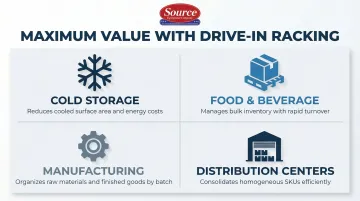
Key industries where drive-in racking delivers maximum value:
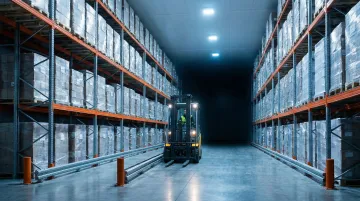
- Cold storage and freezer facilities reduce cooled surface area and cut energy costs
- Food and beverage operations manage bulk inventory with rapid, predictable turnover
- Manufacturers store raw materials and finished goods organized by production batch
- Distribution centers consolidate homogeneous SKUs with high pallet counts per SKU
Top 5 Drive-In Racking Systems for High-Density Storage
Each system below was evaluated on structural capacity, lane configuration options, ANSI/RMI compliance, industry track record, and fit across common warehouse environments — from cold storage to high-throughput distribution.
Mecalux Drive-In Racking
Mecalux is a global pallet racking manufacturer with decades of presence in North American warehousing and distribution. The company offers drive-in configurations including single- and double-entry lane setups, with modular design flexibility that adapts to diverse facility requirements.
Key advantages:
- Modular design adapts lane depth and frame height across diverse facility layouts
- High weight capacities per lane suit bulk storage in industrial and food-grade settings
- Galvanized and double-layer paint options built for cold and humid environments
According to Mecalux's technical documentation, the system is "extremely common" in cold storage rooms and freezers where maximizing expensive temperature-controlled space is critical.
| Feature | Specification |
|---|---|
| Key Configurations | Lane depth: 2–12 pallets deep; Single/double entry; Configurable frame heights for vertical optimization |
| Load Capacity | Variable per rail level based on configuration; Engineered to support bulk storage with high bay capacity ratings |
| Compliance & Certifications | Engineered per 2023 RMI design standards (ANSI recognized); Cataphoresis coating for wear-prone elements; Hot-dip galvanizing and double-layer paint for harsh environments |
Steel King Drive-In Racking
Steel King Industries, based in Wisconsin, specializes in heavy-duty structural racking with a strong presence in cold storage and food distribution environments. The company emphasizes structural steel construction over roll-formed alternatives for superior impact resistance.
Why buyers choose it:
- SK3000 Structural Steel construction handles the repeated forklift contact inherent to drive-in systems
- Compatible with standard and reach forklifts — no specialized equipment required
- Proven longevity in demanding cold storage and food distribution settings
Steel King notes that drive-in racks are "subject to more abuse than any other rack configuration" — a reality their structural approach is built around.
| Feature | Specification |
|---|---|
| Key Configurations | Lane depth range customizable; Available upright heights for various ceiling clearances; Single/double entry and drive-through options |
| Load Capacity | High pallet and bay capacity ratings; SK3000 Structural Rack construction for heavy-duty applications |
| Compliance & Certifications | R-Mark certification confirms ANSI MH16.1 compliance; Cold storage and freezer-grade options available; Structural steel for impact resistance |
Frazier Industrial Drive-In Racking
Frazier Industrial is a U.S.-based rack manufacturer with a long history of custom-engineered pallet racking solutions across manufacturing, distribution, and cold storage sectors. The company's engineering-to-order capability distinguishes Frazier for non-standard configurations.
Notable strengths:
- Engineering-to-order capability handles non-standard ceiling heights, lane depths, and entry configurations
- High-capacity structural uprights sized to specific application load requirements
- Double Wide configuration increases throughput in high-cycle operations
Frazier's documentation highlights the Double Wide option as a productivity driver in demanding fulfillment environments.
| Feature | Specification |
|---|---|
| Key Configurations | Custom depth, height, and entry configurations; Double Wide configuration available; Engineered for unique warehouse footprints |
| Load Capacity | High pallet weight limits; Bay capacity engineered to specific application requirements |
| Compliance & Certifications | ANSI/RMI compliance; Seismic zone ratings available; Corrosion-resistant surface treatments for harsh environments |
Unarco Drive-In Racking
Unarco is a longstanding American rack manufacturer serving a wide range of industries, positioned as a supplier for both new construction and warehouse retrofits. The company offers versatility with both structural and roll-formed product lines.
Where Unarco delivers value:
- Cost-competitive pricing versus fully structural alternatives
- Broad distributor network supports faster lead times for new builds and retrofits
- "Spacesaver" tapered arms allow pallets to slide in easily, cutting forklift contact and bay wear
Unarco's technical specs detail the Spacesaver arm geometry and its impact on pallet positioning accuracy.
| Feature | Specification |
|---|---|
| Key Configurations | Standard lane depth range with custom options; Available in roll-formed and structural upright gauges; Single/double entry types |
| Load Capacity | Pallet capacity per level varies by configuration; Typical bay capacity suitable for bulk distribution |
| Compliance & Certifications | ANSI/RMI compliance; Industry-specific certifications for food, cold storage, and industrial use; Rated for cold and freezer storage applications |
Ridg-U-Rak Drive-In Racking
Ridg-U-Rak, based in Pennsylvania, maintains a strong domestic manufacturing footprint with consistent delivery timelines. The company is popular in distribution and manufacturing environments where predictable lead times matter.
What buyers rely on:
- Consistent quality across standard sizes makes procurement and replacement straightforward
- Strong dealer network supports fast sourcing and regional availability
- Rolled Rail (galvanized) and Space Saver Structural Rail options let buyers balance cost against load requirements
Ridg-U-Rak's selection guide walks through rail selection based on ceiling height and pallet weight targets.
| Feature | Specification |
|---|---|
| Key Configurations | Lane depth options from standard to deep configurations; Frame height range for various ceiling heights; Roll-formed or structural steel upright frames |
| Load Capacity | Pallet weight capacity and bay load ratings engineered per application; Column sizes: 3x2-1/4, 3x3, and 4x3 inches |
| Compliance & Certifications | Member in good standing of RMI; ANSI compliance; Available finishes include galvanized for cold storage; Seismic certifications available |
How We Chose the Best Drive-In Racking Systems
Systems were assessed based on structural capacity, configuration flexibility (lane depth, height, single vs. double entry), ANSI/RMI compliance, cold storage or industry-specific suitability, and documented performance in real warehouse environments. The common mistake buyers make is prioritizing upfront cost over load ratings and compliance—a decision that creates safety and operational risks down the line.
Key factors that tie directly to business outcomes:
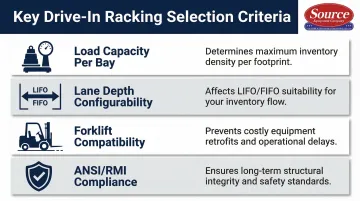
- Load capacity per bay - Impacts how much inventory fits per footprint
- Lane depth configurability - Affects LIFO/FIFO suitability and SKU diversity
- Forklift compatibility - Prevents costly retrofits and operational delays
- ANSI/RMI compliance - The R-Mark certification assures designs meet current ANSI MH16.1 standards, critical for structural integrity in high-abuse environments
Source Equipment Company applies these same criteria when helping clients match systems to their specific space constraints, inventory mix, and throughput goals—an approach built on over 35 years of material handling experience.
Beyond the rack itself, installation quality, ongoing inspection protocols, and supplier support all affect total cost of ownership. Buyers should evaluate vendors on post-sale support, not just product specs. Source Equipment backs purchases with expert consultation, compliance guidance, and fast nationwide shipping from its Massachusetts headquarters.
Conclusion
Choosing the right drive-in racking system comes down to matching structural capacity, lane configuration, and compliance standards to your specific inventory profile and warehouse layout. Brand reputation matters, but operational fit matters more.
Before committing to a system, work through three core questions:
- Can it scale? Confirm the system supports expansion as inventory grows without a full structural overhaul.
- What's the true cost? Factor in installation, ongoing maintenance, and periodic inspection — not just the sticker price.
- Does the supplier customize? Off-the-shelf defaults rarely match real warehouse constraints; look for suppliers who configure to your layout.
If you're working through those questions and need a second set of eyes, Source Equipment Company has been sourcing and configuring drive-in racking solutions since 1989. Call 1-800-743-5545 to walk through your facility requirements and get a customized configuration recommendation.
Frequently Asked Questions
What is the difference between drive-in and drive-through racking?
Drive-in racking has a single entry point per lane using LIFO (Last-In, First-Out) inventory flow, while drive-through racking has entry points on both ends supporting FIFO (First-In, First-Out) flow. Drive-in suits non-perishable goods with rapid turnover; drive-through works for date-sensitive inventory requiring rotation.
How many pallets deep can a drive-in racking system go?
Most drive-in systems are commonly configured between 6–8 pallets deep, though systems can be designed up to 12+ pallets deep depending on structural specs, forklift reach, and inventory management needs. Deeper configurations increase density but reduce selectivity.
Is drive-in racking suitable for cold storage or freezer environments?
Yes, drive-in racking is one of the preferred systems for cold storage because it minimizes aisle space, reducing the cooled area needed and lowering energy costs. Galvanized or specially coated frames should be specified for freezer applications to prevent corrosion in moisture-heavy environments.
What is the most flexible racking system?
Selective pallet racking is the most flexible option, offering direct access to every pallet position and easy reconfiguration. Drive-in racking trades flexibility for density, making it better suited for uniform, high-volume SKUs rather than diverse inventories.
What is the lifespan of a racking system?
A well-maintained racking system can last 20–25 years or more. Lifespan depends on load compliance, forklift impact frequency, inspection regularity, and prompt repair of damaged components.
What load capacity should I look for in a drive-in racking system?
Match the rack's rated pallet capacity — expressed in lbs per rail level and lbs per bay — to your actual pallet weights, and always include a safety margin. Verify ANSI/RMI compliance and never exceed posted load ratings. Doing so creates serious safety risks and may void certifications.
![7 Best Push Back Rack Systems [Compared & Reviewed]](https://file-host.link/website/sourceequipment-4q4q99/assets/blog-images/bc31782b-6cd0-4f79-9c79-0153c2ae0e2d/1772057450853280_cd396ee34926480398a9dea0aabcd2e9/1080.webp)