Introduction
Small businesses face a critical challenge in warehouse operations: limited space drives up operational inefficiencies, picking errors, and lost revenue. When every square foot counts, disorganized layouts and underutilized vertical space directly translate to higher costs and slower fulfillment. Research shows that average peak warehouse space utilization has dropped to just 73.2%, meaning many businesses are paying for space they aren't effectively using.
The right storage solution fixes this without expanding your facility. Optimized systems help small businesses recover usable floor space, improve order fulfillment speed by 20–30%, and cut labor costs by reducing travel time and picking errors.
Most warehouses use less than 50% of their available cubic capacity — focusing only on floor area while ignoring the vertical space above their heads. That's recoverable capacity sitting idle.
This guide covers 10 proven warehouse storage solutions, how to evaluate them against your specific constraints, and what to consider before investing. From cost-effective selective racking to automated vertical lift modules, each solution addresses different inventory types, picking frequencies, and space constraints. The goal is helping you find the right fit — not just the most popular option.
Key Takeaways
- Small warehouses gain most from solutions that maximize vertical space, reduce aisle waste, and match storage format to inventory type
- Options span from low-cost selective pallet racking to high-density vertical lift modules—the right fit depends on your product mix, throughput, and available floor space
- Choosing the wrong solution costs more long-term than investing in the right one upfront—scalability and workflow fit matter as much as price
- Getting a professional layout assessment before purchasing prevents expensive mismatches between your storage system and how your team actually works
Why Warehouse Storage Matters More for Small Businesses
Small businesses feel storage inefficiencies more acutely than large warehouses. Tighter margins, fewer staff, and less room for operational slack mean every misplaced pallet or wasted aisle translates directly to cost. When a picker spends an extra 30 seconds per order searching for inventory, that time multiplies across hundreds of daily picks, eroding productivity and increasing labor expenses.
The Vertical Space Opportunity
Most small warehouses use less than 50% of their available cubic footage, focusing on floor area alone. This represents a massive untapped resource. The shift from square footage thinking to cubic footage thinking expands storage capacity without expanding your building footprint. By calculating Warehouse Space Utilization (Used Space / Total Available Space × 100), many businesses discover they're operating at a fraction of their potential density.
That same wasted cubic footage connects directly to labor costs. Poor layout forces pickers to travel farther between locations — and since labor typically makes up the largest share of warehouse operating budgets, even modest reductions in travel time show up quickly on the bottom line. The efficiency gains from better layout tend to include:
- Fewer steps per pick through tighter slotting and vertical organization
- Lower labor hours per order as travel distance shrinks
- Reduced overtime driven by search time and retrieval delays
The 10 solutions below address different inventory types, picking frequencies, and space constraints. Not all will be right for every business—matching the system to your specific operational workflow matters more than selecting the most advanced or expensive option.
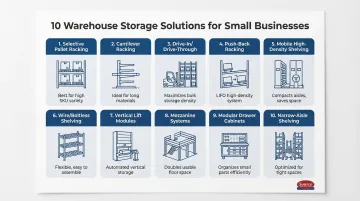
Top 10 Warehouse Storage Solutions for Small Businesses
These solutions are selected based on space efficiency, scalability for small operations, and suitability across common small business inventory types including retail, manufacturing, food service, and distribution.
Selective Pallet Racking
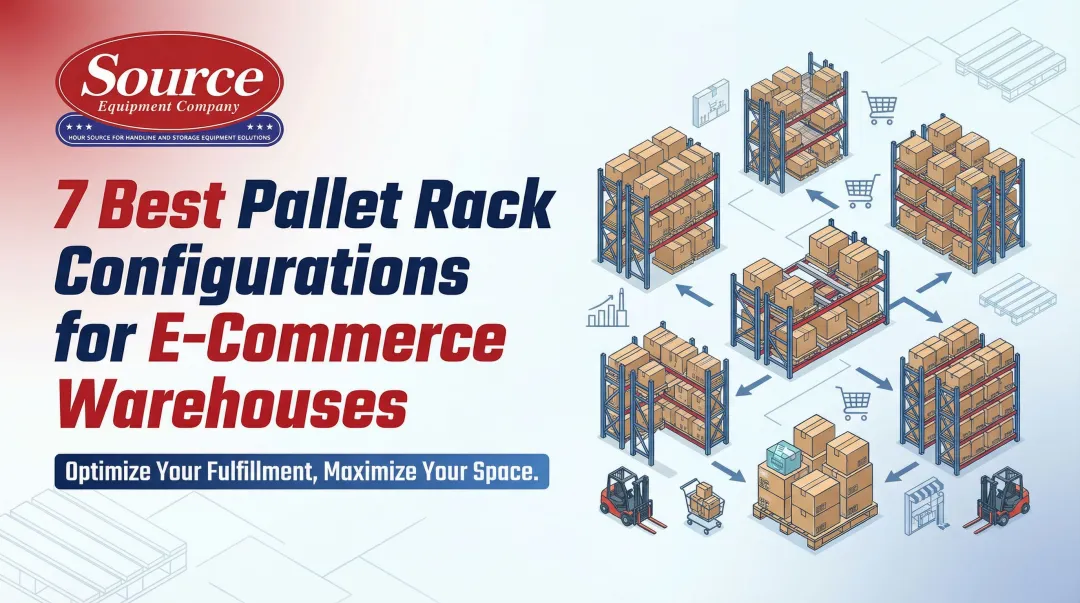
Selective pallet racking is the industry's most popular warehouse storage system, providing direct access to every pallet position. This makes it ideal for small businesses with high SKU variety and frequent picking needs where selectivity outweighs density.
Key Specifications:
- Upright Heights: 8 to 30 feet (customizable based on ceiling clearance)
- Beam Lengths: 96 to 144 inches (8-12 feet) to accommodate standard pallets
- Load Capacity: Typically 5,000 lbs per beam pair
- Aisle Width: Requires approximately 12 feet for counterbalanced forklifts
- Cost Range: Most cost-effective starting point for small warehouses
Selective racking serves as the baseline against which all high-density systems are measured. It offers 100% selectivity, meaning every pallet is accessible without moving others—critical for operations with diverse inventory and fast-moving SKUs.
Best for: Businesses with 50+ SKUs, frequent picking operations, and moderate inventory quantities per SKU.
Cantilever Racking
Cantilever racking eliminates front vertical columns through an open-arm design, making it superior for storing long or irregularly shaped items like lumber, pipe, furniture, or sheet metal. The unobstructed front face allows easy loading and retrieval of bulky materials that don't fit standard pallet configurations.
Key Specifications:
- Arm Adjustability: Vertical adjustment in 4-inch increments
- Weight Capacity: Ranges from 1,000 to 6,600 lbs per arm depending on length and design
- Configurations: Available in single-sided (wall-mounted) or double-sided (aisle-oriented) setups
- Height: Up to 30 feet vertical
The adjustable arm design accommodates varying product lengths and weights, while the modular construction allows for reconfiguration as inventory needs change. By utilizing vertical space up to 30 feet, cantilever systems reclaim floor space previously consumed by horizontal stacking.
Best for: Lumber yards, plumbing suppliers, furniture warehouses, and metal fabrication shops storing non-palletized goods.
Drive-In / Drive-Through Racking
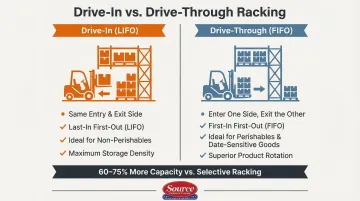
Drive-in and drive-through racking eliminate individual aisles by allowing forklifts to enter the rack structure, creating high-density storage for bulk inventory. This design increases storage capacity by 60% to 75% compared to selective racking by reducing the number of required aisles.
Operational Distinctions:
- Drive-In (LIFO): Forklifts enter and exit from the same side, following Last-In, First-Out principles—ideal for non-perishable goods
- Drive-Through (FIFO): Forklifts enter one side and exit the other, supporting First-In, First-Out operations for perishables
Trade-offs:
- Maximum density for limited SKU variety
- Slower access compared to selective systems
- Reduced selectivity (must remove front pallets to access rear positions)
Best for: Cold storage facilities, seasonal inventory, bulk food distribution, and operations storing large quantities of few SKUs where land or energy costs are high.
Push-Back Racking
Push-back racking offers a middle ground between drive-in density and selective accessibility. Pallets load from the front and roll back on inclined rails using nested carts, maintaining LIFO access without requiring forklifts to enter the rack structure.
Key Specifications:
- Depth: 2 to 6 pallets deep
- Density: Similar to drive-in racking with better selectivity
- Operation: Gravity-fed return when front pallet is removed
- Safety: Measurably reduces rack damage risk compared to drive-in systems
Push-back systems provide higher throughput than drive-in racks because forklifts operate from a single aisle position. The gravity-fed design automatically brings the next pallet forward, reducing picking time and improving operator safety.
Best for: Small businesses needing high density but handling multiple SKUs, or operations where speed and safety outweigh maximum density.
Mobile High-Density Shelving
Mobile shelving mounts shelving units on carriages that move along rails, eliminating fixed aisles and consolidating storage into a smaller footprint. This system can reduce space requirements by 45% or alternatively double or triple storage capacity within the same floor area.
Key Specifications:
- Load Capacity: 3,000 to 30,000 lbs per carriage depending on configuration
- Operation Types:
- Manual (push-pull handles)
- Mechanical assist (crank handles moving thousands of pounds with 1 lb of effort)
- Electric (push-button operation)
- Space Savings: 45% reduction compared to static racking
Mobile systems create a single aisle that moves to wherever access is needed, compacting all other rows. This suits inventory with moderate daily access volume where every item doesn't require simultaneous accessibility.
Best for: Medical records, pharmacy storage, retail backrooms, apparel warehouses, and small parts inventory where space is at a premium.
Wire / Boltless Shelving
Wire and boltless shelving represent the most accessible, low-cost storage option for small businesses. These systems assemble without tools, adjust easily, and accommodate a wide range of weight capacities. Wire shelving's open design provides ventilation advantages critical for food service and pharmaceutical applications.
Key Specifications:
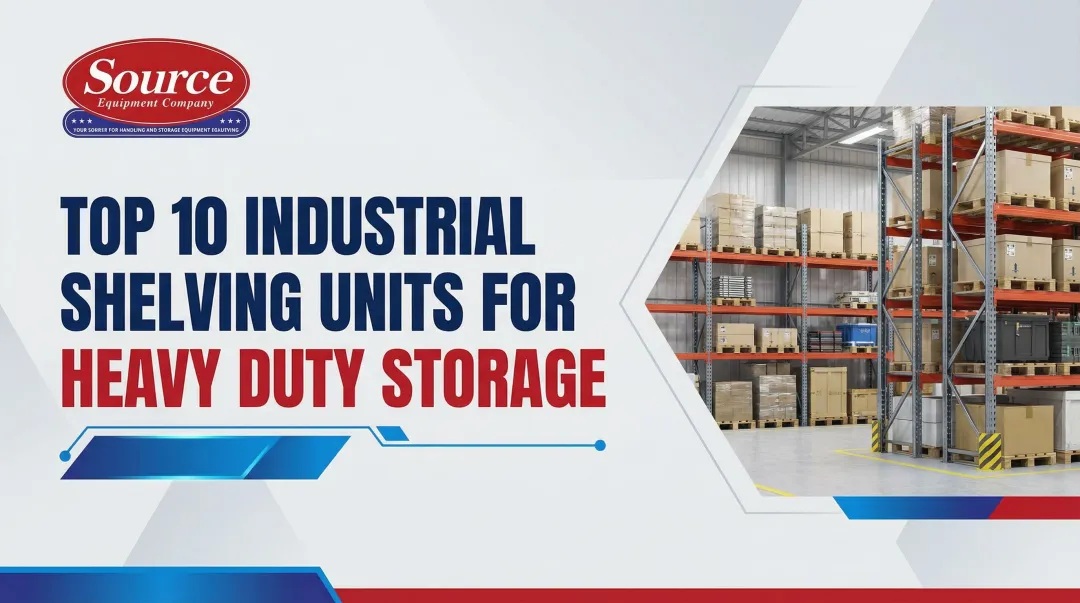
- Load Capacity: 85 lbs (light-duty) to 1,000 lbs (heavy-duty industrial) per shelf
- Shelf Dimensions: Wide variety including 18" × 47" up to larger configurations
- Cost Range: $200-$300 for basic 5-shelf units
- Certifications: NSF certified options for food service and healthcare
The open wire construction promotes airflow, reduces dust accumulation, improves visibility, and allows sprinkler penetration—making it ideal for environments requiring hygiene standards. Installation requires minimal tools and can be completed in hours.
Limitations: Not suitable for palletized goods or very heavy loads; best for hand-picked inventory and lighter materials.
Best for: Food prep areas, cold storage, medical supply rooms, retail stockrooms, and light manufacturing parts storage.
Vertical Lift Modules (VLMs)
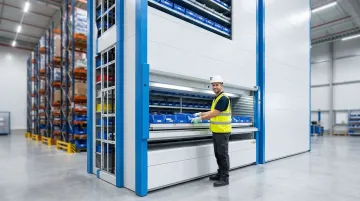
VLMs are automated storage and retrieval systems that use vertical height to store trays of parts, delivering them to an operator at an ergonomic access window. These systems can reduce floor space requirements by up to 85% while increasing picking accuracy to 99.9%.
Key Specifications:
- Tray Widths: 0.6 meters (~2 ft) up to 4.4 meters (~14 ft)
- Load Capacity: 200 to 2,200 lbs per tray
- Height Requirements: 16 to 30+ feet for optimal ROI
- Throughput: Increases picking productivity by up to 67% by eliminating walk time
- Cost: Approximately $95,000 baseline, or $6,000-$8,000 per vertical foot
VLMs deliver items to the picker rather than requiring the picker to travel. Pick-to-light technology guides operators to exact locations, eliminating picking errors. The enclosed design provides security and environmental protection for high-value or sensitive inventory.
ROI Considerations:
- Labor cost reduction up to 21%
- Payback periods often under 18 months
- Significant reduction in picking errors and associated costs
Best for: Small businesses with high labor costs, high-value small parts, electronics inventory, or operations requiring exceptional accuracy.
Mezzanine Storage Systems
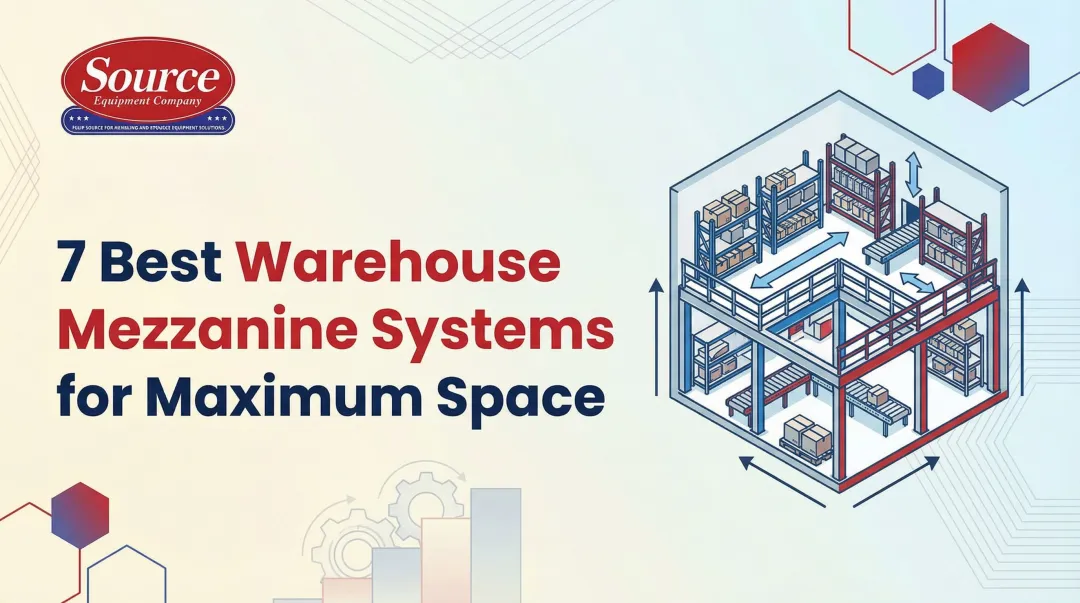
Mezzanines are raised platforms that create a second floor within your existing warehouse, effectively doubling usable area without expanding the building footprint. Modular mezzanines can be relocated or reconfigured as business needs change.
Key Specifications:
- Load Capacity: Typically 125 PSF (pounds per square foot) for standard storage; 250+ PSF for heavy-duty applications
- Clearance Requirements: Minimum 7 feet above and below the deck (20+ feet total ceiling height ideal)
- Cost Range: $35 to $85 per sq. ft. for modular systems
- Installation Timeline: 2-6 weeks (versus months for building expansion)
Cost Comparison:
- Mezzanine: $35-$85/sq. ft.
- New construction: $150-$400/sq. ft.
Modular mezzanines offer tax advantages through depreciation and avoid the lengthy permitting processes associated with building expansion. They're ideal for creating overflow storage, office space over warehouse floor, or dedicated pick/pack zones.
Best for: Businesses with high ceilings (20+ feet), growing inventory needs, or requiring additional operational space without relocating.
Modular Drawer Cabinets and Parts Storage
Modular drawer cabinets replace disorganized bins and shelving with labeled, organized, high-density drawer systems specifically suited for managing high volumes of small parts, tools, fasteners, or components.
Key Specifications:
- Drawer Weight Capacities: Varies by configuration from light-duty to heavy industrial applications
- Cabinet Configurations: Stackable units with customizable drawer heights
- Security Options: Locking mechanisms for controlled access
- Footprint: Compact designs maximize storage density per square foot
ANSI-compliant cabinet systems — like those offered by Source Equipment Company — provide labeled, dedicated locations for every part number. This improves picking accuracy, cuts training time for new employees, and eliminates the productivity loss from searching through unsorted bins.
Best for: Manufacturing operations, MRO (maintenance, repair, operations) inventory, electronics assembly, automotive parts storage, and any operation managing hundreds of small SKUs.
Narrow-Aisle Shelving Systems
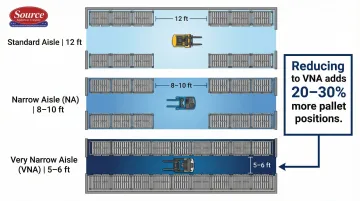
Narrow-aisle (NA) and very narrow aisle (VNA) systems reconfigure standard rack rows to reduce aisle widths, unlocking significant storage capacity within the same footprint.
Aisle Width Comparison:
- Standard Aisle: ~12 feet (for counterbalanced forklifts)
- Narrow Aisle (NA): 8 to 10 feet
- Very Narrow Aisle (VNA): 5 to 6 feet
Reducing aisle width from 12 feet to 6 feet allows for 20-30% more racking rows—often increasing pallet positions by 20-30% without expanding the building.
Equipment Requirements:
- NA Systems: Require reach trucks
- VNA Systems: Require turret trucks or order pickers (often wire-guided or rail-guided)
Trade-offs: The storage gain comes with equipment investment. VNA trucks cost more than standard forklifts, and operators require specialized training. However, for mid-volume operations with consistent SKUs and limited expansion options, the storage capacity gain often justifies the equipment investment within 2-3 years.
Best for: Established small businesses with consistent inventory volumes, limited expansion options, and budgets to invest in specialized material handling equipment.
How to Choose the Right Warehouse Storage Solution
Match Storage to Inventory Type First
The most important starting point is matching the storage system to inventory type, not floor plan. Audit these three key variables before choosing:
- SKU Count: High SKU variety (100+) requires selective access; low SKU count (under 20) allows high-density systems
- Pallet/Unit Weight: Determines load capacity requirements and equipment specifications
- Picking Frequency: Fast-movers need immediate access; slow-movers can tolerate deeper storage
A business storing 200 SKUs with daily picking needs requires different infrastructure than one storing 10 SKUs with weekly replenishment cycles.
The Vertical Clearance Factor
Ceiling height determines which solutions are viable—yet most small businesses skip this step and regret it later:
- VLMs: Require 16-30 feet clearance (taller = better ROI)
- Mezzanines: Need 20+ feet total (7 feet minimum above and below deck)
- High-bay pallet racking: Optimal at 20+ feet
- Wire shelving: Works in low-ceiling facilities (8-12 feet)
Calculate your clear height (ceiling to floor, minus obstructions like HVAC, sprinklers, and lighting). This single measurement immediately eliminates or prioritizes certain solutions.
Prioritize Scalability and Modular Design
Small businesses should prioritize solutions that can be reconfigured or expanded as inventory grows. Modular systems avoid the sunk-cost trap of fixed infrastructure that can't adapt.
Scalable Solutions:
- Selective pallet racking (add bays incrementally)
- Wire shelving systems (expand or reconfigure)
- Modular mezzanines (relocate or expand)
- Push-back racking (add depth as density needs increase)
Fixed Solutions:
- Drive-in racking (difficult to reconfigure)
- Custom mezzanines (permanent installation)
- VLMs (significant relocation costs)
Source Equipment carries pallet rack systems, wire shelving, and modular mezzanines — the categories most likely to scale without forcing a full infrastructure replacement down the road.
Once you've mapped out scalability needs, the next variable that separates the right choice from the expensive one is total cost of ownership.
Calculate Total Cost of Ownership
Walk through this framework before purchasing:
- Upfront Cost: Purchase price and delivery
- Installation: Professional setup vs. DIY assembly
- Maintenance: Annual service requirements and parts replacement
- Labor Impact: Time saved or added per pick/putaway operation
A lower-priced shelving option can cost more over time if it adds even 15 seconds per pick — across 200 daily orders, that gap adds up fast.
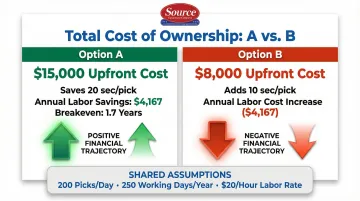
Example Calculation:
- Option A: $15,000 upfront, saves 20 seconds per pick
- Option B: $8,000 upfront, adds 10 seconds per pick
- At 200 picks/day, 250 days/year, $20/hour labor rate
- Option A saves $4,167/year in labor costs
- Option A pays for itself in 1.7 years, then continues saving money
Conclusion
For small businesses, the right warehouse storage solution isn't the most expensive or technologically advanced one—it's the one that matches operational workflow, product type, and growth trajectory. A $95,000 VLM might deliver 18-month payback for a high-volume electronics distributor but make no sense for a lumber yard that needs cantilever racking at $15,000.
Evaluate solutions against your specific constraints before purchasing:
- Ceiling height (eliminates or enables certain options)
- SKU count (determines selectivity requirements)
- Budget (including total cost of ownership, not just purchase price)
- Picking frequency (impacts density vs. accessibility trade-offs)
Source Equipment Company has worked with warehouses, manufacturers, and distributors since 1989. Their assessments cover space constraints, inventory flow, and picking patterns—clients typically see 20-30% faster order fulfillment after implementation. Equipment is UL Listed and ANSI-compliant, with nationwide shipping from their Leominster, MA headquarters.
Contact Source Equipment at 1-800-743-5545 or bfellows@sourceequipment.com to schedule a free consultation and get a storage layout tailored to your space and budget.
Frequently Asked Questions
Frequently Asked Questions
How to maximize space in a small warehouse?
Use vertical space with taller racking systems (up to ceiling clearance limits), switch to narrow-aisle layouts to reduce wasted aisle width, and implement high-density or mobile shelving to eliminate fixed aisles. These strategies can increase storage capacity by 40-75% without expanding your footprint.
How to layout a small warehouse?
An effective small warehouse layout prioritizes workflow zones (receiving, storage, pick/pack, shipping) arranged to minimize travel distance between sequential operations. Use CAD-based planning tools to eliminate dead zones and pinch points, and position fast-moving inventory closest to packing stations to reduce picker travel time.
What is the most popular warehouse management system?
Popular WMS platforms include Manhattan, SAP EWM, NetSuite, and Fishbowl — each tracking inventory and managing operations digitally. Keep in mind that no software compensates for poor rack layout; solid physical storage infrastructure is what makes a WMS perform.
What are the 5 KPIs for a warehouse?
The five common warehouse KPIs are inventory accuracy, order fulfillment rate, picking accuracy, storage utilization rate, and on-time shipment rate. Storage solution choice directly impacts several of these metrics—particularly storage utilization, picking accuracy, and fulfillment speed.
What are the 7S rules in warehouse?
The 7S framework extends the traditional 5S lean methodology (Sort, Set in order, Shine, Standardize, Sustain) by adding Safety and Security. The premise is straightforward: safe, secure environments are prerequisites for efficiency — not afterthoughts.
What is the most cost-effective warehouse storage solution for small businesses?
Wire/boltless shelving and selective pallet racking offer the lowest upfront cost ($200-$5,000 depending on configuration) and the widest applicability across inventory types. That said, always calculate total cost of ownership including labor — a $15,000 system that cuts picking time by 30% often beats an $8,000 system that adds handling steps.