Introduction
Warehouse square footage costs are rising across North America. Direct vacancy rates doubled to 6.6% in 2023, while taking rents climbed to $8.08 per square foot annually—a 15.9% increase over 2022. Distribution centers, manufacturers, and retailers face mounting pressure as storage capacity maxes out and expansion costs climb.
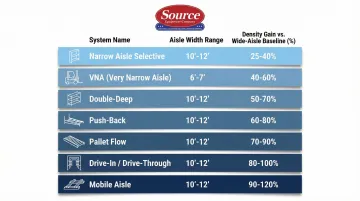
Narrow aisle racking systems solve this problem by reducing aisle widths from the standard 10-12 feet down to 8 feet or less. That reduction alone can unlock 20-50% more pallet positions within your existing footprint, with no construction required.
What follows covers the 7 best narrow aisle racking systems—what makes each one distinct, and how to choose the right fit based on your SKU count, inventory rotation, ceiling height, and equipment needs.
Key Takeaways
- Narrow aisle systems reduce aisles from 12' to 6', delivering up to 50% more pallet positions in the same floor area
- All 7 systems covered here—from narrow aisle selective to VNA and mobile aisle—serve different inventory profiles and operational needs
- Specialized lift equipment (reach trucks, turret trucks) is often required and represents a key cost variable
- System selection depends on SKU count, pallet turnover, ceiling height, floor flatness, and budget, not aisle width alone
- Expert consultation before purchasing prevents costly mismatches between system type and warehouse workflow
What Are Narrow Aisle Racking Systems?
Narrow aisle racking refers to any pallet storage configuration that reduces aisle width below the standard 10–12 feet. This category spans a spectrum from narrow aisle (8–10') to very narrow aisle or VNA (5.5–6.5').
The narrower the aisle, the more rack rows you can fit in the same footprint — and the better you utilize vertical space. That translates directly to a lower cost-per-pallet-position, which is the metric that matters most when you're paying per square foot.
Those gains do come with trade-offs. Tighter aisles require specialized lift equipment and more deliberate workflow planning. The 7 systems below break down the real options — across warehousing, distribution, manufacturing, food service, and retail — so you can match the right configuration to your operation.
7 Best Narrow Aisle Racking Systems for Space Optimization
Each system below was selected based on space efficiency, operational versatility, load capacity, and real-world adoption across warehousing and distribution. The right choice depends on your SKU count, inventory rotation requirements, and ceiling height.
Narrow Aisle Selective Pallet Racking
For operations upgrading from wide-aisle setups, narrow aisle selective racking offers the lowest barrier to entry. It compresses standard selective rack aisles to 8–10', accessible by narrow aisle reach trucks without requiring a full system overhaul.
Key differentiator: It preserves 100% SKU selectivity and FIFO inventory rotation while increasing pallet density by roughly 20-25% versus wide-aisle layouts. This balance of accessibility and density works well for high-SKU operations that can't sacrifice selectivity.
| Feature | Specification |
|---|---|
| Typical Aisle Width | 8'–10' |
| Lift Equipment Required | Narrow aisle reach truck or stand-up counterbalanced forklift |
| Best For | High-SKU, high-selectivity warehouses with moderate density needs |
Narrow aisle reach trucks typically operate in aisles between 8'6" to 9' wide, with some models requiring as little as 106 inches (8.83 feet). A Raymond Reach-Fork truck in a 105" aisle can save approximately 15% of floor space or store 19% more pallets compared to a counterbalanced truck in a 144" aisle.
Very Narrow Aisle (VNA) Racking
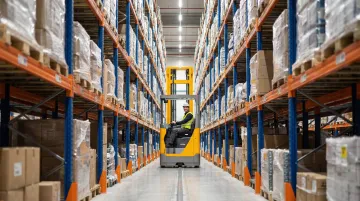
VNA racking compresses selective storage into aisles of just 5.5–6.5', using man-up or man-down turret trucks on rail or wire guidance. Pallet positions increase by 40–50% versus standard wide-aisle selective rack.
Why it stands out: VNA systems excel in high-bay warehouses with ceiling heights above 22' where vertical storage density is the priority. The wire/rail guidance system significantly reduces rack damage from forklift strikes—wire guidance dominates U.S. installations due to lower installation cost. Best suited for pharmaceutical, auto parts, and high-volume distribution operations.
| Feature | Specification |
|---|---|
| Typical Aisle Width | 5.5'–6.5' |
| Lift Equipment Required | Man-up/man-down turret truck with rail or wire guidance system |
| Best For | High-bay warehouses needing maximum vertical and horizontal density with high SKU selectivity |
Critical consideration: VNA installations require "superflat" floors measured by the American Concrete Institute (ACI) Fmin standard—not ASTM FF/FL. Floor remediation alone can add $1,500–$3,000 to project costs.
Turret trucks also carry a higher equipment price than standard reach trucks, so total system cost warrants careful budgeting before committing to VNA.
Double-Deep Pallet Racking
Double-deep racking is a two-pallet-deep storage system that doubles pallet positions per aisle face compared to single-deep selective rack. Aisles remain slightly wider than VNA (9-10') but a deep-reach forklift is required to access the rear pallet positions.
Strength as a density-first solution: Ideal when two or more pallets of the same SKU are common, since rear-position pallets are only accessible after the front pallet is removed. This sacrifices full selectivity for density gains of 30-40% compared to single-deep racking.
| Feature | Specification |
|---|---|
| Typical Aisle Width | 9'–10' (to accommodate deep-reach truck outriggers) |
| Lift Equipment Required | Deep-reach forklift or double-reach truck |
| Best For | Operations with limited SKU variety and higher pallet quantities per SKU |
Double-deep systems work well for bulk storage and low-SKU operations where LIFO (Last-In, First-Out) inventory management is acceptable. The reduced selectivity makes this unsuitable for operations requiring strict FIFO compliance.
Push-Back Racking
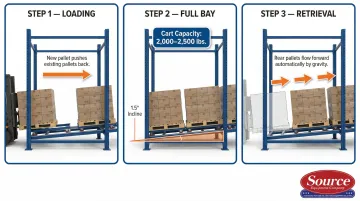
Push-back racking uses nested carts on inclined rails — loading a new pallet pushes the previous one back; on removal, rear pallets flow forward automatically. Systems typically accommodate 2–6 pallet depths per bay.
Advantage over double-deep: No deep-reach truck required—standard forklifts operate from the aisle face, making it more equipment-flexible. LIFO inventory rotation applies, making it suitable for non-date-sensitive goods in manufacturing and distribution.
| Feature | Specification |
|---|---|
| Typical Aisle Width | 8'–9' (operates from single aisle face) |
| Lift Equipment Required | Standard counterbalanced forklift or reach truck |
| Best For | Medium-to-high density storage with moderate SKU variety and LIFO inventory rotation |
Push-back systems offer up to 90% more product storage than selective racks and 400% more selectivity than drive-in configurations. Those gains depend on the gravity mechanics: cart capacities typically run 2,000–2,500 lbs, and a slope of approximately 5/16" per foot (1.5°) is required for reliable forward flow.
Pallet Flow (Gravity Flow) Racking
Pallet flow racking is a high-density system using inclined rollers or wheels that allow pallets to glide by gravity from the load end to the pick end. Pallets are loaded from the rear and retrieved from the front, enabling true FIFO rotation across multiple pallet depths—often 10-20 deep, with some systems accommodating up to 30 pallets.
Best use case: High-throughput operations like food distribution, cold storage, and e-commerce fulfillment where FIFO compliance and pick speed are critical. Separate load and pick aisles reduce traffic and increase throughput significantly.
| Feature | Specification |
|---|---|
| Typical Aisle Width | Load and pick aisles both at 8'–10'; no cross-aisle required |
| Lift Equipment Required | Standard forklift (separate load and pick ends) |
| Best For | FIFO-critical operations with high-volume, repeating SKUs (food, beverage, pharma, e-commerce) |
Pallet flow racking increases product storage density by nearly 90% over selective racks due to the elimination of intermediate aisles. Speed controllers manage pallet descent at constant speeds (typically 0.3 m/sec) to prevent damage and ensure safe operation.
Drive-In / Drive-Through Racking
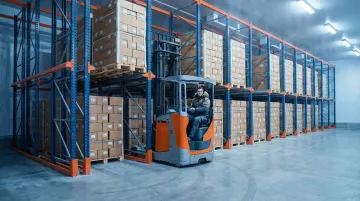
Drive-in and drive-through racking eliminate cross-aisles entirely — forklifts enter the rack structure to place or retrieve pallets on interior rails. Drive-in uses a single entry point (LIFO); drive-through has entry and exit points on both ends (FIFO).
Differentiator as the highest density solution: Ideal for low-SKU, high-volume bulk storage where full selectivity is not needed. Commonly used in cold storage, seasonal goods, and commodities. Note that only one forklift can operate in a lane at a time, which is a throughput constraint.
| Feature | Specification |
|---|---|
| Typical Aisle Width | No access aisles within rack blocks; perimeter access aisles at 10'–12' |
| Lift Equipment Required | Counterbalanced forklift (must fit within rack entry dimensions) |
| Best For | Low-SKU, high-volume bulk storage in cold storage, food, and seasonal distribution |
Drive-in systems can improve space utilization by up to 75% compared to selective racking, storing pallets as many as 10 deep. Because forklifts operate inside the rack structure, controlled entry and exit speeds are non-negotiable — even minor collisions accumulate structural damage over time.
Mobile Aisle (Moveable Base) Racking
Mobile aisle racking mounts entire rack rows on motorized or manual carriages that slide on floor rails. One active aisle exists at a time — open it where needed, close it when done. This approach delivers floor utilization that rivals drive-in systems while maintaining full selectivity.
Key advantage: Mobile racking can achieve storage density comparable to drive-in racking while retaining full SKU selectivity. Commonly used in records storage, cold storage, and pharmaceutical warehouses where space cost is extremely high.
| Feature | Specification |
|---|---|
| Typical Aisle Width | Single active aisle (typically 8'–10') across entire rack installation |
| Lift Equipment Required | Standard reach truck or order picker (used in the single open aisle) |
| Best For | High-value space environments (cold storage, pharma, archives) where maximum density with selectivity is required |
Mobile systems can increase storage capacity up to 90% and save up to 45% of space compared to static racks. Critical requirement: Floors must be laser-leveled and designed for high point loads, with maximum variation within 3mm across a 1000mm x 1000mm area.
How We Chose the Best Narrow Aisle Racking Systems
Selection focused on systems that deliver measurable space efficiency gains, accommodate standard pallet sizes, and are widely supported by material handling suppliers in North America.
Common mistake buyers make: Choosing a system based on density alone without accounting for existing lift fleet, floor specifications, or SKU rotation requirements.
Key Evaluation Criteria
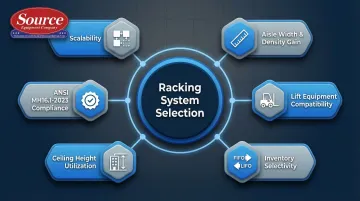
Each system was evaluated across six factors:
- Aisle width and density gain — pallet position increases versus wide-aisle baseline, measured as percentage of total floor space recovered
- Lift equipment compatibility — standard forklift compatibility versus specialized requirements (turret trucks, deep-reach trucks, wire guidance systems) and associated capital costs
- Inventory selectivity — FIFO, LIFO, or full selectivity, and the downstream impact on picking efficiency and stock rotation
- Ceiling height utilization — vertical storage capacity and compatibility with high-bay facilities (22'+ ceilings)
- ANSI MH16.1-2023 compliance — structural design standards and OSHA requirements to prevent rack collapse and workplace hazards
- Scalability — modular expansion capabilities and compatibility with existing rack systems
These criteria reflect the real-world trade-offs that warehouse operators face when selecting a system. Source Equipment Company has worked through these same decisions with warehouses, distribution centers, and manufacturers since 1989 — evaluating space constraints, inventory requirements, and workflow patterns to match operations to the right rack configuration.
Conclusion
The right narrow aisle racking system depends on a combination of operational factors: aisle width, SKU count, inventory rotation method, lift equipment budget, and ceiling height. The best fit varies by operation.
Assess not just upfront cost but long-term scalability, floor and equipment requirements, and alignment with your throughput goals before locking in a configuration. The density gains are real—but only when matched correctly to your operational profile.
Source Equipment Company has been helping warehouses, distribution centers, and manufacturers optimize storage since 1989. Their team assesses your facility's specific layout, inventory profile, and throughput requirements to recommend an ANSI-compliant racking configuration that actually fits. Call 1-800-743-5545 to discuss your project.
Frequently Asked Questions
Frequently Asked Questions
What aisle width is considered narrow aisle racking?
Narrow aisle racking typically refers to aisle widths between 8-10 feet, while very narrow aisle (VNA) configurations run 5.5-6.5 feet. This contrasts with the standard 10-12 foot wide-aisle layout used with conventional counterbalanced forklifts.
Do narrow aisle racking systems require special forklifts?
Narrow aisle (8-10') can often be served by standard narrow aisle reach trucks, while VNA configurations (under 7') require specialized turret trucks or order pickers operating on rail or wire guidance systems. Budget for this equipment when planning a VNA project.
What are the benefits of VNA racking?
VNA racking offers significant advantages over standard wide-aisle selective rack:
- Up to 40-50% more pallet positions
- Better vertical space utilization in high-bay facilities
- Reduced rack damage through guided truck systems
- Full SKU selectivity retained
What is the most widely used pallet racking system?
Selective pallet racking is the most widely used system due to its flexibility, full SKU accessibility, and compatibility with standard forklifts. Narrow aisle and VNA variants of selective rack are its most space-efficient configurations.
Which is better keystone or teardrop pallet rack?
Teardrop pallet rack is the most common and widely compatible style in North America due to its tool-free beam connection and cross-manufacturer interchangeability. Keystone is another beam-and-upright system but with less universal compatibility.
What is the going rate for pallet storage?
Pallet racking typically runs $50-$500 per pallet position: selective $50-$200, VNA $100-$250, double-deep $80-$300, push-back $150-$300, and pallet flow $250-$350. Narrow aisle systems cost more upfront but deliver a lower cost per pallet position through higher density. Final pricing varies based on materials, installation complexity, and infrastructure requirements.
![7 Best Push Back Rack Systems [Compared & Reviewed]](https://file-host.link/website/sourceequipment-4q4q99/assets/blog-images/bc31782b-6cd0-4f79-9c79-0153c2ae0e2d/1772057450853280_cd396ee34926480398a9dea0aabcd2e9/1080.webp)