Introduction
When warehouse floor space hits capacity, most facilities are looking at two expensive options: relocate or expand outward. Both mean permits, construction delays, and capital you'd rather put elsewhere.
Mezzanine systems offer a third path — unlocking the vertical space already inside your building and effectively doubling usable square footage without touching your footprint.
The numbers explain why demand is rising. The global industrial mezzanine market was valued at $7.63 billion in 2024 and is projected to reach $11.34 billion by 2033, a compound annual growth rate of 4.5%. At the same time, U.S. industrial vacancy rates held at 7.1% in Q4 2025, with asking rents climbing to $10.18 per square foot and new construction completions at an eight-year low.
For operations trying to scale within tight real estate markets, building up is the most practical move available.
Key Takeaways
- Warehouse mezzanines create a structural second floor within your facility, doubling usable space without new construction
- The seven systems covered span freestanding, rack-supported, and modular designs — each suited to different load and layout needs
- Selection depends on load capacity (PSF rating), ceiling height, workflow requirements, and OSHA/ANSI compliance
- Most systems ship as bolt-together kits, so upfront planning around column placement and stairway access saves costly rework later
What Is a Warehouse Mezzanine System?
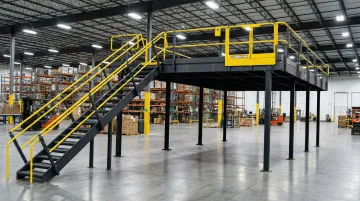
A warehouse mezzanine system is a raised structural platform installed between the floor and ceiling of an existing facility, designed to create additional usable floor area without expanding the building's footprint. Unlike permanent construction, mezzanines are semi-permanent structures that can be disassembled, reconfigured, or relocated as operational needs change—making them a faster and far less expensive path than new construction or facility relocation.
Mezzanines are classified under the International Building Code (IBC Section 505.2) as intermediate levels that become part of the story below them. Because they are structural additions affecting building safety and egress, they require stamped engineering drawings and a local building permit in most jurisdictions.
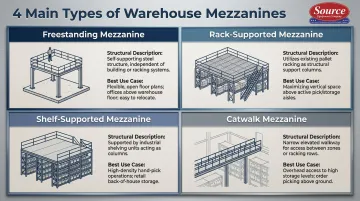
Four Main Types of Warehouse Mezzanines
Each of the four main types serves a different operational profile:
| Type | Structure | Best For |
|---|---|---|
| Freestanding | Independent steel columns anchored to the floor | Storage, offices, assembly, pick-and-pack — maximum layout flexibility |
| Rack-Supported | Pallet rack uprights as structural supports | High-density storage; active pallet storage below the deck |
| Shelf-Supported | Shelving units as the structural base | High-SKU, small-parts picking in e-commerce and distribution |
| Catwalk | Narrow elevated walkways tied to racking | Accessing inventory in very tall rack systems where floor-level picking is impractical |
7 Best Warehouse Mezzanine Systems for Maximum Space
The systems below were selected based on load capacity, system flexibility, compliance credentials (UL Listed, ANSI Compliant), industry recognition, and fit across warehousing, manufacturing, and distribution environments.
MiTek Mezzanine Systems
MiTek Mezzanine Systems, headquartered in New Berlin, Wisconsin, designs, manufactures, and installs engineered freestanding mezzanine structures for material handling and logistics. A six-time MHEDA Most Valuable Supplier Award winner, MiTek is one of the most recognized names in the industry.
Why it stands out:
- Engineering-forward design approach for complex configurations
- US-based manufacturing and installation network for both new construction and retrofit projects
- Custom-engineered platforms sized to specific facility footprints, with modular design that supports phased expansion
| System Type | Load Capacity | Key Features |
|---|---|---|
| Freestanding structural steel | Custom-engineered to project specifications | Modular design, comprehensive engineering support, multiple decking and finish options |
Steele Solutions Inc.
Steele Solutions, headquartered in Franklin, Wisconsin, designs and manufactures engineered steel structures for commercial, industrial, and military applications. Their experience across sectors — including defense contracts — translates directly into heavy-load capacity that most commercial mezzanine suppliers can't match.
Why it stands out:
- Custom-engineered structures built for heavy industrial applications
- Integration capabilities with automated systems and conveyors
- Military-grade fabrication standards applied to commercial installations
| System Type | Load Capacity | Key Features |
|---|---|---|
| Custom engineered steel platforms | Standard 125 PSF; engineered up to 200+ PSF for heavy equipment | Automation integration, heavy-duty capacity, turnkey design-through-installation support |
Panel Built Inc.
Panel Built, headquartered in Blairsville, Georgia, specializes in modular mezzanine systems and prefabricated industrial structures. The company is known for fully configurable systems with a wide range of decking, railing, and finish options — a practical fit for operations that anticipate layout changes or phased growth.
Why it stands out:
- Modular bolt-together design allows expansion, reconfiguration, or disassembly without major cost
- Fast installation with minimal operational disruption
- Broad customization options for color, finish, and decking materials
| System Type | Load Capacity | Key Features |
|---|---|---|
| Modular freestanding | Up to 125 PSF standard | Pre-engineered modules, customizable color/finish options, rapid installation |
Mecalux Mezzanine Platforms
Mecalux, headquartered in Barcelona, Spain, operates in the U.S. through Interlake Mecalux. The company leads in metal racking and multi-level mezzanine platforms, serving logistics and retail distribution environments where high-density storage and multi-tier configurations are the priority.
Why it stands out:
- Multi-level mezzanine capability (up to several floors) for maximum vertical space utilization
- Tight integration with pallet racking and shelving systems
- Large-scale international deployments backed by global certifications
| System Type | Load Capacity | Key Features |
|---|---|---|
| Rack-supported and freestanding multi-level platforms | Engineered to project specifications | Dismountable and reusable design, multi-floor capability, integration with automated storage systems |
Gonvarri Material Handling (Dexion)
Gonvarri Material Handling operates in the U.S. through its Dexion brand out of Franklin, Wisconsin. The company focuses on scalable mezzanine structures built for long-term adaptability, with documented large-scale deployments including a 3,000 m² mezzanine installation in Sweden.
Why it stands out:
- Emphasis on scalability and long-term structural adaptability
- Large-scale installation capability for major logistics operations
- Palomat automated stacking integration, handling up to 25 pallets per cycle
| System Type | Load Capacity | Key Features |
|---|---|---|
| Structural and integrated logistics platforms | Engineered to project specifications | Large-scale configurability, automation compatibility, cantilever systems integration |
Wildeck Inc.
Wildeck Inc., a Holden Industries company headquartered in Waukesha, Wisconsin, is one of the most recognized U.S. manufacturers of industrial mezzanines, work platforms, and vertical reciprocating conveyors (VRCs). Their products are specified for warehouses, distribution centers, and manufacturing plants nationwide, with explicit ANSI MH28.3 compliance across all product lines.
Why it stands out:
- Long-standing U.S. manufacturing reputation with employee-owned backing
- ANSI MH28.3 compliance explicitly stated across product lines
- VRC lift integration for efficient vertical material flow between mezzanine levels
| System Type | Load Capacity | Key Features |
|---|---|---|
| Freestanding, rack-supported, and work platforms | Engineered to project specifications | ANSI MH28.3 compliance, VRC integration, wide span options, comprehensive safety guarding |
SSI Schaefer Mezzanine Systems
SSI Schaefer, with U.S. headquarters in Charlotte, North Carolina, provides automated material handling and storage solutions globally. Their multi-tier mezzanine systems are built for high-throughput distribution and e-commerce fulfillment environments where storage density and order-fulfillment speed both matter.
Why it stands out:
- Full integration with automated conveyor, sorting, and warehouse management systems
- Designed for operations that need both storage density and fast order fulfillment — not one or the other
- Scalable multi-tier design from single-story to multi-story configurations
| System Type | Load Capacity | Key Features |
|---|---|---|
| Multi-tier and automation-integrated platforms | 350 kg/m² (~70 PSF) to 1,000 kg/m² (~200 PSF) | Conveyor integration, scalable multi-tier design, WMS compatibility, optimized plug-in connections |
Key Factors to Consider When Choosing a Warehouse Mezzanine System
Ceiling Height and Clearance
A minimum ceiling height is required to accommodate both a usable upper level and sufficient clearance underneath. The International Building Code (IBC Section 505.2) requires a clear height of not less than 7 feet (2,134 mm) both above and below the mezzanine floor. This means your facility typically needs a minimum ceiling height of approximately 15 feet to comfortably accommodate the mezzanine deck thickness and required clearances. Confirm this threshold before system selection—insufficient clearance is one of the most common reasons mezzanine projects fail during permitting.
Load Capacity and Floor Rating
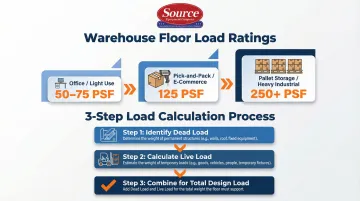
Matching the mezzanine's PSF (pounds per square foot) rating to your intended use is critical for safety and cost-efficiency:
- Office / Light Use: 50-75 PSF for personnel, desks, and light archives
- Pick-and-Pack / E-commerce: 125 PSF for shelving, conveyor belts, and inventory storage
- Pallet Storage / Heavy Industrial: 250 PSF or higher for heavy pallet jacks, dense inventory, or machinery
How to Calculate Load Requirements:
- Identify the dead load — the fixed weight of the structure itself (decking, beams, columns)
- Calculate the live load — the weight of temporary items like people, inventory, and equipment
- Add both together; engineers design to the maximum anticipated combined load to ensure structural integrity
Use Case and Workflow Integration
The type of operation determines whether a freestanding, rack-supported, or shelf-supported system is most appropriate:
- Freestanding systems work best for offices, assembly areas, or operations requiring flexible layouts
- Rack-supported systems maximize storage density when the space below will be used for pallet storage
- Shelf-supported systems suit high-SKU picking operations in e-commerce and distribution
Consider how mezzanine placement affects forklift access, employee flow, and receiving/shipping workflows. Poor placement can create bottlenecks that negate the space benefits.
Compliance Requirements (OSHA, ANSI, Local Permits)
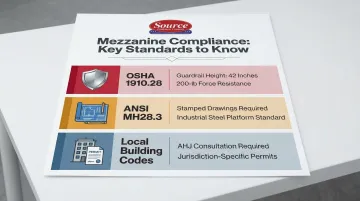
Mezzanines must comply with multiple safety and structural standards:
- OSHA 1910.28: Fall protection for walking-working surfaces, requiring guardrails 42 inches (± 3 inches) high that can withstand a 200-pound outward or downward force
- ANSI MH28.3: Design standard for industrial steel work platforms, typically requiring stamped engineering drawings
- Local Building Codes: Permit requirements vary by jurisdiction — check with your local authority having jurisdiction (AHJ) early in the planning process
Professional engineering and permitting are typically required for permanent installations above a defined size or load threshold. Consult with a material handling professional or structural engineer early in your planning process.
Scalability and Reconfigurability
A modular or bolt-together system gives you options that a welded structure simply doesn't when your operations change. Modular systems can be expanded, reconfigured, or relocated without the capital expenditure of replacing an entire structure. Source Equipment Company Inc. has supplied modular mezzanine systems to warehouses and distribution centers nationwide since 1989, with a focus on configurations that grow alongside the operation rather than require full replacement.
How We Selected These 7 Systems
Each system on this list was evaluated against five criteria:
- Engineering compliance (UL Listed, ANSI Compliant certifications)
- Load capacity range across light- and heavy-duty applications
- System flexibility — freestanding, rack-supported, and modular configurations
- Manufacturer track record with verifiable installations in industrial settings
- Fit across warehousing, manufacturing, and distribution environments
We also filtered out systems based on common selection mistakes:
- Choosing based solely on price without considering total cost of ownership
- Overlooking clearance height requirements that prevent permitting approval
- Ignoring local permit requirements that delay or halt installations
Every system that made the cut addresses these issues directly — with published load specs, documented certifications, and enough installation history to confirm real-world performance.
Important Note: The "best" system depends on facility-specific variables including ceiling height, load requirements, workflow design, and local code requirements. Consult a material handling expert before purchasing to ensure your selection aligns with your operational needs and regulatory environment.
Conclusion
Warehouse mezzanine systems are one of the highest-ROI investments available to facility managers—allowing operations to double usable space within the existing footprint, without the cost or disruption of relocation. With industrial real estate tightening and construction costs rising, vertical space optimization has shifted from optional upgrade to operational priority.
The right system depends on load requirements, ceiling height, workflow design, and compliance needs—not brand name or upfront price. Each of the seven systems covered here brings distinct strengths:
- Heavy-load industrial applications — structural steel systems built for sustained weight demands
- Modular flexibility — bolt-together configurations that adapt as operations change
- Automation integration — platforms designed for high-throughput fulfillment environments
If you're evaluating mezzanine systems for your facility, Source Equipment Company Inc. can help. Serving clients nationwide since 1989, we provide expert consultation on selecting, configuring, and procuring the right warehouse mezzanine system for your specific operational needs. Contact us at 1-800-743-5545 or email bfellows@sourceequipment.com to discuss your project.
Frequently Asked Questions
What are the different types of mezzanines?
The four main types are freestanding/structural (independent steel columns for maximum flexibility), rack-supported (uses pallet rack uprights to maximize storage below), shelf-supported (integrates shelving for high-SKU picking operations), and catwalk (narrow elevated walkways for accessing tall racking systems).
How much does a commercial mezzanine cost?
Costs vary based on system size, type, load capacity, and customization. Basic storage mezzanines typically range from $20–$60 per square foot, while custom or high-load systems range from $40–$70+ per square foot. Complex multi-tier systems can exceed $250 per square foot depending on features and automation integration.
How much weight can a steel mezzanine hold?
Steel mezzanines are typically engineered for specific PSF ranges: office/light use (50–75 PSF), standard storage (125 PSF), and heavy storage (250+ PSF). Actual capacity varies by manufacturer and custom engineering specifications—always refer to the stamped engineering drawings for your specific system.
Does a mezzanine need to be engineered?
Yes. Most industrial mezzanines require stamped engineering drawings to comply with ANSI MH28.3 and local building codes, particularly for installations above a defined size or load threshold.
Do you need a permit to build a mezzanine?
Permit requirements vary by jurisdiction but are commonly required for mezzanines above a certain square footage or load capacity. Under the International Building Code, mezzanines are considered structural additions affecting building safety and egress. Consulting a material handling specialist or structural engineer before installation clarifies local requirements.
What are the OSHA standards for mezzanines?
OSHA 1910.28 covers fall protection for walking-working surfaces. Key requirements include guardrails 42 inches (± 3 inches) high that can withstand a 200-pound outward or downward force, toeboards or screens to prevent falling objects, and posted load ratings. These standards apply to any platform 4 feet or more above a lower level.