![Cover image for Top 7 Scissor Lift Tables for Industrial Use [2026]](https://file-host.link/website/sourceequipment-4q4q99/assets/blog-images/a58d61ba-739e-482f-bf49-2c608354d89a/1772056856752192_6903141a3c3f44fc8eef24afb1a11abc/360.webp)
Introduction
In fast-moving industrial environments—warehouses, manufacturing floors, distribution centers—workers repeatedly strain to move heavy loads between height levels, creating both inefficiency and injury risk. Scissor lift tables solve this by bringing the work to the worker, eliminating dangerous manual lifting and positioning loads at ergonomic heights.
According to the 2024 Liberty Mutual Workplace Safety Index, overexertion injuries cost U.S. businesses $12.49 billion annually in direct workers' compensation costs—21.5% of all workplace injury expenses. The Bureau of Labor Statistics reports 568,150 sprain and strain cases involving days away from work in 2024 alone.
This guide reviews the top 7 scissor lift tables for industrial use in 2026, covering load capacity, lift height, duty cycle, and which applications each model suits best—so you can match the right equipment to your operation.
Key Takeaways
- Scissor lift tables eliminate repetitive bending and lifting by raising loads to ergonomic working heights
- Evaluate load capacity, lift height, platform size, power source, and ANSI/UL certifications before buying
- The 7 brands featured represent the strongest options for North American industrial buyers in 2026
- Match the lift to your application — stationary production, pallet loading, mobile cart, or assembly station
- Most industrial buyers get the longest service life by pairing the right lift with a Platform Centering Device
What Is a Scissor Lift Table and Why It Matters for Industrial Operations
A scissor lift table is a work-positioning device that uses crossed, linked steel arms (scissors mechanism) powered by hydraulic cylinders, electric actuators, or pneumatic bladders to raise and lower a platform to a desired working height.
The Industrial Value Proposition
Scissor lift tables reduce repetitive bending, eliminate the need for forklifts on positioning tasks, and let one worker handle jobs that would otherwise require a crew. The result: lower labor costs and fewer injuries.
Research on safety interventions found that facilities implementing ergonomic material handling equipment saw a 35% reduction in employee-reported lifting injuries, with manufacturing case studies documenting 40–60% reductions in back injury claims.
Types and Selection Factors
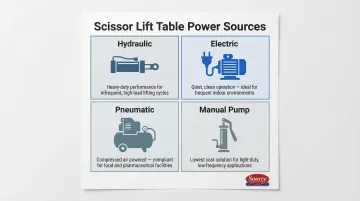
Those safety and efficiency gains depend on choosing the right unit for your operation. Four main types are available:
- Hydraulic – Heavy-duty, high cycle durability, suited for infrequent heavy lifts
- Electric – Quieter, cleaner indoor operation, ideal for frequent use
- Pneumatic – Runs on compressed air, perfect where air supply exists and electric isn't desired
- Manual pump – Lowest cost, limited to low-frequency applications
The right type depends on load weight, frequency of use, available power infrastructure, and floor space constraints.
Top 7 Scissor Lift Tables for Industrial Use in 2026
These seven options were selected based on load capacity range, build quality, safety certifications, breadth of industrial applications, and verified market reputation in North America.
Source Equipment Company
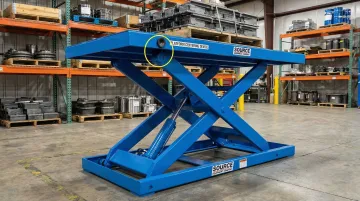
Founded in 1989 and headquartered in Leominster, MA, Source Equipment Company serves warehousing, manufacturing, food service, retail, and distribution nationwide. Their scissor lift tables are UL Listed and ANSI Compliant, featuring Patented Platform Centering Devices designed to double or triple lift service life.
Key Differentiators:
- Patented Platform Centering Devices that automatically align platforms and reduce dangerous side loading
- Expert consultation services to match the right lift to specific applications
- Fast nationwide shipping from Massachusetts headquarters
- UL Listed controllers and ANSI code compliance for workplace safety assurance
| Feature | Specification |
|---|---|
| Load Capacity | 2,000 – 30,000 lbs across model range |
| Lift Height | Up to 48 inches on Multi-Stage models; custom heights available |
| Key Feature | Patented Platform Centering Devices; UL Listed and ANSI Compliant; expert consultation and nationwide delivery |
Southworth Products
Based in Portland, Maine since 1890, Southworth Products is a long-established U.S. manufacturer known for its broad catalog of hydraulic and mechanical scissor lift tables designed for heavy industrial and ergonomic applications.
Key Differentiators:
- Torque Tube Construction minimizes platform twisting and deflection under load
- Custom engineering options including corrosion-resistant coatings, stainless steel, and specialized finishes
- LSD Series dual-scissor mechanism for higher capacities and wider platforms (up to 132 inches)
| Feature | Specification |
|---|---|
| Load Capacity | 2,000 – 12,000 lbs |
| Lift Height | Up to 98 inches on LS-Series models |
| Key Feature | Heavy-duty torque tubes for stability; custom finishes for harsh environments; dual-scissor high-capacity options |
Vestil Manufacturing
Headquartered in Angola, Indiana, Vestil Manufacturing offers scissor lift tables across a wide capacity and price range, covering light to heavy industrial applications through an unusually broad set of power source options.
Key Differentiators:
- Extensive power source variety: electric (AC/DC), pneumatic, and manual foot-pump models
- UL-listed components with electric toe guards for pinch-point protection
- "Quick Ship" program ships standard models within days, reducing lead times for time-sensitive deployments
| Feature | Specification |
|---|---|
| Load Capacity | 1,000 – 12,000 lbs |
| Lift Height | 43 – 56 inches standard; high-travel models available |
| Key Feature | Multiple power source options; UL and ANSI compliance; Quick Ship availability for standard models |
Bishamon Lift Corporation
Based in Ontario, California, Bishamon is recognized for ergonomically focused lift tables and pallet positioners, commonly used in manufacturing assembly lines and warehousing environments.
Key Differentiators:
- EZ Loader auto-leveling pallet positioners that self-adjust as boxes are added or removed, requiring no power source
- CompacLift X Series for tight production cells (440–1,650 lb capacity)
- ISO 9001 certified quality management system
| Feature | Specification |
|---|---|
| Load Capacity | 2,200 – 6,600 lbs (Alpha Series) |
| Lift Height | Up to 60 inches on larger models |
| Key Feature | Auto-leveling pallet positioners; turntable and tilt options; ISO 9001 certification |
Pentalift Equipment Corporation
A Canadian manufacturer based in Guelph, Ontario, Pentalift maintains strong North American presence and is known for custom-engineered hydraulic lift tables built for demanding industrial and dock applications.
Key Differentiators:
- Extreme capacity focus: heavy-duty models from 15,000 – 120,000 lbs
- PentaFLOW Cylinder – exclusive sealed hydraulic design that prevents contamination and eliminates oil spills
- Proven dock-leveler integration capability for seamless loading bay operations
| Feature | Specification |
|---|---|
| Load Capacity | 2,500 – 120,000 lbs (heavy-duty MLT and High Capacity series) |
| Lift Height | 29 – 45 inches standard; custom high-travel available |
| Key Feature | Extreme capacity engineering; PentaFLOW sealed cylinders; dock-leveler integration |
Autoquip Corporation
Based in Guthrie, Oklahoma, Autoquip Corporation specializes in custom-engineered lift and positioning equipment for demanding industrial environments, including aerospace, automotive, and heavy manufacturing.
Key Differentiators:
- Custom engineering depth with over 1,000 designs including rotating, tilting, and tandem configurations
- Extreme capacity solutions up to 135,000 lbs and vertical travel exceeding 40 feet
- Lifetime lubrication with maintenance-free bearings for reduced downtime
| Feature | Specification |
|---|---|
| Load Capacity | Up to 135,000 lbs (custom solutions) |
| Lift Height | 24 – 60 inches standard; custom high-travel vertical lifts exceed 40 feet |
| Key Feature | Fully custom configurations; aerospace/automotive specialization; maintenance-free bearings |
Presto Lifts
Based in Foxborough, Massachusetts, Presto Lifts (now Presto ECOA) offers a wide range of standard and custom scissor lift tables for warehousing, manufacturing, and distribution environments.
Key Differentiators:
- High-rise specialists with double, triple, and quad scissor mechanisms providing maximum lift height in small footprints
- Extended vertical travel models (DSL/TSL/QSL series) lift from 70 inches up to 356 inches
- Quick Ship program with many popular models available to ship in one week or less
| Feature | Specification |
|---|---|
| Load Capacity | Up to 120,000 lbs (super heavy-duty models) |
| Lift Height | Up to 356 inches on multi-stage high-rise models |
| Key Feature | Multi-stage high-rise configurations; Quick Ship availability; pneumatic options for explosion-proof environments |
Key Features to Evaluate When Choosing an Industrial Scissor Lift Table
Load Capacity and Platform Sizing
The lift must exceed your maximum load weight with a safety margin—industry best practice recommends sizing for 150% of your maximum nominal load to account for uneven distribution and dynamic forces. Platform dimensions must accommodate the largest pallet or workpiece without excessive overhang. Undersizing both leads to safety risks, premature mechanical wear, and potential equipment failure.
Power Source Trade-Offs
Match your power source to your duty cycle and facility setup:
- Hydraulic: Best for heavy, infrequent lifts with high cycle durability requirements
- Electric: Quieter and cleaner, suited to indoor manufacturing with frequent use
- Pneumatic: Ideal where compressed air is already available; eliminates hydraulic contamination risks critical in food processing and pharma
- Manual-pump: Lowest upfront cost, but limited cycle frequency and requires physical effort
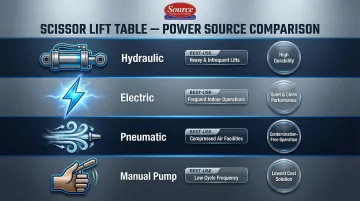
Tie your final choice to lifts-per-hour demands and existing infrastructure.
Certifications and Compliance
ANSI MH29.1-2020 and UL 508A listings are the baseline safety standards buyers should require. ANSI MH29.1 governs design, manufacture, and performance of industrial scissor lifts, establishing criteria for stability, platform protection, and operator training. UL 508A certifies the safety of industrial control panels, ensuring electrical components meet rigorous safety benchmarks.
Non-certified equipment exposes businesses to significant liability. OSHA investigations reveal that employers failing to address positioning hazards face citations averaging thousands of dollars per violation, with serious incidents triggering much higher fines and legal costs. Using ANSI-compliant, UL-listed equipment is your primary defense.
When evaluating suppliers, confirm that equipment carries both certifications before purchasing — Source Equipment Company's scissor lift tables ship UL Listed and ANSI Compliant, so that box is already checked.
How We Selected These Scissor Lift Tables
Evaluation Criteria
Our selection process prioritized six critical factors:
- Load capacity – Coverage from light-duty shop lifts to super heavy-duty industrial platforms
- Lift height – Vertical travel range to fit diverse workstation and loading heights
- Safety certifications – ANSI MH29.1 compliance and UL listings
- Build quality – Steel grade, cylinder design, and structural durability under sustained load
- Power source – Hydraulic, electric, pneumatic, and manual configurations
- North American availability – Verified distributor networks and service support
Common Buyer Mistake
Every criterion above reflects long-term value — which is why the most frequent buyer mistake is focusing on sticker price instead of total cost of ownership. A lower-cost unit without proper platform centering or safety certifications can cost far more in maintenance, downtime, compliance risk, and injury liability over a 5–10 year lifespan.
A 2021 NIH study found that ergonomic equipment adoption cuts injury claims and improves productivity — returns that easily outweigh upfront price differences.
Conclusion
Choosing the right scissor lift table is not a one-size-fits-all decision. It requires matching load capacity, platform size, power source, and certifications to your specific workflow, facility constraints, and safety requirements. With overexertion injuries costing U.S. businesses over $12 billion annually, investing in proper work-positioning equipment is both a safety imperative and a financial necessity.
That's where expert guidance makes the difference. Source Equipment Company Inc. has helped warehouses, production lines, and distribution centers find the right equipment since 1989. Their UL Listed and ANSI Compliant inventory, Patented Platform Centering Devices, and fast nationwide shipping from Massachusetts mean you get a solution built for your application — not just a catalog pick.
Contact Source Equipment's team for a consultation at 1-800-743-5545 or snyder@sourceequipment.com.
Frequently Asked Questions
Which lift is best for commercial use?
For most commercial applications—retail stockrooms, light manufacturing, food service—an electric scissor lift table with 1,000–4,000 lb capacity is the most practical choice. Electric models offer clean operation, ease of use, and low maintenance—and ANSI/UL certifications are essential for compliance and liability protection in commercial settings.
What lifts do dealerships use?
Automotive dealerships typically use hydraulic or electro-hydraulic scissor lift tables and vehicle hoists rated for 6,000–12,000 lbs, used for parts staging, tire changes, and underbody access. Platform size and surface material (diamond plate, drip-proof) matter for safe handling of heavy components in these environments.
What is the standard weight capacity for an industrial scissor lift table?
Light-duty models start around 1,000 lbs, standard industrial models run 2,000–6,000 lbs, and heavy-duty or custom-engineered units can exceed 20,000 lbs. Always select a unit rated above your maximum expected load—industry best practice recommends 150% of nominal load to account for uneven distribution and dynamic forces.
What is the difference between hydraulic and electric scissor lift tables?
Hydraulic models use a power unit and cylinders for heavy, infrequent lifting with high cycle durability. Electric models use a motor-driven screw or electric-over-hydraulic system for quieter, cleaner operation better suited to frequent indoor use. The right choice depends on load weight, cycle frequency, and available power.
What safety certifications should a scissor lift table have?
Buyers should look for ANSI MH29.1 compliance (the North American standard for lift table safety) and UL Listing for electrical components. These certifications confirm the unit has been tested for structural integrity, overload protection, and electrical safety—critical for OSHA compliance, insurance purposes, and liability protection.
How do I determine the right scissor lift table for my facility?
Define your maximum load weight, required height range, platform dimensions, power source, and duty cycle (lifts per shift). Then match those specs to a certified model—or consult a material handling specialist like Source Equipment Company to avoid costly mismatches and ensure the right fit.