Introduction
Overexertion injuries—including strains from lifting and repetitive overexertion—account for 31% of all workplace DART cases (days away from work, job restriction, or transfer) in the United States, according to 2023 Bureau of Labor Statistics data. Over a two-year period, these musculoskeletal disorders (MSDs) resulted in 946,290 reported cases, costing employers approximately $15.1 billion annually in workers' compensation expenses alone.
Ergonomic lift tables address this directly by eliminating manual lifting, reducing awkward postures, and positioning materials at optimal working heights. OSHA's recommended "power zone"—between mid-thigh and mid-chest—is where these tables keep every load, protecting workers from the cumulative strain that leads to career-ending injuries.
This article evaluates five top ergonomic lift tables based on load capacity, height range, safety features, and industry fit, helping operations managers make informed purchasing decisions that protect both workers and bottom lines.
Key Takeaways
- Ergonomic lift tables cut MSD injuries by positioning loads at optimal heights, eliminating bending and overreaching
- Top five picks span light-duty to heavy industrial capacities with manual, hydraulic, and electric power options
- Key selection criteria: load capacity, lift height range, power source, ANSI/UL certifications, and mobility needs
- Choose based on your workflow: static assembly stations have different requirements than mobile warehouse picking applications
- Expert consultation reduces costly mis-specification risks
Why Ergonomic Lift Tables Matter for Workplace Safety
Musculoskeletal disorders (MSDs)—strains, sprains, and repetitive motion injuries affecting muscles, tendons, and joints—are among the most costly injuries in warehouse and manufacturing environments. The financial toll is significant: overexertion injuries alone account for roughly 25% of total workers' compensation costs nationwide, driving up absenteeism, lost productivity, and healthcare expenses.

The fix centers on what OSHA calls the "power zone"—the mid-thigh to mid-chest height range where the body lifts with maximum efficiency and minimum strain. Think of it as a baseball strike zone for safe lifting.
Ergonomic lift tables enforce this range automatically. Regardless of where a pallet or load starts, workers stay in the optimal position—no bending, stooping, or overreaching required.
Purpose-built models now serve e-commerce fulfillment, food processing, and assembly manufacturing—each with different load, height, and mobility requirements. The five lift tables below are the strongest options across those categories.
Top 5 Ergonomic Lift Tables to Reduce Workplace Injuries
These five lift tables were selected based on ergonomic design quality, load range, safety certifications, and suitability for industrial environments like warehousing, manufacturing, food service, and distribution operations. Each profile below covers what sets the product apart, its key specifications, and the operational contexts where it performs best.
Southworth Products — Lift-N-Steer Work Assist Table
Southworth Products is one of the longest-standing lift table manufacturers in the U.S., known for purpose-built ergonomic solutions across industrial and assembly environments. Their product line has earned a reputation for durability and ANSI compliance.
The Lift-N-Steer design combines a hydraulic scissor lift platform with steering capability, allowing a single operator to both position and raise a load without assistance — reducing injury risk and labor cost in one motion. This dual-function approach is particularly valuable in assembly environments where materials must be moved between workstations while maintaining ergonomic height positioning.
Specifications:
| Feature | Details |
|---|---|
| Load Capacity | 2,000 to 6,000 lbs (varies by model) |
| Lift Height Range | Minimum 5–7 inches / Maximum 36–56 inches |
| Key Ergonomic Features | Foot-pump hydraulic operation, multiple platform surface options, velocity fuse for controlled descent, toe guards, ANSI MH29.1 compliant |
Bishamon Industries — EZ-Loader MCD Series
Bishamon Industries specializes in ergonomic lifting and material positioning equipment, widely adopted in automotive, electronics, and distribution warehouse settings. Their focus on self-leveling technology has made them a preferred choice for high-frequency loading operations.
The MCD Series uses a self-leveling spring mechanism that automatically adjusts platform height as loads are added or removed, keeping the work surface consistently at the operator's ideal height without power or manual adjustment. Its captive air system — built around a Firestone Airstroke Actuator — eliminates mechanical springs and requires no electrical connection, making it well suited for wash-down environments.
Specifications:
| Feature | Details |
|---|---|
| Load Capacity | 4,000 lbs maximum (self-leveling range: 250–3,500 lbs) |
| Lift Height Range | Minimum 10.5 inches / Maximum 30.5 inches (20-inch total travel) |
| Key Ergonomic Features | Self-leveling pneumatic mechanism, EZ-Adjust knob for capacity changes up to 1,200 lbs, full-coverage finger guard, optional turntable, CE marked under Machinery Directive 2006/42/EC |
Vestil Manufacturing — Hydraulic Scissor Lift Table (EHLT Series)
Vestil Manufacturing is a large-volume industrial equipment producer offering a broad catalog of scissor lift tables frequently specified by warehouse and distribution operations for their cost-effective, ANSI-compliant designs. Their extensive product line covers applications from light-duty to heavy industrial.
The EHLT Series offers electric-hydraulic operation with push-button control, reducing operator fatigue during high-frequency lifting tasks. Available in a wide range of platform sizes and capacities, it adapts readily across production and fulfillment workflows without requiring custom configuration.
Specifications:
| Feature | Details |
|---|---|
| Load Capacity | 1,000 to 12,000 lbs (varies by model) |
| Lift Height Range | Minimum 7 inches / Maximum 43 inches |
| Key Ergonomic Features | Push-button pendant control (24V AC), electric toe guard for pinch point protection, internal safety velocity fuse maintains height if hose fails, 2HP 460V 3-phase motor, optional accordion bellows guard, overload protection |
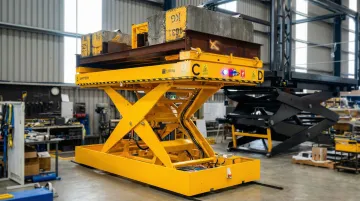
Presto Lifts — Scissor Lift Table (HL Series)
Presto Lifts is a U.S.-based manufacturer with a strong reputation for safety engineering in lift tables, particularly popular in food processing, pharmaceutical, and regulated manufacturing environments where compliance and durability are mandatory. Their heavy-gauge construction and sanitary design options address a gap most competitors don't fill.
Presto's HL Series is built with heavy-gauge steel and incorporates standard safety features like a hydraulic load-holding valve and automatic platform lock. Stainless steel variants are available for sanitary environments — an important distinction for food service and pharmaceutical buyers that must meet NSF compliance requirements.
Specifications:
| Feature | Details |
|---|---|
| Load Capacity | 2,000 to 4,000 lbs |
| Lift Height Range | Minimum floor level / Maximum 28 inches |
| Key Ergonomic Features | Hydraulic load-holding valve prevents drift, stainless steel option for wash-down areas, push-button operation, safety bar and toe guards, maintenance props, foot-operated floor locks on portable models, exceeds ANSI MH29.1 standards |
Advance Lifts — Heavy-Duty Ergonomic Scissor Lift
Advance Lifts focuses on heavy-duty industrial lift tables capable of handling high-volume, high-frequency operation in sectors such as metal fabrication, automotive assembly, and large-footprint distribution centers. Their engineering emphasizes durability and extended service life.
Advance Lifts' heavy-duty models support exceptionally high load capacities while maintaining ergonomic positioning capability — filling the gap for operations where standard-duty tables fall short but full-scale goods lifts are unnecessary. Their patented Platform Centering Device maintains optimal platform alignment during operation; Advance Lifts states the device doubles or triples lift life compared to conventional configurations.
Specifications:
| Feature | Details |
|---|---|
| Load Capacity | 8,000 to 12,000 lbs (single scissor); 16,000 to 24,000 lbs (double long); up to 120,000 lbs (quad scissor super heavy-duty models) |
| Lift Height Range | Minimum 10 inches / Maximum 70 inches (varies by model; Model HD-1260: 10" lowered / 70" raised) |
| Key Ergonomic Features | Dual-cylinder hydraulics, reinforced platform construction, safety velocity fuse, machine-grade cylinders with clear plastic return lines, UL Listed controllers, customizable platform dimensions, ANSI compliant, 10-year/250,000 cycle structural warranty |
How We Chose the Best Ergonomic Lift Tables
Products were assessed on five factors: load capacity alignment with industrial demands, ergonomic height range, power source reliability, built-in safety mechanisms, and compliance with ANSI or UL standards.
Source Equipment Company Inc. holds UL Listed and ANSI Compliant certifications and has applied these benchmarks when recommending equipment to warehousing, manufacturing, food service, and distribution clients since 1989.
The Most Common Buyer Mistake
Selecting a lift table based on maximum load capacity alone while underestimating the importance of height range and platform size. A table rated for 4,000 lbs that only lifts to 30 inches provides little ergonomic benefit for assembly workstations requiring 40-48 inch working heights. The equipment must position loads within OSHA's power zone (mid-thigh to mid-chest) to deliver injury reduction.
Matching Equipment to Workflow
The right choice depends on frequency of use and mobility requirements:
- Fixed-station assembly: stationary electric-hydraulic tables with precise height control
- Mobile picking or palletizing: self-leveling or caster-mounted units that move with the operator
- High-frequency operations: electric-hydraulic models to eliminate operator fatigue
- Wash-down environments: stainless steel construction and pneumatic (air-powered) operation to avoid electrical hazards
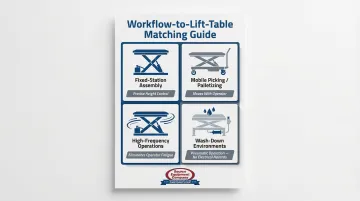
Workflow fit is only part of the equation. Parts availability and long-term reliability matter just as much — equipment with documented service life extensions, like patented centering devices, can double or triple a lift's working life and offset the higher upfront cost.
Conclusion
Ergonomic lift tables are one of the most cost-effective investments an operation can make to reduce injuries, cut labor costs, and retain workers. Overexertion injuries alone cost U.S. employers $15.1 billion annually — proper material handling equipment directly offsets that exposure.
Evaluate options by how well each lift table matches your specific workflow, load profile, and industry environment — not by price or brand name alone. Capacity, height range, power source, safety certifications, and mobility requirements all need to align together.
Expert consultation before purchasing helps avoid costly mismatches between equipment capabilities and operational demands.
Source Equipment Company Inc. has been serving warehousing, manufacturing, food service, and distribution operations since 1989. You can reach their team for consultation on selecting the right ergonomic lift table at 1-800-743-5545 or sourceequipment.com.
Frequently Asked Questions
What are the ergonomic lifting practices?
Ergonomic lifting practices include maintaining loads within the power zone (mid-thigh to mid-chest height), avoiding twisting motions, using mechanical aids such as lift tables for loads above NIOSH's recommended 51-lb limit, and ensuring proper team-lift protocols for heavy or awkward loads.
What are examples of ergonomic equipment?
Common ergonomic material handling equipment includes scissor lift tables, pallet levelers, self-leveling spring lifts, tilt tables, lift carts, and ergonomic conveyor systems—each engineered to reduce bending, overreaching, and manual lifting strain in industrial environments.
Which tool is best used for heavy lifting?
Hydraulic or electric-hydraulic scissor lift tables are the most practical choice for industrial heavy lifting—they handle high load capacities while positioning materials at ergonomically correct working heights. Double-scissors or heavy-duty models are the go-to for multi-ton loads.
How do ergonomic lift tables reduce workplace injuries?
Lift tables reduce injuries by eliminating the need for manual lifting, keeping work at the optimal height to prevent bending and overreaching, and reducing cumulative strain on the back and shoulders—the primary sources of musculoskeletal disorders in warehouse and manufacturing environments.
What weight capacity should I look for in an ergonomic lift table?
Select a table rated at least 25% above your heaviest routine load to account for variable weights and long-term wear. Standard industrial models range from 500 lbs to over 6,000 lbs, with heavy-duty options exceeding 12,000 lbs.
What certifications should an ergonomic lift table have?
Look for ANSI compliance (particularly ANSI/ASME standards for material handling equipment), UL Listing where applicable, and industry-specific certifications like NSF for food service environments. These certifications confirm the equipment meets tested safety and performance standards.
![5 Best Dock Levelers & Loading Dock Equipment [Ranked]](https://file-host.link/website/sourceequipment-4q4q99/assets/blog-images/cba71f81-3e42-4291-bf9e-05a6ccff3240/1772056847504033_e23c00baf283442db9d00ea9f8ad2a1d/1080.webp)