Introduction
Mismatched dock and industrial lift equipment costs facilities thousands in downtime, worker injuries, and throughput loss. When your dock lift can't handle sit-down forklifts, or your scissor table buckles under powered pallet jack loads, operations grind to a halt. Equipment failures mid-shift don't just slow production — they put workers at risk. In an industry where musculoskeletal disorders cost U.S. businesses over $50 billion annually and the warehousing sector employs 1.84 million workers nationwide, the right lift equipment directly affects both your bottom line and your team's safety.
That's where equipment selection becomes a strategic decision. Advance Lifts, founded in 1974 and manufacturing from a 120,000-square-foot facility in St. Charles, IL, produces one of the broadest dock and industrial lift lines available. Source Equipment Company, based in Leominster, MA and serving businesses nationwide since 1989, helps warehousing, food service, retail, manufacturing, and distribution teams identify and source the right Advance Lifts model for their specific operations.
This guide breaks down the top Advance Lifts models for dock and industrial use, what makes each suitable for specific applications, and how to evaluate the right fit based on capacity, installation constraints, and environmental requirements.
Key Takeaways
- Advance Lifts offers pit-mounted, top-of-ground, portable dock lifts, air-actuated tables, and heavy-duty scissor lifts — each suited to a specific facility type or load requirement
- T-Series pit-mounted dock lifts handle 5,000–20,000 lb. loads, making them the go-to choice for high-volume distribution centers
- Food processing and explosion-proof facilities rely on AT Series air lift tables for contamination-free operation
- Selection requires matching lifting capacity, axle load rating, platform size, and installation constraints
- Installation type — pit-mounted vs. top-of-ground — often determines which model fits without costly facility modifications
What Are Advance Lifts and Why Do They Matter for Dock & Industrial Use?
Advance Lifts manufactures hydraulic and air-powered scissor lift platforms that bridge height gaps between truck beds and facility floors and position loads at the right working height on production lines. This matters because truck bed heights vary from 21 inches (step vans) to 58 inches (refrigerated reefers), and standard dock levelers only operate within a ±12-inch range—leaving most vehicles unserviceable at ground-level facilities.
The two primary application categories are:
- Dock lifts — Handle the full vehicle spectrum from step vans to refrigerated semi-trailers, with up to 58 inches of vertical travel to reach any truck bed height
- Industrial scissor lift tables — Position loads at optimal working height on manufacturing and assembly lines, cutting repetitive strain injuries and improving throughput
Advance Lifts offers multiple series and dozens of configurations across both categories. The breakdown below covers the best models by application.
Best Advance Lifts Models for Dock & Industrial Use
These models are evaluated on lifting capacity range, axle load ratings, platform versatility, safety certifications (ANSI/OSHA compliance), warranty strength, and suitability for specific industries or environments.
T-Series Pit-Mounted Dock Lifts (T2000, T3000, T4000 Series)
The T-Series pit-mounted dock lifts are the most widely installed dock lift category in North America. Designed for permanent installation in a concrete pit at ground-level buildings or raised dock faces, the T50608 (T2000 Series) is cited as the number one dock lift model in the country.
Key Differentiators:
- Capacities span 5,000 to 20,000 lbs. with platform sizes from 6'x8' to 8'x12'
- Flush-mount installation eliminates drive-over obstacles
- NEMA 12 UL-approved controller, chrome-plated axles with lifetime-lubricated bearings
- 10-year structural warranty and ANSI/OSHA-compliant 8" bevel toe guards standard
- Ideal for powered pallet jacks, straddle stackers, and sit-down fork trucks
- Custom widths up to 12' and lengths up to 65' available
| Feature | Specification |
|---|---|
| Capacity Range | 5,000 lbs. (T2000) to 20,000 lbs. (T4000); axle end load ratings up to 16,000 lbs. |
| Platform Sizes | 6'x8' to 8'x12'; custom widths up to 12' and lengths up to 65' available |
| Key Applications | High-volume warehouse docks, manufacturing shipping/receiving, facilities handling full-size semi-trailers and refrigerated reefers |
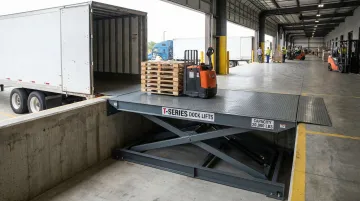
If your facility runs full semi-trailers or refrigerated reefers daily, the T-Series is the default starting point — the capacity ceiling and pit-flush design rule out alternatives for that volume and weight class.
6000 Series Top-of-Ground Dock Lifts
The 6000 Series (Models 6100, 6150, 6200, 6300) are designed for installation on a concrete pad without any pit excavation. This makes them the practical choice when underground utilities, drainage concerns, or lease restrictions prevent pit construction.
Key Differentiators:
- Capacities range from 5,000 to 12,000 lbs. with platform sizes from 6'x8' to 6'x12'
- Hinged approach ramps with built-in wheel chocks (Models 6100, 6150) prevent loads from rolling off
- Model 6150 has a self-contained onboard power unit
- Top-of-ground units can be relocated since no pit needs to be filled
- Units have been reported to provide up to 35 years of continuous service
| Feature | Specification |
|---|---|
| Capacity Range | 5,000 lbs. (Model 6100/6150) to 12,000 lbs. (Model 6300) |
| Platform Sizes | 6'x8' to 6'x12'; overall footprint including ramp ranges from 11.5 ft. to 18 ft. long |
| Key Applications | Facilities without pit access, retail receiving, leased buildings, operations requiring a portable-to-permanent solution |
The primary trade-off versus the T-Series is capacity ceiling: the 6000 Series tops out at 12,000 lbs., so facilities regularly handling heavier loads will still need a pit-mount. For most retail and light manufacturing receiving operations, that ceiling is never reached.
1000 Series Portable Dock Lifts
The 1000 Series (Models 1035, 1045, 1055) are freestanding, mobile dock lifts that can be repositioned to different locations on smooth concrete surfaces. These units are designed for facilities that need dock lift capability without committing to a fixed installation.
Key Differentiators:
- Capacities of 4,000–5,000 lbs. with 4'x7' and 6'x6' platform sizes
- Model 1035 is optimized for pallet loads
- Models 1045 and 1055 are designed for cart loads
- All units include built-in power units and wheel chock ramps
- Best suited for hand carts, four-wheeled carts, and manual pallet jack operations
| Feature | Specification |
|---|---|
| Capacity Range | 4,000–5,000 lbs.; axle end load rating 2,000 lbs. |
| Platform Sizes | 4'x7' (Model 1035); 6'x6' (Models 1045, 1055) |
| Key Applications | Seasonal loading areas, multi-door facilities, smaller distribution operations, retail back-of-house receiving |
One key disqualifier: the 2,000 lb. axle end load rating rules out powered pallet jacks and sit-down forklifts. If your operation uses powered equipment, step up to the 6000 or T-Series instead.
AT Series Air Spring Actuated Lift Tables
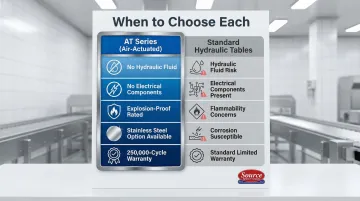
The AT Series is Advance Lifts' air-powered scissor lift table line, designed for vertical positioning without electricity or hydraulic components—a critical requirement in food processing, paint booths, pharmaceutical environments, and any location classified as a hazardous area.
Key Differentiators:
- Features patented platform centering devices that double or triple operational lifespan
- 10-year/250,000-cycle warranty—the strongest in the category
- Available in Single, Double Long, and Double Wide configurations
- Heavy-duty models rated at 6,000 and 8,000 lbs. using dual airbags
- Stainless steel construction available for washdown environments
- Inherently explosion-proof since no electrical components are present
- Baked enamel finish standard
Important Note: Air compressibility means some springiness at intermediate heights, making these unsuitable for applications requiring precise positioning under variable loads. Advance offers air-over-hydraulic alternatives for those cases.
| Feature | Specification |
|---|---|
| Capacity Range | Standard models to 4,000 lbs.; heavy-duty dual airbag models at 6,000 and 8,000 lbs. |
| Configurations | Single, Double Long, Double Wide; stainless steel construction available |
| Key Applications | Food processing lines, pharmaceutical manufacturing, paint booths, explosion-proof environments, any facility prohibiting hydraulic fluid contamination |
In regulated food and pharma environments, the absence of hydraulic fluid is often a compliance requirement, not just a preference — which is what drives AT Series adoption in those settings over otherwise comparable hydraulic tables.
P Series / HD Series / SD Series Industrial Scissor Lift Tables
Advance Lifts' hydraulic scissor lift table lines—the P Series (production), HD Series (heavy duty), and SD/Jumbo Series (super duty)—are designed for ergonomic work positioning within manufacturing and assembly lines. Ergonomic interventions like lift tables have been shown to reduce lower back pain reports significantly (OR 0.53), directly addressing the fact that overexertion from lifting, pushing, and pulling costs U.S. businesses $13.7 billion annually.
Key Differentiators:
- P Series covers standard production environments
- HD Series handles demanding industrial use with higher cycle requirements
- SD/Jumbo Series accommodates the heaviest loads and largest platform footprints
- All series feature chrome-plated cylinders, lifetime-lubricated bearings, ANSI-compliant controls
- High-cycle (HC) and ultra-high-cycle (UHC) variants available for continuous-duty operations with 3,000,000-cycle warranties
- Industry-leading structural warranties
| Feature | Specification |
|---|---|
| Capacity Range | P Series: 2,500–8,000 lbs.; HD Series: 8,000–12,000 lbs.; SD/Jumbo: up to 40,000 lbs. |
| Cycle Rating Options | Standard, High Cycle (HC) with 1,000,000-cycle warranty, Ultra High Cycle (UHC) with 3,000,000-cycle warranty |
| Key Applications | Assembly lines, order-picking stations, packaging lines, manufacturing ergonomics programs, carousel order-packing systems |
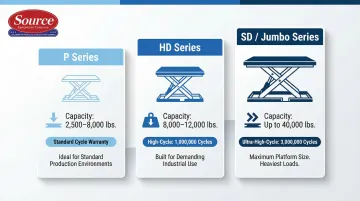
Cycle rating selection is the most consequential spec decision here. A standard-cycle unit running a three-shift assembly line will wear out in months; sizing up to HC or UHC from the start avoids early replacement costs and unplanned downtime.
How to Choose the Right Advance Lifts Model for Your Facility
Avoid the Axle Load Rating Mistake
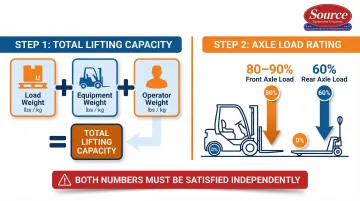
The most common buyer mistake is selecting based on lifting capacity alone and ignoring axle load rating. Powered pallet jacks and straddle stackers concentrate 60% of combined payload weight on a single rear axle, while fork trucks can concentrate 80–90% of total weight on the front axle. Choosing a lift with sufficient total capacity but inadequate axle rating leads to premature failure or structural overload.
Calculate both numbers:
- Total lifting capacity = maximum load weight + transport equipment weight + operator weight
- Axle load = total weight × concentration percentage (60% for pallet jacks, 80–90% for forklifts)
Both numbers must be satisfied, not just the total lifting capacity.
Installation Constraint: Pit vs. Top-of-Ground
Make the pit-mounted vs. top-of-ground decision first — it drives cost, installation timeline, and long-term flexibility. Pit-mounted units are less expensive per unit, but plan to add roughly 50% on top of equipment price for pit construction, electrical, installation, freight, and taxes — bringing total installed cost to about 150% of the unit price.
Top-of-ground units avoid pit costs and underground utility conflicts and can be relocated if facility needs change. While the unit cost is higher, total installed cost is often comparable once pit construction is factored in.
Platform Sizing Logic
Width: Platform width should equal the widest load plus a minimum of 12" for operating clearance with handrails (6" per side).
Length by transport equipment type:
- 6' for hand carts
- 8' minimum for manual pallet jacks
- 10' for powered pallet jacks and straddle stackers
- 10'–12' for sit-down fork trucks
Undersized platforms force operators to position loads at awkward angles, increasing injury risk and slowing throughput.
Environment-Specific Requirements
Food processing, pharmaceutical, and hazardous location facilities — paint booths, solvent areas — should default to the AT Series air-actuated tables. Contamination-free operation and inherent explosion-proof design make them the right choice where hydraulic fluid leaks or electrical components aren't permitted.
If your facility requires stainless steel for washdown environments, specify it when ordering. Standard baked enamel finishes are not rated for high-moisture or sanitation-critical applications.
Warranty and Lifecycle Evaluation
Advance Lifts warranty coverage by product line:
- Dock lifts: 10-year structural warranty, rated to 125,000 cycles
- AT Series: 10-year warranty, rated to 250,000 cycles
A lift rated to 250,000 cycles will outlast two cheaper units with shorter warranties — and eliminate the downtime and labor cost of premature replacement. That cycle difference matters more than purchase price when you're running a high-volume dock.
Getting those specs right from the start is where Source Equipment Company's consultation process pays off — matching model, platform size, and configuration to your space and workflow before the order is placed.
Conclusion
The right Advance Lifts model depends on your specific installation constraints, transport equipment type, load profile, and environmental requirements. A mismatch here doesn't just create workarounds — it shortens equipment life and raises the risk of preventable injuries on the floor.
Evaluate axle ratings, cycle warranties, and installation feasibility alongside unit price before making a final decision. Also factor in whether your load capacity or throughput will grow in the next 3–5 years — a model with headroom for that growth avoids a second capital purchase down the line.
If you want a second set of eyes on that decision, Source Equipment Company has been doing this since 1989. Based in Leominster, MA and serving customers nationwide, their team works with warehousing, manufacturing, food service, and distribution operations to match the right equipment to the right application. Reach them at 1-800-743-5545 or snyder@sourceequipment.com for a no-obligation review of your dock or industrial lift requirements.
Frequently Asked Questions
Is a dock lift the same as a dock leveler?
No. A dock leveler bridges height differences between a fixed raised dock and truck beds within a narrow range (typically ±12 inches). A dock lift travels from ground level up to full truck bed height (up to 58 inches of travel), allowing it to service all vehicle types—from step vans to full refrigerated reefers—from a ground-level facility with no raised dock.
What are the three main types of lifts offered by Advance Lifts?
Advance Lifts organizes its product line into three primary categories:
- Dock lifts — for loading/unloading trucks at ground-level or raised dock facilities
- Industrial scissor lift tables — for ergonomic work positioning in production and manufacturing environments
- Specialty lifts — including air-actuated tables, container dumpers, turntables, and work access platforms for specific industrial applications
What is the difference between a top-of-ground and a pit-mounted dock lift?
Pit-mounted lifts are recessed flush into a concrete pit, eliminating drive-over obstacles and offering capacities up to 20,000 lbs. Top-of-ground models sit on a concrete pad with no pit required (avoiding excavation costs and underground utility conflicts) but include approach ramps and are limited to 12,000 lbs. capacity. Pit-mounted units carry a lower unit price, but total installed cost is typically comparable once pit construction is factored in.
How do I determine the right lifting capacity for a dock lift?
Add the maximum load weight + transport equipment weight (fork truck, pallet jack) + operator weight to get the required lifting capacity. Then separately calculate axle load—fork trucks typically place 80–90% of combined weight on the front axle. Both the total capacity rating and the axle load rating must be satisfied independently—exceeding either disqualifies a model.
Are Advance Lifts AT Series lift tables suitable for food processing environments?
Yes. The AT Series is specifically designed for food processing, pharmaceutical, and contamination-sensitive environments because it operates entirely on compressed air with no electrical components and no hydraulic fluid, eliminating contamination risk. Stainless steel construction is also available for washdown applications.
How wide is a standard scissor lift table platform?
Standard production models typically range from 24" to 48" wide, with heavy-duty and super-duty series offering larger configurations. Custom platform sizes—widths up to 10'–12' and lengths up to 65'—are available for specialty industrial applications.
![5 Best Dock Levelers & Loading Dock Equipment [Ranked]](https://file-host.link/website/sourceequipment-4q4q99/assets/blog-images/cba71f81-3e42-4291-bf9e-05a6ccff3240/1772056847504033_e23c00baf283442db9d00ea9f8ad2a1d/1080.webp)