Introduction
Loading docks are among the most dangerous zones in any warehouse. Heavy machinery, moving vehicles, and foot traffic converge in a confined space, and the risks compound fast. According to industry safety data, 25% of all industrial accidents occur at loading docks — and most are preventable with the right equipment in place.
The costs reach well beyond immediate injury. Equipment damage, cargo losses, OSHA fines, and operational downtime add up fast — yet many warehouses still treat dock safety as an afterthought.
This guide covers six essential equipment categories, why each one matters, and how to choose the right combination for your facility.
Key Takeaways
- Loading dock safety equipment protects workers, prevents costly accidents, and ensures OSHA compliance
- Trailer restraints and dock levelers take top priority — they prevent forklift fall-through, the most catastrophic dock accident
- All six equipment categories work together as a system — gaps in any one area increase risk across the whole dock
- Choosing the right equipment means matching dock volume, trailer types, OSHA requirements, and your facility's layout
- The right safety investment cuts accident-related downtime, lowers insurance premiums, and reduces liability exposure
Why Loading Dock Safety Can't Be an Afterthought
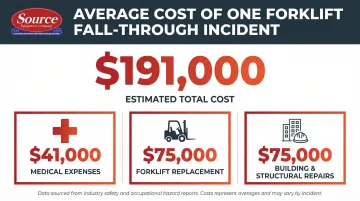
The real cost of dock accidents extends far beyond worker injury. When you factor in equipment damage, cargo losses, OSHA fines, and operational downtime, the financial case for prevention becomes overwhelming. Industry data shows that the average forklift fall-through incident costs approximately $191,000, breaking down to $41,000 in medical expenses, $75,000 for forklift replacement, and $75,000 in building and structural repairs.
OSHA strictly enforces fall protection at loading docks through 29 CFR 1910.28(b)(1)(i), which mandates that employers must protect employees on walking-working surfaces with unprotected edges four feet or more above a lower level. Non-compliance carries serious penalties: as of January 2025, OSHA maximum penalties reach $16,550 for serious violations and $165,530 for willful or repeated violations.
The human cost compounds those financial numbers. In 2023 alone, 67 workers died in forklift-related incidents, with falls to lower levels accounting for nearly 19% of forklift fatalities. Each case represents a preventable tragedy — one that destroys families and erodes the workplace culture that keeps operations running.
That's the case for acting now rather than reacting later. The six safety equipment categories covered below form a layered infrastructure that targets the most common and costly dock hazards — and works best when treated as a system, not a checklist.
Essential Loading Dock Safety Equipment Every Warehouse Needs
These six equipment types form the foundation of a safe, compliant, and efficient loading dock—selected for their proven impact on injury prevention, operational continuity, and regulatory adherence.
Dock Levelers
A dock leveler bridges the height gap between the warehouse floor and trailer bed, enabling safe forklift and pallet jack transitions. Without one, that gap becomes a direct source of equipment damage and worker injury. Dock levelers absorb forklift shock at the threshold, extend equipment life, and integrate seamlessly with trailer restraints and dock seals to keep every component of the dock operating in sequence.
The three primary types each serve different operational needs:
- Mechanical levelers use spring-loaded mechanisms and require manual operation
- Hydraulic levelers offer push-button operation with smoother transitions that reduce "dock shock"
- Air-powered levelers use low-pressure air bag systems for reliable, cost-effective operation
When selecting a dock leveler, capacity is critical. Manufacturers recommend using a dynamic load multiplier of 2.5 when calculating necessary capacity—meaning if your heaviest loaded forklift weighs 12,000 lbs, you need a leveler rated for at least 30,000 lbs.
| Type | Typical Capacity Range | Key Safety Feature |
|---|---|---|
| Mechanical | 30,000 – 50,000+ lbs | Spring-loaded lip extension, hold-down devices, manual chain operation |
| Hydraulic | 30,000 – 80,000+ lbs | Powered lip extension, automatic hold-down, smooth transition reduces shock |
| Air-Powered | 30,000 – 50,000 lbs | Air bag lifting system, lip extension, cross-traffic support legs |
Standard platform sizes include 6' x 6' and 6' x 8' configurations, with 72-inch and 78-inch widths available to match specific bay requirements. The leveler's lip extension closes the gap between dock and trailer, while cross-traffic legs provide stability when the leveler is in the stored position.
Vehicle and Trailer Restraint Systems
Trailer restraints—also called dock locks or vehicle restraints—secure the rear impact guard or wheel of a truck to the dock, preventing trailer creep, premature pull-away, and forklift fall-through.
Wheel chocks are the manual alternative, but powered restraint systems offer automated, fail-safe engagement that doesn't depend on driver compliance.
Vehicle restraints are the most critical single piece of dock safety equipment. Industry data indicates facilities face a 1-in-10 chance per year that a forklift will be involved in a loading dock accident, with trailer separation being a primary risk factor. Forklift fall-through incidents carry an extremely low survival rate: the equipment's weight (often 9,000+ lbs) typically crushes the operator, making restraints a life-saving investment.
OSHA standards 29 CFR 1910.178(k)(1) and (m)(7) mandate that trucks be secured to the dock during loading and unloading. While wheel chocks meet the minimum requirement, OSHA directives explicitly allow "mechanical means" (vehicle restraints) as a preferred alternative, provided they effectively prevent movement.
| Restraint Type | Activation Method | Key Safety Benefit |
|---|---|---|
| Wheel-based restraint | Manual or automatic/powered | Locks truck wheels to prevent forward/backward movement |
| Rear impact guard (RIG) hook | Automatic/powered, interlocked with door/leveler | Engages truck's ICC bar, prevents vertical and horizontal separation |
| Wheel chock | Manual placement by driver or dock worker | Basic prevention of rolling; least reliable due to human error |
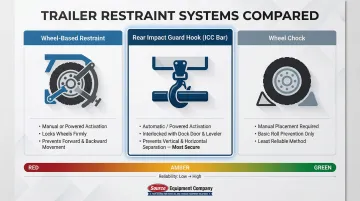
Modern restraint systems can interlock with dock doors and levelers, creating a sequenced workflow: the restraint must engage before the door opens, and the door must be fully open before the leveler deploys. This eliminates human error and enforces safe operating procedures automatically.
Dock Seals and Shelters
Dock seals and shelters create a weathertight barrier around the truck trailer at the dock opening. Dock seals use foam pads that compress against the trailer for a tighter fit, while dock shelters use flexible curtains that accommodate a wider range of trailer sizes with a looser seal. Both protect workers and cargo from weather exposure and help maintain climate control inside the warehouse.
Worker safety improves by eliminating exposure to rain, ice, extreme heat, and cold at the dock face, while operational efficiency increases through reduced energy loss and less cargo damage from moisture. Research supporting California's Title 24 standards shows that proper dock sealing can reduce energy loss by up to 90% per dock position, with first-year electricity savings reaching 0.443 kWh/ft² in certain climate zones.
Beyond direct energy savings, unsealed docks force HVAC systems to run more frequently, increasing wear and maintenance costs. Gaps also allow entry of dust, pests, and debris that can compromise product quality—particularly critical for food service, pharmaceutical, and retail distribution centers.
| Style | Best Application | Safety/Efficiency Impact |
|---|---|---|
| Foam pad seal | Consistent trailer sizes, high-volume docks | Tight compression seal, maximum weather protection, best energy efficiency |
| Inflatable seal | Variable trailer sizes, temperature-controlled facilities | Adjustable seal pressure, accommodates trailer height variation |
| Fabric shelter | Varied fleet, outdoor docks with extreme weather | Flexible curtains, widest size accommodation, moderate seal |
| Combination seal/shelter | Mixed fleet operations | Foam pads for sides, fabric curtain for top, balances fit and flexibility |
In most climate zones, energy savings outweigh installation costs over the equipment's lifespan—a benefit-to-cost ratio above 1.0. For facilities operating in extreme climates or handling temperature-sensitive cargo, this investment pays for itself within the first year.
Loading Bay Edge Protection and Safety Barriers
OSHA standard 29 CFR 1910.28(b)(1)(i) requires fall protection at any unprotected edge with a drop of four feet or more. Loading dock edges, open doorways during idle periods, and mezzanines all qualify. The main solutions include safety chains, dock safety gates, retractable barriers, and guardrails—each serving different operational scenarios.
Modern dock safety barriers, such as retractable systems that mount to the door frame, provide protection from falls and accidental equipment roll-offs without obstructing active loading operations. These systems engage automatically when the door opens and no trailer is present, eliminating the need for workers to manually install barriers during idle periods.
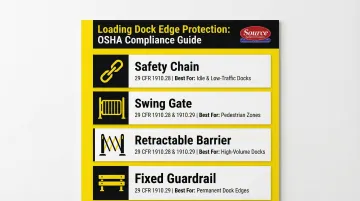
Key barrier types and applications:
- Safety chains offer basic protection for idle docks; low cost but require manual engagement
- Swing gates provide hinged access control; ideal for pedestrian zones and mezzanine edges
- Retractable barriers mount to door frames and deploy automatically; best for high-traffic docks
- Fixed guardrails offer permanent protection for ramp approaches and permanent edges
| Barrier Type | OSHA Compliance Standard | Ideal Use Case |
|---|---|---|
| Safety chain | 29 CFR 1910.28 (Fall Protection) | Idle dock openings, low-traffic bays, temporary protection |
| Swing gate | 29 CFR 1910.28 & 1910.29 (Guardrail Systems) | Pedestrian zones, controlled access points, mezzanine edges |
| Retractable barrier | 29 CFR 1910.28 & 1910.29 | High-volume docks, automatic protection during idle periods |
| Fixed guardrail | 29 CFR 1910.29 (Fall Protection Systems) | Ramp approaches, permanent edges, areas with no trailer access |
OSHA interpretations clarify that while active loading operations may temporarily expose the dock edge, barriers must be in place when the dock is not in use. Retractable systems solve this compliance challenge by automatically engaging whenever a door opens without a secured trailer present.
Dock Lighting Systems
Proper lighting at the loading dock serves two distinct functions: interior dock lights mounted on the leveler or door frame illuminate inside the trailer so forklift operators can spot and stack pallets accurately, while exterior/overhead dock lighting improves visibility in the loading bay during night shifts or low-light conditions.
Poor visibility is a leading contributing factor to dock incidents. OSHA standards and industry consensus specify minimum illumination levels for safe operation:
- General dock areas: Minimum 2 foot-candles (20 lux)
- Active forklift/task areas: Minimum 5 foot-candles (50 lux)
Inadequate lighting complicates the detection of dock edges and trailer status, contributing to the 13% of forklift injuries associated with falls to a lower level. Upgrading to LED dock lights improves contrast and visibility inside trailers, reducing that risk while cutting energy consumption compared to traditional halogen systems.
| Light Type | Coverage | Key Benefit |
|---|---|---|
| Trailer interior dock light | Inside trailer cargo area | Improved pallet spotting accuracy, reduced forklift errors, better load quality |
| Overhead bay lighting | Dock apron and loading bay area | Enhanced visibility during night operations, reduced trip hazards |
| Signal/status lights | Operational status communication | Clear go/stop signals for truck drivers, visual confirmation of restraint engagement |
Signal lights integrated with restraint systems provide visual confirmation that the trailer is secured before loading begins. Red/green indicator lights communicate dock status to drivers, preventing premature departure and reinforcing the interlock between restraints, doors, and levelers.
Commercial Overhead Dock Doors
The dock door is the boundary between the controlled warehouse environment and external hazards. A high-quality commercial overhead door provides security against theft, protects products and personnel from weather extremes, and when upgraded to a high-speed roll-up model, significantly reduces dock cycle time and energy loss per truck visit.
High-speed doors reduce the risk of forklift collisions with slow-moving doors and integrate with interlocking dock systems, meaning the door must be fully open before the leveler activates. Modern high-speed doors open at 50 to 100 inches per second (approximately 4-8 ft/sec), dramatically reducing the time the dock is exposed to outside conditions.
Self-repairing curtain technology addresses the high cost of door strikes. Forklift collisions with doorways can cost a facility approximately $30,000 annually in repairs and downtime. Self-repairing doors feature flexible curtains that dislodge from guides on impact without damage, then automatically re-insert on the next cycle—eliminating 70-90% of repair costs.
| Door Type | Speed / Durability | Key Safety/Operational Benefit |
|---|---|---|
| Standard overhead sectional | 6-12 inches/second; moderate durability | Basic security and weather protection, manual or chain-driven operation |
| High-speed roll-up | 50-100+ inches/second; self-repairing curtain | Interlocking capability, reduced forklift door-strike risk, minimal air infiltration |
| Insulated dock door | Variable speed; enhanced thermal performance | Climate control for temperature-sensitive cargo, energy savings, noise reduction |
High-speed doors with interlocking capability enforce safe operational sequences: the restraint engages first, the door opens second, and the leveler deploys third. For high-volume facilities, that built-in sequencing removes the reliance on individual workers to follow procedure correctly—every shift, every truck.
How to Choose the Right Loading Dock Safety Equipment
The most common mistake buyers make is purchasing equipment in isolation rather than as a coordinated system. The real safety gains come from interlocking dock levelers, restraints, and doors in a sequenced workflow that eliminates human error. When these systems work together, the restraint engages first, the door opens second, and the leveler deploys third. That sequence removes the human decision-making that causes the most serious dock accidents.
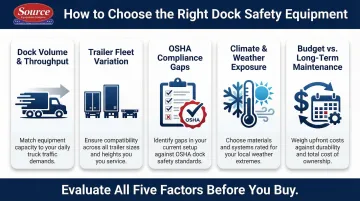
Core evaluation factors for equipment selection:
- Dock volume and daily truck throughput – High-volume operations justify investment in powered restraints and high-speed doors
- Trailer fleet variation – Mixed fleet sizes require adjustable seals/shelters and levelers with wider capacity ranges
- OSHA compliance gaps – Audit your current setup against 29 CFR 1910.28 and 1910.178 to identify required upgrades
- Climate and weather exposure – Facilities in extreme climates see faster ROI on insulated doors and high-performance seals
- Budget for upfront investment vs. long-term maintenance – Hydraulic systems cost more initially but reduce maintenance over 10+ years
Source Equipment Company has been helping warehouses and distribution centers select the right equipment since 1989. Their team assesses space requirements, workflow patterns, and compliance needs to recommend equipment combinations that fit how your facility actually operates — not just what's available off a shelf.
Look for UL Listed and ANSI Compliant designations when evaluating any dock safety product. These certifications confirm that equipment has been independently tested and verified for safety performance — a meaningful baseline for worker protection and regulatory compliance.
Conclusion
Loading dock safety is a system-level commitment, not a single product decision. The six equipment categories covered in this guide—dock levelers, vehicle restraints, seals and shelters, edge protection, lighting, and commercial doors—work together. Each one addresses a distinct failure point, from forklift fall-throughs and fall hazards to weather-related exposure.
The cost of doing nothing far exceeds the investment in proper equipment. With forklift fall-through incidents averaging $191,000 each, OSHA penalties reaching $165,530 for willful violations, and 25% of all industrial accidents occurring at loading docks, the financial and human case for prevention is overwhelming. Research shows that implementing engineering controls can reduce workers' compensation claim frequency by up to 66%—a measurable impact on both safety outcomes and operational costs.
Audit your current dock setup against the equipment categories covered in this post. Identify gaps in your fall protection, restraint systems, and environmental controls. Then prioritize investments that address your highest-risk scenarios first—typically trailer restraints and dock levelers, which together prevent the most serious accidents.
Ready to upgrade your loading dock safety? Contact Source Equipment Company for a consultation to assess your loading dock setup and identify the right combination of safety equipment for your facility. Serving warehouses and distribution centers nationwide since 1989, the team provides expert guidance from initial equipment assessment through selection. Call 1-800-743-5545 or email bfellows@sourceequipment.com to get started.
Frequently Asked Questions
What is the most important safety equipment for a loading dock?
Vehicle/trailer restraints and dock levelers are the highest-priority items. Together they address the most lethal dock hazard—trailer separation and forklift fall-through—which accounts for nearly 19% of forklift fatalities and costs an average of $191,000 per incident.
What are OSHA's requirements for loading dock safety?
OSHA standard 29 CFR 1910.28(b)(1)(i) requires fall protection at edges with drops of four feet or more, while 29 CFR 1910.178 mandates that trucks be secured during loading. Both standards carry citation and penalty risk, so documented compliance is essential.
How often should loading dock safety equipment be inspected?
Plan on monthly functional inspections and annual comprehensive evaluations as a baseline. High-wear components like dock leveler springs, restraint mechanisms, and door sensors may require weekly checks in high-volume facilities to ensure reliable operation.
What is the difference between a dock seal and a dock shelter?
Dock seals use foam pads that compress tightly against the trailer for maximum weather protection and energy efficiency. Dock shelters use flexible curtains that accommodate a wider range of trailer sizes with a looser seal, making them better for facilities with varied fleets.
How does a trailer restraint prevent forklift fall-through accidents?
The restraint locks the truck's rear impact guard or wheel to the dock face, preventing trailer creep or premature pull-away during active forklift operations. This eliminates the gap that would otherwise open between the dock and trailer, which is the primary cause of fall-through incidents.
Can investing in loading dock safety equipment lower insurance or operational costs?
Engineering controls at the dock reduce claim frequency by up to 66%, which translates directly to lower workers' compensation premiums and liability exposure. Fewer incidents also mean less downtime, less equipment damage, and lower cargo losses—all of which improve operational margins.