![Cover image for 5 Best Dock Levelers & Loading Dock Equipment [Ranked]](https://file-host.link/website/sourceequipment-4q4q99/assets/blog-images/cba71f81-3e42-4291-bf9e-05a6ccff3240/1772056847504033_e23c00baf283442db9d00ea9f8ad2a1d/360.webp)
Introduction
Loading docks are where warehouse efficiency lives or dies. Approximately 25% of all warehouse accidents occur in this single operational zone, making equipment selection a high-stakes decision that directly impacts throughput, product integrity, and worker safety. One poorly chosen dock leveler can stall forklift traffic, delay shipments, and push injury risk up across every shift.
Dock levelers bridge the height gap between your facility floor and trailer beds, enabling safe, continuous material transfer across varying trailer heights. That gap — and how well your equipment handles it — determines whether forklifts transition smoothly or operators deal with jolts, jams, and downtime. The wrong leveler doesn't just slow throughput; it becomes a recurring maintenance cost and a liability.
This guide ranks the five best dock levelers and loading dock equipment options based on load capacity, durability, operational versatility, and industry certifications. You'll learn the key criteria that separate reliable equipment from premature failures—so you know exactly what to prioritize before committing to a purchase.
Key Takeaways
- Wrong dock leveler choice directly impacts safety, throughput, and equipment lifespan
- Hydraulic levelers win for high-frequency, heavy-load operations; mechanical and edge-of-dock types suit lighter, lower-volume docks
- All five ranked options come from manufacturers with proven load capacity, build quality, and industry certifications
- Key selection factors: dynamic load rating, operational frequency, trailer height variation, and cold storage or food-grade compliance needs
- Source Equipment Company offers expert consultation to match the right leveler to your operation
Overview of Dock Levelers in the Warehousing & Distribution Industry
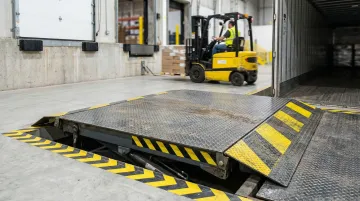
A dock leveler is a mechanical, hydraulic, or air-powered platform installed at the loading dock that bridges the gap and height differential between a building's dock floor and the bed of a parked trailer or truck.
The operational stakes are significant. Approximately 21 forklift accidents occur at loading docks every day. Separately, contact with objects and equipment ranks as the third leading cause of work-related death, making equipment selection a direct factor in both worker safety and operational continuity.
Poor leveler choices carry real costs:
- Premature equipment failure that interrupts throughput
- Accidents from mismatched capacity or dock type
- Unplanned maintenance downtime that compounds across shifts
With multiple product types, capacities, and manufacturers on the market, the rankings below cover the five best dock levelers and loading dock equipment options based on reliability, performance, and industry fit.
5 Best Dock Levelers & Loading Dock Equipment [Ranked]
These five products were selected based on load capacity ratings, operational versatility, build quality, industry certifications, and user trust across warehousing, manufacturing, and distribution environments.
Rite-Hite RHH-4000 Hydraulic Dock Leveler
Rite-Hite is one of the largest loading dock equipment manufacturers in North America, with decades of production experience behind their product line. The RHH-4000 is one of their flagship hydraulic pit levelers, widely deployed across high-frequency warehouse and distribution operations where reliability and safety are non-negotiable.
Key differentiators:
- Push-button operation eliminates manual handling at the dock
- Full-range lip extension maintains consistent trailer contact across varying heights
- Biodegradable hydraulic fluid options suit food-and-beverage and environmentally regulated facilities
- Integrates directly with Rite-Hite's interlocked safety controls for coordinated operation with vehicle restraints and overhead doors
| Specification | Details |
|---|---|
| Platform Sizes | 6', 8', 10', and 12' lengths; 6', 6.5', and 7' widths |
| Working Range | Services canted truck beds up to 4 inches (102 mm) |
| Load Capacity | Capacity C: 37,000 lbs / Capacity D: 46,000 lbs / Capacity F: 59,000 lbs / Capacity G: 66,000 lbs |
| Notable Features | Push-button control, biodegradable fluid option, Safe-T-Lip® toe protection (5" or 7" barrier rated to stop 10,000 lb forklift at 4 mph), NEMA 4X interlock-capable control panel, hydraulic velocity fuse limiting free-fall to 3 inches |
Blue Giant Equipment – Hydraulic Pit Leveler Series
Blue Giant is a major North American dock equipment manufacturer with a strong reputation in distribution centers and cold storage environments. Their hydraulic leveler series is engineered for consistent performance across varied trailer heights, with full-function hydraulic control systems that deliver smooth, reliable operation.
Key differentiators include corrosion-resistant finishes suited for wash-down environments, broad sizing options that accommodate facilities with high trailer height variability, and specialized cold storage designs. Blue Giant's inverted deck cylinder design self-bleeds continually to reduce internal corrosion, extending service life in demanding conditions.
| Specification | Details |
|---|---|
| Platform Sizes | 6' x 6' up to 7' x 10' nominal dimensions |
| Working Range | 12 inches (305 mm) above and 12 inches (305 mm) below dock level |
| Load Capacity | 30,000 to 80,000 lbs standard; Super-Duty (Model SD) rated 60,000 to 160,000 lbs |
| Notable Features | NEMA 4X moisture/corrosion-resistant controls, inverted cylinder design for reduced corrosion, vertical-storing models for cold storage applications, load classes from Workhorse to Ultra |
Pentalift Equipment Corporation – Hydraulic Dock Leveler
Pentalift specializes in heavy-duty loading dock and material handling lifts, with a strong presence in manufacturing, paper, and packaging industries that demand high-capacity, high-frequency equipment. Their levelers are engineered specifically for demanding load cycles, with customizable pit dimensions and heavy-duty steel construction that prioritizes long service life and reduced downtime.
Key differentiators:
- High-strength steel construction built to withstand demanding load cycles
- Customizable pit dimensions to fit non-standard facility configurations
- Capacity ratings that scale to extreme applications — up to 160,000 lbs
| Specification | Details |
|---|---|
| Platform Sizes | Standard widths: 6', 6.5', 7'; Standard lengths: 6', 8', 10' (8' most popular); Custom dimensions available |
| Working Range | Varies by model; engineered for high trailer height variability |
| Load Capacity | Standard: 25,000 to 100,000 lbs; Extreme capacity: up to 160,000 lbs |
| Notable Features | Heavy-gauge 4-way safety tread plate (55,000 psi yield), HD Series with 10 structural "C" beams, HU Ultima Series with 6" structural "I" beams, 3/8" thick headboard (50,000 psi yield), full-width self-cleaning hinge tube (70,000 psi yield) |
Nordock – Hydraulic & Mechanical Dock Levelers
Nordock is a versatile, value-oriented dock equipment manufacturer offering both hydraulic and mechanical dock leveler options, making them a practical choice for facilities managing mixed-fleet receiving or operating with budget-conscious operations. Their broad product range spans multiple leveler types with competitive lead times.
Differentiators include a modular design philosophy that simplifies installation and maintenance, a patented dual-function hydraulic system with fewer parts to reduce maintenance requirements, and the flexibility to choose between hydraulic and mechanical operation within the same product lineup. This versatility allows facilities to standardize on one manufacturer while tailoring equipment type to specific dock positions.
| Specification | Details |
|---|---|
| Available Types | Hydraulic (Constructor, Heavy-Duty, Super-Duty), Mechanical (Industrial, Constructor), Edge-of-Dock (Push-Button), Telescoping-Lip (Vertical/Horizontal) |
| Platform Sizes | Multiple series with standard dock dimensions |
| Load Capacity | Hydraulic: 25,000 to 160,000 lbs; Mechanical: 20,000 to 50,000 lbs; Edge-of-Dock: up to 80,000 lbs |
| Notable Features | Dual-function hydraulic system with fewer parts, mechanical smooth pull-chain operation, modular design for simplified maintenance, warranties up to 20 years on hinges/10 years structural/5 years hydraulics |
Kelley (ASSA ABLOY Entrance Systems) – Hydraulic Dock Leveler
Kelley is a legacy loading dock equipment brand, now part of ASSA ABLOY, with a long track record in high-volume distribution, retail, and food-grade operations. Their hydraulic levelers are known for consistent performance, safety-focused design elements, and broad dealer support networks that ensure service availability across North America.
Key differentiators:
- ASSA ABLOY's support infrastructure provides access to authorized service networks and parts availability nationwide
- Compatible with a full ecosystem of dock accessories — seals, shelters, and vehicle restraints — for integrated dock solutions
- HK series 5-inch steel safety barrier lip is rated to withstand 10,000 lbs at 4 mph, protecting against vacant dock drop-off accidents
| Specification | Details |
|---|---|
| Platform Sizes | Widths: 6', 6.5', 7'; Lengths: 6', 8', 10' |
| Working Range | 6' and 8' models: 12" (305 mm) above/12" below dock; 10' models: 18" (457 mm) above/12" below dock |
| Load Capacity | 30,000, 35,000, 40,000, 45,000, and 50,000 lbs (HK series); 40,000 to 50,000 lbs (HK-S series) |
| Notable Features | 5" steel safety barrier lip (10,000 lbs at 4 mph rating), NEMA 4X interlock-capable control panels, compatible with STAR®, HIDDEN HOOK™, and AUTO CHOCK® vehicle restraints, ENERGY GUARD® perimeter weatherseal compatibility, strong dealer/service network |
How We Chose the Best Dock Levelers
Selecting dock levelers involves more than comparing price tags and static load ratings. Facilities commonly make the mistake of choosing based on static load capacity alone while ignoring dynamic gross load frequency—a leading cause of premature equipment failure and safety incidents. Static capacity measures weight on a stationary deck, while dynamic capacity accounts for moving loads and is typically 2 to 5 times lower.
Each leveler in this guide was evaluated across six criteria that reflect real-world operational demands.
Evaluation Criteria
Load Capacity and Frequency Ratings:
- Static vs. dynamic capacity: Static is the weight a leveler supports when stationary. Dynamic (gross) capacity accounts for forklifts in motion and requires a multiplier — typically 2.5x for standard use, up to 5.0x for severe conditions
- Cycle frequency: High-frequency operations demand levelers rated for continuous use
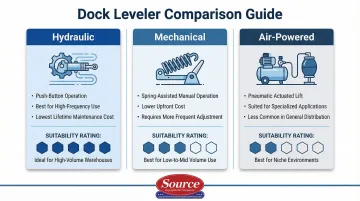
Operational Type:
- Hydraulic: Push-button operation, best for high-frequency use, lowest maintenance over lifespan
- Mechanical: Spring-assisted, lower upfront cost, requires more frequent adjustment
- Air-powered: Suited for specific applications, less common in general distribution
Industry Certifications:
- ANSI MH30.1: The performance and testing standard for dock leveling devices
- UL Listed controllers: Ensures electrical components meet safety standards
- OSHA 1910.178 alignment: Equipment designed to support forklift safety compliance
Build Quality and Service Life:
- Deck plate thickness and yield strength
- Hinge design and material grade
- Corrosion-resistant finishes for wash-down or cold storage environments
- Manufacturer warranty terms (structural, hydraulic, parts)
Ease of Maintenance:
- Access to hydraulic components
- Availability of replacement parts
- Service network coverage
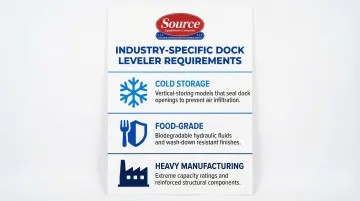
Industry-Specific Requirements:
- Cold storage: Vertical-storing models that seal dock openings
- Food-grade: Biodegradable hydraulic fluids and wash-down resistant finishes
- Heavy manufacturing: Extreme capacity ratings and reinforced structural components
Source Equipment Company has supplied loading dock equipment to warehouses, manufacturers, and distribution centers since 1989. Their UL Listed and ANSI compliant product line covers the full range of types and capacities covered in this guide.
Conclusion
The right dock leveler is not a one-size-fits-all decision. Operational fit matters more than brand name. Evaluate load frequency (not just static weight), trailer variability, industry regulations, and long-term maintenance costs before committing to a product. A leveler that seems economical upfront can become a liability if it requires frequent repairs or doesn't support your volume demands.
Those criteria feed directly into total cost of ownership — not just purchase price. While mechanical levelers cost $5,000–$7,500 and hydraulic units run $5,500–$10,000, a higher-quality hydraulic leveler that reduces maintenance downtime and supports 20–30% improvements in fulfillment throughput will typically deliver stronger ROI over its 15–25 year lifespan. Scalability matters too — choose equipment that grows with your operation, not one you'll need to replace in five years.
If you're working through this decision, Source Equipment Company (founded 1989) can help you match the right equipment to your facility's workflow and volume requirements. They ship nationwide from their Massachusetts headquarters and specialize in customized material handling solutions for warehousing, manufacturing, and distribution operations. Reach them at 978-537-5545 or bfellows@sourceequipment.com.
Frequently Asked Questions
What is the average cost of a dock leveler?
Edge-of-dock levelers typically cost $1,200 to $2,000 for 20k-30k lb capacity units. Mechanical pit levelers range from $5,000 to $7,500, while hydraulic pit levelers cost $5,500 to $10,000 for materials. Installation adds $500 to $1,000+ depending on pit construction requirements and optional safety add-ons.
How to choose the right dock leveler?
Evaluate these four factors before selecting a leveler:
- Gross load weight and cycle frequency — use dynamic multipliers, not static ratings
- Trailer bed height range serviced at your facility
- Industry regulatory requirements, such as food-grade wash-down or cold storage sealing
- Long-term maintenance capabilities and service access
What is the difference between a pit leveler and a dock leveler?
"Dock leveler" covers all leveling devices as a category. A "pit leveler" installs into a recessed concrete pit at the dock face for a flush finish. Edge-of-dock levelers mount directly to the exterior wall—no pit required—making them faster and less expensive to install.
What is the life expectancy of a dock leveler?
A well-maintained hydraulic dock leveler typically lasts 15–25 years, while mechanical models have similar lifespans with consistent maintenance. Cycle frequency—not just load weight—drives wear more than any other variable. High-cycle operations should specify equipment rated for continuous use.
What type of dock leveler is best for cold storage or temperature-controlled facilities?
Vertical-storing hydraulic levelers are recommended for cold storage environments. They seal the dock opening when not in use by allowing the overhead door to close directly on the pit floor, creating a complete 4-sided seal that minimizes air infiltration and cross-contamination—critical for frozen food and pharmaceutical distribution.
Is a vehicle restraint necessary with a dock leveler?
Yes, vehicle restraints are a critical safety complement to dock levelers. They prevent trailer creep or separation during loading operations, which can cause forklifts to fall between the dock and trailer. OSHA guidelines strongly recommend them, and many facilities require them as part of dock safety protocols to protect workers and maintain compliance.