Introduction
When a warehouse is processing same-day and next-day orders across hundreds of SKUs, the wrong rack configuration doesn't just slow things down — it becomes a direct cost. Pick speed, order accuracy, and cost per shipment all trace back to how storage is structured. With 68% of online shoppers considering delivery speed a deciding factor and 36% expecting next-day delivery, fulfillment infrastructure is now a competitive differentiator.
Most e-commerce warehouses underperform because they default to a single rack type rather than matching configuration to inventory profile, SKU velocity, and operational flow. That one-size-fits-all approach wastes throughput capacity while driving up labor costs and error rates.
This guide breaks down the 7 best pallet rack configurations specifically suited to e-commerce warehouses, along with selection criteria to match each configuration to your operation.
Key Takeaways
- Pallet rack configurations depend on SKU count, inventory turnover, order volume, and floor space
- Selective racking suits high-SKU diversity; flow racking suits high-velocity FIFO inventory
- Push-back and drive-in systems work best for bulk or seasonal storage
- Mezzanine and carton flow racking maximize vertical space and accelerate small-parcel picking
- The right configuration, matched to your workflow, can improve fulfillment speeds by 20–30%
What Makes E-Commerce Warehouses Different From Traditional Warehouses
E-commerce warehouses handle far more SKUs, smaller order sizes, and faster fulfillment cycles than traditional bulk-distribution facilities. Traditional distribution centers focus on pallet-in/pallet-out operations for B2B shipments — moving full pallets to retailers in predictable volumes.
E-commerce fulfillment centers operate differently: they pick, pack, and ship individual items to thousands of residential addresses every day, which creates a fundamentally different set of storage demands.
Three key pressures distinguish e-commerce fulfillment:
- Manages thousands of SKUs, each requiring individual pick access — not pallet-level retrieval
- Demands speed and accuracy that traditional pick workflows aren't built to support
- Operates in urban and suburban markets where industrial rents hit $8.08/sq ft in 2023, up 15.9% year-over-year, making vertical space utilization a financial necessity
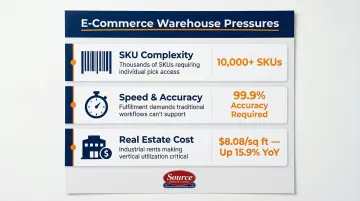
These pressures mean pallet rack configuration isn't just a storage decision — it directly shapes pick speed, labor cost, and how well your operation scales.
7 Best Pallet Rack Configurations for E-Commerce Warehouses
Each configuration below addresses a specific set of fulfillment demands—use the trade-off summaries to match each system to your SKU mix, throughput requirements, and available footprint.
Selective Pallet Racking
Selective racking is the most widely deployed configuration in e-commerce warehouses, handling nearly 80% of warehouse products due to its low cost and high accessibility. It provides direct, aisle-by-aisle access to every pallet position, making it ideal for operations with high SKU variety and frequent stock rotation.
The key advantage for e-commerce: 100% selectivity means any SKU can be picked at any time without moving other pallets, which reduces labor time and supports both manual and forklift picking workflows. This configuration works equally well with counterbalanced forklifts, reach trucks, and very narrow aisle (VNA) equipment.
Aisle width optimization matters:
- Counterbalanced forklifts require approximately 12 feet of aisle width
- Reach trucks operate in narrower aisles around 8.75 feet
- VNA trucks can work in aisles as tight as 5.5 to 6 feet, significantly increasing floor space utilization
Wire decking is strongly recommended for selective rack installations. It prevents loose items from falling, improves visibility, and allows sprinkler water to penetrate the rack structure, ensuring compliance with fire safety standards.
| Attribute | Details |
|---|---|
| Best For | High-SKU-variety fulfillment centers, operations with frequent replenishment cycles |
| Storage Density | Moderate (requires dedicated aisles; lower density than deep-storage systems) |
| Key Consideration | Aisle width must accommodate forklift type; works well with wire decking for visibility and safety |
Carton Flow Racking
Carton flow racking (also called gravity flow shelving) uses inclined roller or wheel lanes so cartons automatically advance to the pick face as items are removed, designed specifically for high-velocity, small-parcel e-commerce picking.
It supports FIFO inventory rotation (critical for perishables or date-sensitive goods) and keeps pick faces loaded at all times, reducing picker travel. It also integrates well with pick-to-light and zone-picking systems common in e-commerce fulfillment.
The performance data is compelling: carton flow can cut picker travel time by up to 70% versus static shelving, and when paired with pick-to-light technology, picking speeds can increase threefold.
| Attribute | Details |
|---|---|
| Best For | Small-parcel e-commerce, high-velocity SKUs, zone-pick and batch-pick operations |
| Storage Density | High at the pick level; lanes can be tiered to increase SKU count per bay |
| Key Consideration | Requires consistent carton sizing for reliable lane flow; load end must be replenished from the opposite side of the pick face |
Pallet Flow Racking
Pallet flow racking is the full-pallet equivalent of carton flow—pallets load from the rear and flow forward on roller tracks toward the pick aisle, operating on FIFO rotation automatically. This separation of loading and picking aisles eliminates forklift congestion during peak periods.
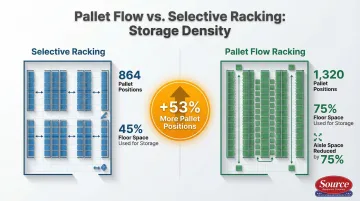
It's best suited for high-volume, fast-moving SKUs stored in full pallet quantities—such as top-selling seasonal items—reducing forklift travel during replenishment and improving throughput at peak demand. Pallet flow systems can store up to 100% more product than selective racks and reduce aisle space requirements by 75%. In direct comparisons, pallet flow configurations have delivered 1,320 pallet positions versus 864 for selective racking in equivalent footprints.
| Attribute | Details |
|---|---|
| Best For | High-velocity single-SKU lanes, seasonal peak fulfillment, FIFO-required inventory |
| Storage Density | Very high; multiple pallets deep per lane with minimal aisle requirements |
| Key Consideration | Higher upfront cost than selective racking; best value when lane SKUs have consistent, predictable demand |
Double-Deep Pallet Racking
Double-deep racking stores two pallet positions back-to-back within a single aisle, accessed by a reach truck with a pantograph attachment. It provides approximately 40% more pallet positions than single-deep selective racking within the same building footprint.
The selectivity trade-off is real: the front pallet must be moved to access the rear, so this works best for SKUs with at least two pallets of the same product in rotation. It suits bulk-buy fast movers well but is a poor fit for highly varied inventory.
Rack design must also account for the truck's outriggers (stabilizing legs), often requiring the bottom beam level raised 10–12 inches off the floor or wider bay openings to prevent outrigger impact with uprights.
| Attribute | Details |
|---|---|
| Best For | SKUs with multiple pallets of identical product; operations balancing density with moderate selectivity |
| Storage Density | High; approximately 40% more pallet positions than selective racking for the same footprint |
| Key Consideration | Requires reach truck with double-deep attachment; not suited for FIFO or high-SKU-variety operations |
Push-Back Pallet Racking
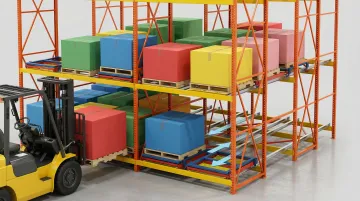
Push-back racking is a gravity-fed, last-in-first-out (LIFO) system where pallets sit on nested carts that roll back along inclined rails as new pallets are loaded—the most recently added pallet is always at the front for picking. Unlike drive-in racking, forklifts do not enter the rack structure, which reduces the risk of collision damage and increases operation speed.
For e-commerce operations, push-back works best with medium-velocity SKUs that don't require strict date rotation. It provides higher density than selective racking while maintaining front-aisle accessibility—a strong choice for overstock replenishment bays adjacent to active pick zones. Push-back systems can store up to 90% more product than selective racking in some configurations, while still allowing access to multiple SKUs (one per lane).
| Attribute | Details |
|---|---|
| Best For | Medium-velocity SKUs, replenishment staging, operations needing density without sacrificing front-access |
| Storage Density | High; 2–5 pallets deep per lane depending on system design |
| Key Consideration | LIFO rotation means it is not suitable for perishables or date-coded products requiring FIFO management |
Drive-In / Drive-Thru Racking
Drive-in racking (single entry, LIFO) and drive-thru racking (entry from both ends, FIFO) allow forklifts to enter the rack structure itself to place and retrieve pallets from rails running the depth of the bay. This configuration can hold up to 75% more pallets than standard selective racking, using up to 75% of available floor space for storage compared to 45% for selective rack.
In e-commerce warehouses, this system is best reserved for bulk seasonal inventory, promotional stock, or raw material buffers—not core SKU storage, given its low selectivity. The drive-thru variant is particularly useful for dedicated overflow or seasonal capacity bays.
Precise engineering is required: typical systems space vertical guide angles 42 inches apart for 40-inch wide pallets, leaving roughly 1 inch of clearance on each side.
| Attribute | Details |
|---|---|
| Best For | Seasonal overstock, uniform SKU bulk storage, low-turnover buffer inventory |
| Storage Density | Very high; eliminates most aisle space within the storage block |
| Key Consideration | Low selectivity limits practical use to 1–3 SKU types per bay; requires specific forklift clearance tolerances |
Mezzanine Pallet Racking
Mezzanine racking is a structural solution that creates a secondary storage and picking level above the main warehouse floor, effectively doubling usable square footage without expanding the building footprint.
With industrial rents averaging over $8.00 per square foot, vertical expansion is often more cost-effective than leasing additional space or relocating. Mezzanine levels can be configured for dedicated pick-and-pack zones, returns processing, or small-item bin storage directly above ground-level pallet storage.
Mezzanines are complex structures requiring engineering for specific load capacities, column placement, and seismic forces. Installations must adhere to the International Building Code (IBC) and local regulations, often requiring distinct permits and fire suppression upgrades.
| Attribute | Details |
|---|---|
| Best For | E-commerce fulfillment centers in high-cost real estate markets, operations needing dedicated pick floors |
| Storage Density | Doubles effective floor area; upper levels can house bin shelving, carton flow lanes, or additional pallet positions |
| Key Consideration | Requires structural engineering review and local building permits; column spacing must be planned around racking layout |
How to Choose the Right Pallet Rack Configuration for Your E-Commerce Warehouse
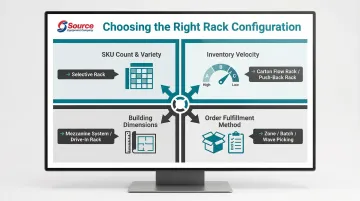
Four primary variables determine the optimal configuration for your operation:
1. SKU count and variety — Operations managing 500+ active SKUs typically need selective rack as the foundation, with specialized zones carved out for high-velocity items. High variety means immediate access to every product isn't optional — it's a baseline requirement.
2. Inventory turnover velocity — Classify inventory by velocity before choosing a system. "A" items (fast movers) need accessible storage like carton flow or selective rack; "C" items (slow movers) are candidates for high-density options like push-back or drive-in, where access speed matters less than storage density.
3. Available clear height and floor area — Buildings with 36+ feet of clear height can prioritize vertical cube utilization — taller selective rack, multi-level pick modules, or mezzanine installations all become viable. Tighter floor footprints push toward high-density systems like drive-in or push-back.
4. Order fulfillment method — Zone picking, batch picking, and wave picking each interact differently with rack layout. Zone picking benefits from carton flow lanes that keep high-velocity items at the pick face; batch picking favors selective rack for maximum SKU accessibility across a single travel path.
Hybrid Configurations Work Best
Most high-performing e-commerce warehouses use 2–3 rack types in combination. A common hybrid layout pairs selective racking for the main storage field with carton flow lanes for top-velocity small items and a mezzanine level for returns and pack stations.
One pool supplies distributor, for example, built a pick module with two-deep pallet flow at ground level for fast-moving bulk and carton flow on middle levels for case picking. Selective rack on the top tier handled replenishment storage — a three-system layout that addressed every velocity tier in one footprint.
Getting the combination right before committing to a layout prevents costly reconfiguration later — the kind that can run $50,000–$200,000 when structural changes are involved. Source Equipment Company works through this analysis with operators before a single rack is ordered.
How We Selected These 7 Configurations
Each configuration was chosen for its direct applicability to e-commerce fulfillment demands. Selection criteria included:
- SKU density compatibility with fast-moving inventory
- Impact on pick speed and order cycle times
- FIFO/LIFO suitability for product rotation
- Integration with common e-commerce fulfillment workflows
- Scalability as order volumes grow
Every system on this list addresses operational challenges specific to direct-to-consumer fulfillment.
Before diving in, here are the most common selection mistakes to avoid:
- Optimizing for lowest upfront cost without calculating total cost of ownership
- Defaulting to selective racking across all storage zones, regardless of SKU velocity
- Overlooking forklift type compatibility with the chosen system
- Leaving vertical space untapped in high-ceiling facilities
- Skipping growth planning, which forces costly reconfigurations later
Conclusion
There is no single best pallet rack configuration for every e-commerce warehouse—the right choice depends on SKU profile, order volume patterns, building constraints, and growth trajectory. The configurations covered here—from high-SKU selective systems to high-density flow racks and vertical mezzanine solutions—address the storage challenges that come up most often in e-commerce fulfillment.
Evaluate your current rack setup against fulfillment speed, pick accuracy, and space utilization metrics before defaulting to a single system. Most high-performance operations benefit from hybrid configurations that match storage type to inventory velocity and picking method.
If you're ready to evaluate or redesign your rack layout, Source Equipment Company Inc. has been working with warehouses and distribution centers on storage system configurations since 1989. Reach out for a consultation on the right setup for your operation—nationwide shipping available from the Leominster, MA headquarters. Call 1-800-743-5545 or email snyder@sourceequipment.com.
Frequently Asked Questions
What are the different types of warehouse racking?
The main categories include selective, double-deep, drive-in/drive-thru, push-back, pallet flow, carton flow, cantilever, and mezzanine racking. The right type depends on your inventory profile, storage density needs, and picking method—high-SKU operations typically use selective rack, while high-volume single-SKU storage benefits from flow or drive-in systems.
What are OSHA requirements for warehouse racking?
OSHA does not publish a dedicated racking standard but enforces general duty clause requirements under Section 5(a)(1) of the OSH Act. The RMI (Rack Manufacturers Institute) ANSI MH16.1 standard is the recognized industry benchmark for rack design, load capacity labeling, and inspection protocols that OSHA and industry inspectors rely upon.
What is the 5S rule in warehousing?
The 5S methodology (Sort, Set in Order, Shine, Standardize, Sustain) is a lean framework for reducing waste and improving warehouse productivity. Pallet rack configurations support 5S directly by establishing fixed product locations and reducing search time—implementation has been linked to 12.62% increases in usable floor area and 4% gains in operational efficiency.
What is e-commerce warehousing?
E-commerce warehousing is the storage and fulfillment infrastructure used to receive, organize, pick, pack, and ship individual consumer orders directly to customers. Unlike traditional bulk distribution, it handles higher SKU counts, smaller order sizes, and faster fulfillment cycles built around small-parcel, direct-to-consumer shipping.
What is the best pallet rack configuration for a high-SKU e-commerce warehouse?
Selective pallet racking is the baseline for high-SKU operations, providing immediate access to every pallet position. Adding carton flow lanes for top-velocity items and a mezzanine level for dedicated pick zones creates an efficient hybrid layout that handles diverse e-commerce inventory without sacrificing accessibility.
Can pallet rack configurations be reconfigured as my e-commerce business grows?
Yes, most roll-formed selective and modular racking systems are designed to be adjusted or expanded. Systems meeting ANSI standards with compatible beam and frame profiles allow businesses to add bays, adjust beam heights, or incorporate new system types as inventory needs evolve. Industry-standard teardrop designs offer 93% compatibility with existing systems, making future expansion straightforward without requiring full teardown.
![Best Pallet Rack Manufacturers in the USA [2026 Guide]](https://file-host.link/website/sourceequipment-4q4q99/assets/blog-images/5dce1de7-5314-4f9f-8d64-3cc82628ff96/1772061141216628_2ef8fa7a4181457b983c1fdb365c3991/1080.webp)