Introduction
Cold storage warehousing demands more than standard shelving—temperature-sensitive goods like food, pharmaceuticals, and dairy require precise environmental control, and the wrong racking system can compromise both product safety and energy efficiency. With refrigeration accounting for 60-70% of a facility's total electricity consumption, every cubic foot of storage becomes expensive real estate that directly impacts your operating costs.
The cold storage rack decision affects far more than storage capacity. It influences cooling costs, worker safety in frigid environments, inventory rotation accuracy, and long-term ROI. High-density racking systems can reduce refrigeration costs by approximately 15% and potentially cut overall energy costs by 30% or more by minimizing the volume of air requiring temperature control.
This guide covers the 6 best pallet rack systems for cold storage warehouses—what makes each one viable for sub-zero environments and how to choose the right fit for your operation.
Key Takeaways
- High-density systems minimize cooled air volume, directly reducing energy costs by 15–30%
- Match your inventory rotation to the right system: FIFO (Pallet Flow) for perishables with expiration dates, LIFO (Drive-In, Push-Back) for bulk frozen goods
- Galvanized or powder-coated steel is essential for durability against moisture, frost, and corrosion
- The 6 best cold storage rack systems covered: Selective, Drive-In, Pallet Flow, Push-Back, Mobile, and Pallet Shuttle
- Material selection and forklift compatibility can make or break your cold storage racking investment
Why Cold Storage Warehouses Need Specialized Pallet Racking
Cold storage warehousing operates under unique constraints that standard racking isn't built to handle. These facilities run from refrigerated (34–45°F) to deep-freeze (below 0°F) — temperature ranges that directly shape which rack systems work and which fail.
Three cold-storage-specific demands govern rack selection:
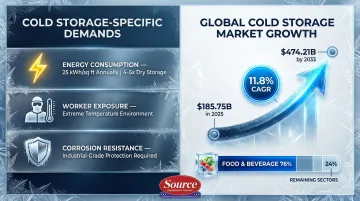
- Minimizing cooled air volume cuts energy costs — cold storage facilities consume roughly 25 kWh per square foot annually, 4–5 times more than conventional dry storage
- Limiting worker exposure time in extreme temperatures reduces injury risk and heat infiltration from open dock doors
- Resisting condensation, frost buildup, and corrosion — all of which accelerate inside temperature-controlled spaces
These pressures are intensifying as demand grows. The global cold storage market was valued at $185.75 billion in 2025 and is projected to reach $474.21 billion by 2033, growing at an 11.8% CAGR — driven by food & beverage (76% of 2025 revenue), pharmaceuticals, and e-commerce. More facilities means more rack decisions made under these same constraints.
The 6 rack systems below were selected specifically for cold storage performance, each evaluated against storage density, inventory flow compatibility, and durability in low-temperature environments.
The 6 Best Pallet Rack Systems for Cold Storage Warehouses
Each system below was chosen based on its ability to perform reliably in low-temperature environments while addressing storage density, inventory flow, and operational efficiency.
Selective Pallet Racking
Selective pallet racking is the most widely used warehouse storage system—upright frames and horizontal beams create single-pallet-deep lanes with full aisle access to every SKU. It offers broad compatibility with standard forklifts and ease of installation, making it the most accessible entry point for cold storage operations.
Why it works in cold storage:
Direct access to every pallet reduces worker search time in cold environments, minimizing exposure to sub-zero temperatures. The system supports diverse SKU counts, making it ideal for facilities storing varied frozen or refrigerated products. Its open structure promotes air circulation around stored goods, which helps maintain consistent temperatures throughout the facility.
| Attribute | Details |
|---|---|
| Best For | Cold storage facilities with high SKU variety and moderate inventory turnover needing direct pallet access |
| Cold Storage Advantage | Open aisle design promotes consistent airflow and cold air distribution around stored inventory |
| Key Consideration | Lower storage density than other systems; may require more refrigerated floor space, increasing energy costs |
Drive-In Pallet Racking
Drive-in pallet racking is a high-density system where forklifts enter the rack structure directly to load or retrieve pallets. It operates on LIFO (Last-In, First-Out) inventory management, with a single entry/exit point per lane that dramatically reduces aisle requirements.
Why it's particularly valuable in cold storage:
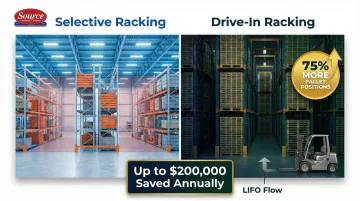
Its deep lane configuration shrinks the total air volume that needs refrigeration. Drive-in racking can accommodate up to 75% more pallets than selective racking in the same space, creating a near-solid block of product that minimizes cooled air volume.
Coloma Frozen Foods saved up to $200,000 annually in reduced labor, transportation, energy, and maintenance costs after consolidating storage with drive-in racking.
Best suited for bulk frozen goods—meats, vegetables, beverages—where uniformity is high and strict date rotation is less critical.
| Attribute | Details |
|---|---|
| Best For | High-volume, low-SKU cold storage of bulk frozen goods like meats, dairy, and beverages |
| Cold Storage Advantage | Fewer aisles mean less cooled air volume, directly reducing refrigeration energy costs |
| Key Consideration | LIFO only—not suitable for perishables with strict expiration date management; higher risk of rack contact from forklift entry |
Pallet Flow Racking
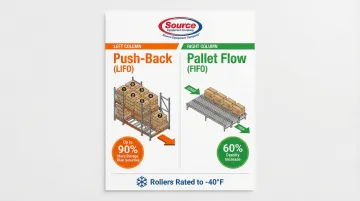
Pallet flow racking is a gravity-fed system with inclined lanes and rollers or wheels. Pallets loaded at the back automatically slide to the front as inventory is removed, enabling automatic FIFO (First-In, First-Out) rotation without manual intervention. Specific roller types engineered for freezer environments can withstand temperatures as low as -40°F (-40°C) without cracking or becoming brittle.
Critical advantage in cold storage:
Automatic FIFO eliminates the need for workers to manually rotate stock in cold conditions, reduces handling time, and ensures products with expiration dates—dairy, produce, pharmaceuticals, packaged foods—are always dispensed in the correct order. Pallet flow systems can increase storage density by as much as 60% over conventional selective racking.
GLK Foods implemented pallet flow and saved approximately 150 hours of forklift double-handling during peak harvest season while tripling onsite storage capacity.
| Attribute | Details |
|---|---|
| Best For | Cold storage of perishables with strict expiration dates—dairy, produce, packaged foods, and pharmaceuticals |
| Cold Storage Advantage | Automatic FIFO rotation minimizes worker time in cold environments and prevents expired inventory |
| Key Consideration | Higher upfront installation cost; requires consistent pallet quality and freezer-rated roller components |
Push-Back Pallet Racking
Push-back racking is a dynamic LIFO system where pallets are stored on nested carts or carriers that ride inclined rails. Each new pallet loaded pushes existing pallets deeper into the lane, supporting 2–6 pallets deep per lane from a single aisle face.
Value in cold storage:
Combines high density with faster pallet access than drive-in systems. Push-back racking can hold up to 90% more storage than a selective system, significantly reducing refrigerated floor space requirements. Front-access-only loading eliminates the need for a rear aisle, allowing racks to sit against walls and maximize floor use.
Facilities handling packaged frozen foods, dairy, and temperature-controlled SKUs with fast turnover get the most out of this system—especially when FIFO rotation isn't required. Back-to-back configurations can be set 2–7 pallets deep, yielding up to 12 pallets of storage between aisles.
| Attribute | Details |
|---|---|
| Best For | Moderate-turnover cold storage SKUs like packaged frozen foods and dairy requiring quick front-face access |
| Cold Storage Advantage | Single-aisle access reduces refrigerated floor space and limits open-door events during picking |
| Key Consideration | LIFO inventory flow only; slightly higher risk of pallet damage from cart movement |
Mobile Pallet Racking
Mobile pallet racking mounts standard selective racking frames on motorized bases that move along floor-mounted tracks. Racks can be compacted together when not in use, and a single aisle opens on demand. For cold storage operators, the ability to eliminate almost all non-essential aisles is a direct lever on both energy costs and usable floor space.
Why it excels in cold storage:
By eliminating permanent aisles, it achieves the highest storage density of any manually operated rack system while maintaining full pallet selectivity. Mobile racking can increase storage capacity by 80–120% compared to conventional pallet racking. The compacted configuration minimizes total refrigerated air volume dramatically.
One case study found that mobile racking increased storage capacity by 41% and efficiency by 22%, reducing construction and racking cost to $1,493 per pallet position—a 45% savings compared to $2,000 per pallet position for a conventional footprint.
- Makes the strongest financial case in purpose-built freezer rooms where per-square-foot construction and cooling costs are highest
- Mechanical components must be specified for low-temperature operation, rated between -30°C and +40°C
- Motorized bases require regular maintenance and cold-environment ratings
| Attribute | Details |
|---|---|
| Best For | Cold storage facilities where energy cost per pallet position is a primary concern and floor space is at a premium |
| Cold Storage Advantage | Compacted configuration minimizes refrigerated air volume, producing measurable energy savings in enclosed freezer rooms |
| Key Consideration | Higher capital cost due to motorized bases; mechanical components require regular maintenance and must be rated for freezer environments |
Pallet Shuttle Racking
Pallet shuttle racking is a semi-automated system where a battery-powered shuttle cart runs along rack lanes to autonomously load, move, and retrieve pallets. Operated via remote control, the shuttle eliminates the need for forklifts to enter the rack structure and supports both FIFO and LIFO modes depending on configuration.
Growing adoption in cold storage automation:
By removing the forklift from inside the rack lane entirely, it cuts rack damage risk in narrow freezer aisles and minimizes worker exposure time in sub-zero environments. The global pallet shuttle racking market reached $2.31 billion in 2024 and is projected to grow at 9.2% CAGR through 2033.
In high-volume facilities, pallet shuttle systems can deliver 50%+ labor reductions, 45%+ energy savings, and 30%+ space improvements. Payback periods typically run 3–5 years. Shuttle batteries must be rated for cold temperature operation—lithium-ion units are capable of 6–8 hours of continuous operation at -25°C.
| Attribute | Details |
|---|---|
| Best For | High-throughput deep-freeze storage of uniform SKUs where automation and minimal worker cold exposure are priorities |
| Cold Storage Advantage | Eliminates forklift entry into frozen lanes, reducing rack damage and shortening worker exposure to sub-zero temperatures |
| Key Consideration | High initial investment; battery performance in freezer conditions requires monitoring and a regular charging/swap protocol |
How We Chose the Best Pallet Rack Systems for Cold Storage
We evaluated each system against three cold-storage-specific criteria:
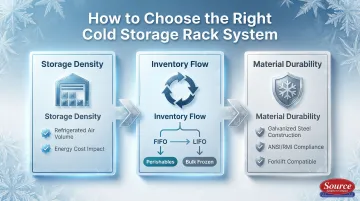
- Storage density — Impact on refrigerated air volume and energy costs
- Inventory flow compatibility — FIFO vs. LIFO suitability for product type
- Material/mechanical durability — Performance in low-temperature, high-humidity environments
A common mistake buyers make is selecting racking based on general warehouse use cases without accounting for the compounding costs of cooling an inefficiently designed storage layout. Standard steel becomes brittle at sub-zero temperatures and can fail catastrophically upon impact, while high humidity and condensation accelerate corrosion.
Critical evaluation factors:
- Forklift compatibility — Standard counterbalance vs. reach truck vs. narrow aisle equipment
- Rack coating or material specification — Galvanized steel or powder-coat finishes that resist corrosion in condensation-heavy environments
- ANSI compliance — Verified load capacity ratings that meet ANSI and RMI standards for your facility
These criteria informed every recommendation in this guide. Source Equipment Company Inc. — serving food service and distribution clients since 1989 — applies this same framework when matching a system to a facility's temperature zone, SKU profile, and throughput needs. Their pallet rack systems use 100% U.S.-sourced steel with galvanized finishes and meet OSHA, ANSI, and RMI compliance standards.
Conclusion
No single pallet rack system is universally best for cold storage. The right choice depends on your operational priorities:
- Maximum density: Mobile or Drive-In racking
- FIFO rotation for perishables: Pallet Flow systems
- Fast access across diverse SKUs: Selective racking
- Increasing automation: Pallet Shuttle systems
Evaluate each option against your temperature zone, product turnover rate, forklift fleet, and long-term energy costs—factoring in total cost of ownership including maintenance, protective coatings, and rack damage over time before finalizing your system.
For warehouses and distribution centers looking for expert guidance on cold storage racking, Source Equipment Company Inc. offers customized material handling consultations backed by decades of experience serving facilities nationwide. Contact the team at 1-800-743-5545 to assess your facility's layout and identify the most cost-effective and compliant rack system for your cold storage operation.
Frequently Asked Questions
How to choose the right pallet racking frame?
Selection depends on load capacity requirements, pallet size and weight, warehouse ceiling height, and forklift type. For cold storage, ANSI compliance and corrosion-resistant coatings (galvanized or powder-coated steel) are essential to withstand condensation, humidity, and frost-induced corrosion that standard painted steel cannot handle.
How to organize cold storage?
Effective cold storage organization relies on zoning by temperature requirement, using high-density racking to minimize refrigerated air volume, and implementing FIFO rotation for perishables. Position fast-moving SKUs closest to loading zones to minimize door-open time and worker exposure to extreme temperatures.
Should pallets be wrapped in racking?
Pallets are stretch-wrapped before being placed in racking, not while inside the rack. Wrapping stabilizes loads during transport and storage, and in cold storage it helps protect products from condensation and frost exposure. Racks should have adequate beam spacing to accommodate wrapped pallet dimensions.
What material is best for pallet racking in cold storage environments?
Galvanized steel or powder-coated steel frames are preferred for cold storage due to their resistance to condensation, humidity, and frost-induced corrosion. Standard painted steel deteriorates faster in freezer environments, increasing maintenance costs and safety risks over time.
What is the difference between FIFO and LIFO inventory management in cold storage?
FIFO (First-In, First-Out) ensures the oldest stock is used first, which is critical for perishables like dairy, produce, and pharmaceuticals with expiration dates. LIFO (Last-In, First-Out) retrieves the most recently stored pallet first, making it acceptable for long-shelf-life bulk frozen goods — so choose your rack system based on which rotation method your inventory requires.
How does pallet racking affect energy efficiency in cold storage warehouses?
High-density rack systems (mobile, drive-in, pallet shuttle) reduce the total volume of air requiring refrigeration by compacting storage and eliminating unnecessary aisles. This directly lowers cooling system workload and energy costs by 15–30%.
![Best Pallet Rack Manufacturers in the USA [2026 Guide]](https://file-host.link/website/sourceequipment-4q4q99/assets/blog-images/5dce1de7-5314-4f9f-8d64-3cc82628ff96/1772061141216628_2ef8fa7a4181457b983c1fdb365c3991/1080.webp)