![Cover image for Best Wire Decking for Pallet Racks [Complete Buyer's Guide]](https://file-host.link/website/sourceequipment-4q4q99/assets/blog-images/4402434f-d9df-486e-a8e5-281a5f1844c3/1772056904256134_cf9276408d18485ea3650a2e729af321/360.webp)
Introduction
A pallet load that shifts on an open beam, a small part that drops through the rack, a forklift operator fighting to center a skid — these are daily friction points in any warehouse. Left unaddressed, they create safety hazards, damage inventory, and slow operations. Wire decking addresses all three by providing a stable, secure surface that keeps loads centered and prevents items from falling through.
Wire decking is the standard pallet rack accessory across warehousing, distribution, food service, manufacturing, and retail operations. This guide covers what you need to choose the right configuration: types of wire decking, key specifications, selection criteria, and top options for different applications.
Key Takeaways
- Wire decking stabilizes pallet rack loads, supports non-palletized items, and satisfies fire sprinkler code requirements
- Channel type—U-channel or flare channel—determines beam compatibility and load capacity
- Choose based on beam type (step vs. box), load weight, environment, and wire gauge
- Standard capacities range from 2,200 to 3,650 lbs per deck depending on configuration
- Look for UL Listed, ANSI Compliant decking to meet safety standards and pass facility inspections
What Is Wire Decking for Pallet Racks?
Wire decking is a welded steel mesh panel supported by structural channels, designed to sit securely between front and rear pallet rack beams. The mesh surface eliminates the gaps where smaller items or improperly positioned pallets can slip through.
It handles three situations standard beam storage can't: loads that lack pallets, oddly shaped items that don't bridge beams cleanly, and forklift placements that need a centered, stable landing surface.
Fire Safety and Operational Advantages
Wire decking offers critical advantages over wood or solid-surface alternatives. The open mesh allows fire sprinkler water to pass through unobstructed—a requirement for NFPA 13 compliance. According to NFPA research, solid shelving blocks sprinkler spray and often requires expensive in-rack sprinkler systems. Wire decking's open design preserves sprinkler effectiveness while providing structural support.
Additional benefits include:
- Meets ASTM A641 standards for non-combustible construction
- Reduces moisture and heat buildup through improved airflow
- Simplifies inventory management and safety inspections with clear sightlines
- Lowers insurance costs by supporting fire safety compliance
For warehouses subject to NFPA 13, avoiding solid decking isn't just a preference—it's often what stands between a standard sprinkler system and a costly in-rack retrofit.
Structural Categories
Once you understand the fire safety case, the next decision is which physical format fits your rack system. Wire decking comes in two main categories: flared channel and step deck (U-channel).
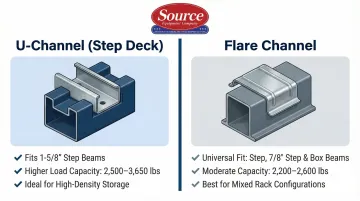
U-channel decks seat into standard step beams and carry higher rated loads, making them the go-to for high-density storage. Flared channel decks offer broader compatibility across beam types at slightly lower load capacities—useful when your facility runs mixed rack configurations.
Best Wire Decking Options for Pallet Racks
The "best" wire deck depends on beam configuration, load type, and operating environment. The options below cover the most widely used configurations across warehousing and industrial applications.
Standard U-Channel Step Deck Wire Decking
U-channel step deck is the most common wire deck type. The U-shaped support channels sit snugly on the 1-5/8" step of standard step beams, delivering higher rated capacity than flare channel designs. Nashville Wire's capacity data shows 3-channel decks typically handle 2,500–2,700 lbs, while 4-channel configurations support 3,200–3,600 lbs under uniformly distributed loads (UDL).
| Feature | Specification |
|---|---|
| Beam Compatibility | Standard 1-5/8" step beams |
| Typical Capacity Range | 2,500–3,650 lbs (UDL) depending on channel count |
| Best For | General warehousing, distribution centers, high-throughput pallet storage |
Three-channel decks are standard for most bay widths up to 96". Four-channel decks are specified for wider bays or heavier loads, providing additional structural support and higher rated capacities.
Flare Channel Wire Decking
Flare channel decks offer a universal-fit solution. The channel ends flare outward and wrap over the top of the beam face rather than resting on a step. This design makes them compatible with step beams, 7/8" step beams, and box beams—ideal for facilities with mixed rack systems or when retrofitting existing racks.
| Feature | Specification |
|---|---|
| Beam Compatibility | Step beams, 7/8" step beams, box beams (universal fit) |
| Typical Capacity Range | 2,200–2,600 lbs (UDL); lower than U-channel equivalents |
| Best For | Multi-beam-type facilities, retrofitting existing rack systems, lighter loads |
The trade-off for universal compatibility is slightly lower rated capacity versus U-channel decks. Flare channel decks work best for lighter-to-medium load applications where beam compatibility is the priority.
Inverted Channel Wire Decking
Inverted channel decks are a step-deck variant where the support channel is flipped so no open channel face is exposed upward. This prevents debris, food particles, and moisture from collecting inside the channels. Rack & Shelf markets this design specifically for food storage and pharmaceutical applications.
| Feature | Specification |
|---|---|
| Beam Compatibility | Standard step beams |
| Typical Capacity Range | Similar to standard U-channel (2,500–3,200 lbs UDL) |
| Best For | Food service, pharmaceutical, and sanitation-sensitive warehouse applications |
USDA and FDA regulations emphasize construction that prevents accumulation of organic materials and moisture. Inverted channel design addresses these requirements directly, making it the standard choice for regulated food and pharmaceutical storage.
Galvanized Wire Decking
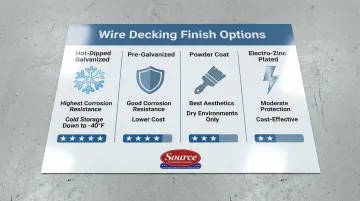
Galvanized finishes provide corrosion resistance for cold storage, refrigerated warehouses, outdoor applications, and facilities with high moisture or chemical exposure. Hot-dipped galvanized coatings meet ASTM A123 standards and retain performance down to -40°F, making them essential for refrigerated environments.
| Feature | Specification |
|---|---|
| Beam Compatibility | Compatible with most step and structural beam types |
| Typical Capacity Range | Equivalent to base deck type; finish does not affect capacity |
| Best For | Cold storage, refrigerated warehouses, food processing, outdoor/covered storage |
Finish options vary by environment and budget:
- Hot-dipped galvanized: Highest corrosion resistance, ideal for cold storage
- Pre-galvanized: Good corrosion resistance, lower cost than hot-dipped
- Powder coat: Better aesthetics, suitable only for dry environments
- Electro-zinc plated: Moderate corrosion resistance at lower cost
Heavy-Duty Wire Decking (4–5 Channel Configurations)
Heavy-duty wire decks feature 4 or 5 support channels and heavier-gauge wire to handle concentrated or high-weight loads. Nashville Wire lists 4-channel decks with capacities up to 3,650+ lbs for standard UDL applications.
| Feature | Specification |
|---|---|
| Beam Compatibility | Step beams; custom builds available for structural beams |
| Typical Capacity Range | 3,000–3,650+ lbs; custom specs available for point-load applications |
| Best For | Heavy manufacturing, bulk storage, applications with non-GMA pallets or concentrated load points |
One spec detail that trips up buyers: UDL ratings assume weight is evenly distributed across the full deck surface. Point loads—footed pallets, drums, or containers with concentrated weight at specific spots—require custom-engineered decks. For those applications, consulting a rack engineer or supplier like Source Equipment Company before ordering ensures the deck is specified correctly and avoids deflection or failure.
How to Choose the Right Wire Decking: Key Buying Factors
Step 1: Identify Your Beam Type First
Beam type is the primary filter for wire decking selection. Using the wrong channel type creates unsafe fits and voids capacity ratings.
Beam compatibility guide:
- Standard 1-5/8" step beams → U-channel decks (highest capacity)
- 7/8" step beams → Specific U-channel or flare channel decks
- Box beams (no step) → Flare channel decks only
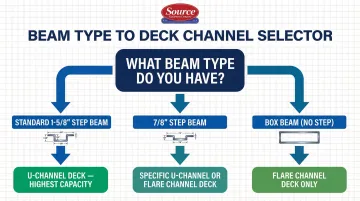
Measure your beam's step depth before ordering. The channel must match the step dimension for proper fit and load transfer.
Step 2: Calculate Your Load Requirements Accurately
Understanding load types prevents dangerous underspecification.
| Load Type | Description | Decking Requirement |
|---|---|---|
| Uniformly Distributed (UDL) | Weight spread across the full deck surface, within 2" of front and rear beams | Standard wire decking — this is how capacity ratings are calculated |
| Point/Line Load | Weight concentrated at specific points: footed pallets, drums, containers | Custom-specified decks engineered for that load profile |
Always verify deck capacity against the combined load of all items on that rack level — not just a single pallet's weight. Multiple lighter pallets can exceed deck capacity when stacked together.
Step 3: Match Wire Gauge and Mesh Pattern to Your Product Type
Wire gauge and mesh opening size affect both capacity and product compatibility.
Mesh pattern selection:
- 1" x 2": Small items, cartons, hand-stacked goods that could slip through wider openings
- 2" x 2": General-purpose applications, moderate-sized items
- 2" x 4": Standard for pallet storage (most common)
- 4" x 4": Large items, maximum airflow
Wire gauge guide:
- 2-gauge: Thickest wire — heavy-duty applications with the highest load capacity
- 4-gauge: Workhorse gauge for high-throughput warehouses and distribution centers
- 5-gauge: Medium-duty applications, lighter loads
- 6-gauge: Light-duty applications, retail environments
Lower gauge numbers mean thicker, stronger wire — and higher rated capacity.
Step 4: Select the Right Finish for Your Environment
Once you've nailed down gauge and mesh, finish selection comes down to your operating environment — temperature range, moisture exposure, cleaning frequency, and any industry regulations that apply.
Finish recommendations by environment:
- Dry warehouses: Powder coat (standard, good appearance)
- Cold storage/refrigerated: Hot-dipped galvanized (retains performance to -40°F)
- Food/pharmaceutical: Inverted channel with galvanized or powder coat finish
- Wet environments: Hot-dipped galvanized or pre-galvanized
- Retail/showroom: Oven-baked enamel (cleaner appearance, moderate protection)
Step 5: Measure Correctly Before Ordering
Incorrect sizing creates safety hazards and products may not be returnable.
Required measurements:
- Beam length (determines deck width)
- Upright depth front to back (determines deck depth)
- Beam step depth (confirms channel type compatibility)
- Beam face width (ensures proper channel fit)
Installation note: Use Tek screws to secure decks in both front and rear positions once installed. This prevents lateral movement during loading and unloading operations.
How We Selected These Wire Decking Options
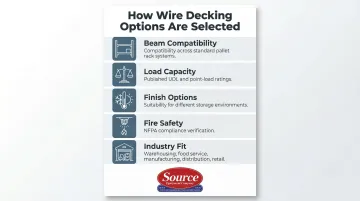
Each option in this guide was evaluated against criteria that matter in real warehouse and industrial settings. We looked at:
- Beam compatibility range across standard pallet rack systems
- Published load capacity ratings (UDL and point-load)
- Finish options suited to different storage environments
- Compliance with NFPA fire safety standards
- Fit across the industries Source Equipment serves: warehousing, food service, manufacturing, distribution, and retail
Common Buyer Mistakes to Avoid
Price only, no compatibility check: Skipping beam verification leads to unsafe installations and voided warranties.
UDL vs. point-load confusion: Concentrated loads exceeding design limits cause premature deck failure.
Wrong finish for the environment: Powder-coat holds up in dry conditions — not in cold storage or wet areas where corrosion sets in fast.
Skipping measurements before ordering: Ill-fitting decks create safety risks and are often non-returnable.
Conclusion
The right wire decking choice comes down to matching three variables in sequence: beam type, load profile, and operating environment. Getting the sequence wrong — specifying finish before confirming beam compatibility, for instance — leads to costly returns and rack downtime. Follow these steps before purchasing:
- Identify your beam type (step beam, box beam, or structural)
- Calculate actual load requirements (UDL vs. point load)
- Select the appropriate finish for your facility conditions (standard zinc, hot-dip galvanized, or powder coat)
Source Equipment Company offers UL Listed, ANSI Compliant wire decking configurations sized and specified for your exact rack system. Contact us at sourceequipment.com or call 1-800-743-5545 for expert guidance and fast nationwide shipping from our Leominster, MA headquarters.
Frequently Asked Questions
What are the different types of wire mesh?
Wire mesh comes in common grid patterns — 1"x2", 2"x2", 2"x4", and 4"x4". Smaller grids prevent small items from falling through; larger grids are standard for palletized loads. Wire gauge ranges from 2 to 6, with lower numbers indicating thicker, stronger wire.
What is the weight capacity of wire decking for pallet racks?
Standard wire deck capacities range from approximately 2,200 to 3,650 lbs per deck under a Uniformly Distributed Load (UDL), depending on channel type, number of channels, and wire gauge. Point-load or line-load applications require custom-specified decks and should be confirmed with a supplier or rack engineer.
What is the difference between U-channel and flare channel wire decking?
U-channel decks fit snugly on the step of standard step beams and offer higher load capacity (typically 2,500–3,650 lbs). Flare channel decks flare outward over the beam face and offer universal beam compatibility including box beams, at a slightly lower rated capacity (2,200–2,600 lbs).
Do I need wire decking on pallet racks?
Wire decking is not always mandatory but is strongly recommended for three reasons: safety (preventing falling loads), versatility (supporting non-palletized items), and fire code compliance (open mesh allows sprinkler water penetration). According to RMI safety guidelines, most insurance carriers and fire marshals treat it as required.
How do I measure wire decking for pallet racks?
Measure four key dimensions: beam length (deck width), front-to-back upright depth (deck depth), beam step depth (channel type), and beam face width. Decks should sit securely between front and rear beams and be secured with Tek screws to prevent movement during loading.
Is wire decking compliant with fire safety codes?
Wire decking's open mesh allows sprinkler water to penetrate through all rack levels, supporting NFPA 13 and FM Global fire suppression requirements. Solid surfaces block sprinkler coverage and typically require costly in-rack sprinkler additions.
![Best Pallet Rack Manufacturers in the USA [2026 Guide]](https://file-host.link/website/sourceequipment-4q4q99/assets/blog-images/5dce1de7-5314-4f9f-8d64-3cc82628ff96/1772061141216628_2ef8fa7a4181457b983c1fdb365c3991/1080.webp)