![Cover image for 7 Best Push Back Rack Systems [Compared & Reviewed]](https://file-host.link/website/sourceequipment-4q4q99/assets/blog-images/bc31782b-6cd0-4f79-9c79-0153c2ae0e2d/1772057450853280_cd396ee34926480398a9dea0aabcd2e9/360.webp)
Introduction
Floor space is one of the most expensive assets in any warehouse — and most operations are using it inefficiently. Push back rack systems store 2–4 pallets deep per lane from a single aisle, increasing storage capacity by up to 90% compared to standard selective racking, without adding aisles or expanding your footprint.
The mechanics are simple: pallets rest on nested steel carts along inclined rails. Each new pallet loaded pushes the previous ones back; when you pull from the front, gravity rolls the remaining pallets forward to the pick face automatically.
This design follows Last-In, First-Out (LIFO) inventory flow, which works well for non-perishables, bulk commodities, and any product where rotation by expiration date isn't a priority.
With dozens of manufacturers competing in the U.S. market, choosing the right system comes down to load capacity, cart build quality, depth configuration, and certifications. This review compares 7 leading push back rack systems on the specs that actually affect buying decisions: weight ratings, rail and cart construction, depth options, and RMI/ANSI compliance.
Key Takeaways
- Push back rack systems store 2–4 pallets deep per lane from a single aisle, reducing aisle requirements and increasing floor space utilization by 25–65%
- These systems operate on a LIFO basis via nested carts on inclined rails, making them ideal for warehouses storing multiple pallets of the same SKU
- Selection hinges on load capacity per lane, cart durability, ANSI MH16.1 compliance, and vendor support
- The 7 systems below span entry-level to heavy-duty configurations from leading U.S. manufacturers
What Is a Push Back Rack System?
A push back rack is a dynamic storage system where pallets rest on nested steel carts mounted on inclined rails. When you load a new pallet, it pushes the previous one back along the rails. When you retrieve the front pallet, gravity brings the remaining pallets forward to the pick face automatically.
LIFO Inventory Model
Push back rack operates on a Last-In, First-Out (LIFO) basis. The last pallet you load is the first one you retrieve. This makes the system suitable for:
- Non-perishable goods
- Bulk commodities
- Manufacturing raw materials
- Operations where stock rotation by expiration date isn't required
For operations requiring First-In, First-Out (FIFO) rotation—such as perishable food or pharmaceuticals—pallet flow rack is the appropriate alternative.
Understanding the inventory model helps clarify which configuration fits your operation best.
Configuration Types
Two primary configurations exist:
- Cart-based push back (most common): Uses rolling carts on rails. Each cart supports one pallet. Carts nest inside one another as pallets push them back. Standard configurations run 2–4 pallets deep per lane.
- Rail-based push back (less common): Uses inclined rollers instead of discrete carts. Typically reserved for deeper lanes (up to 6 pallets) where cart stack height becomes prohibitive.
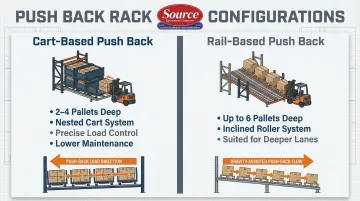
Most systems reviewed below use cart-based designs due to their precise load control and lower maintenance requirements.
7 Best Push Back Rack Systems
The systems below were evaluated on build quality, load capacity per lane, depth configurations, compliance with ANSI MH16.1 and RMI standards, and industry reputation. Use the spec tables to compare systems side by side, then verify all specifications directly with manufacturers before purchase.
UNARCO Push Back Rack
UNARCO ranks among the most recognized U.S.-based pallet rack manufacturers, with a long-standing reputation for engineered industrial storage systems including push back configurations.
UNARCO's push back offering features a low-profile cart design — a 6-deep stack uses only 6.25 inches of vertical bay height, preserving valuable overhead clearance. Carts use welded C-Channel construction with four completely sealed and lubricated stainless-steel skate wheels per cart. All components are manufactured in-house, ensuring consistent quality control.
| Specification | Details |
|---|---|
| Lane Depth Options | 2 to 5 pallets deep (standard); up to 6 deep available |
| Load Capacity per Lane | Up to 2,500 lbs per cart |
| Frame Construction | Structural and roll-formed steel frames available |
| Compliance/Certifications | ANSI MH16.1 compliant; RMI member; UL listed controllers |
UNARCO's systems are engineered for high-volume distribution centers and manufacturing facilities where cart longevity and minimal maintenance are priorities.
Frazier Glide-In® Push Back Racking
Built for distribution centers with high SKU counts and demanding throughput, the Glide-In® Push Back Racking line is engineered for durability and forklift impact resistance.
Frazier's proprietary "Enveloping Cart Design" features carts that nest inside one another, with the deepest cart being the widest for enhanced stability. The system uses hot-rolled structural steel for uprights, beams, and tracks — offering higher abuse resistance than roll-formed alternatives.
Carts include welded cross members to support weak or damaged pallets, and tapered wheels with sealed bearings treated with light aircraft lubricant for operation in extreme temperatures, including freezer environments.
| Specification | Details |
|---|---|
| Lane Depth Options | 2 to 4 pallets deep |
| Load Capacity per Lane | Contact Frazier for load specs by configuration; structural steel construction rated for heavy-duty applications |
| Key Differentiator | Patented Enveloping Cart Design; structural steel construction |
| Compliance/Certifications | ANSI MH16.1-2023 Structural R-Mark certified; RMI member |
Frazier's Glide-In® system is ideal for cold storage and high-impact environments where cart wear and forklift damage are common concerns.
Steel King Industries Push Back Rack
Steel King Industries, headquartered in New London, WI, is known for heavy-duty rack solutions. The SK3600 Pushback Rack is engineered for applications requiring maximum load capacity and structural integrity.
The SK3600 features rails made of 55,000 psi high-strength steel and 4-sided welded structural carts that arrive fully assembled — no field assembly required. Carts are rated up to 3,000 lbs each, the highest capacity among systems reviewed. The powder coat paint finish provides superior durability and impact resistance compared to standard finishes.
| Specification | Details |
|---|---|
| Lane Depth Options | 2 to 5 pallets deep |
| Load Capacity per Lane | Up to 3,000 lbs per cart |
| Build/Material Specs | 55,000 psi high-strength steel rails; 4-sided welded carts; powder coat finish |
| Compliance/Certifications | ANSI MH16.1-2023 R-Mark certified (Cold-Form and Structural); RMI member |
Steel King's SK3600 is the go-to choice for heavy-duty manufacturing and distribution operations storing dense commodities or industrial materials.
Mecalux Push Back Rack
Mecalux operates manufacturing and distribution facilities across North America and Europe, offering push back rack systems designed for high-density warehouse environments with automation integration capabilities.
Mecalux offers both cart-based (2–4 deep) and roller-based (up to 6 deep) configurations, providing flexibility across varying lane depth requirements. Carts are engineered to operate in extreme temperatures from -30°C to 40°C (-22°F to 104°F), covering cold storage and climate-controlled environments. Mecalux also emphasizes compatibility with their Easy WMS warehouse management software for inventory coordination and automated storage systems (AS/RS).
| Specification | Details |
|---|---|
| Lane Depth Options | Cart-based: 2–4 deep; Roller-based: up to 6 deep |
| Load Capacity per Lane | Up to 1,500 kg (approx. 3,300 lbs) per trolley |
| Notable Feature | Modular design; WMS/AS/RS integration; extreme temperature capability |
| Compliance/Certifications | ANSI MH16.1-2023 Cold-Form R-Mark certified; RMI member |
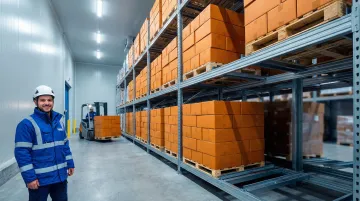
Mecalux is ideal for operations planning warehouse automation or requiring integration with existing WMS platforms.
Advance Storage Products (ASP) Push Back Rack
Advance Storage Products, based in California, is recognized for precision-engineered push back cart systems. ASP produces nearly half of the pushback systems sold in the U.S. — a market share that reflects broad adoption across warehouse types and industries.
The Lo-Pro™ Pushback system features a low-profile design measuring just 6 inches on a 6-deep system. Key cart innovations include:
- Linked carts that prevent uncontrolled rollout
- Serrated pallet grips that grab the underside of pallets for secure positioning
- Captured carts that prevent forklift lift-out
ASP offers "Full Support" systems designed for loads heavier than 3,000 lbs, addressing the needs of heavy-duty industrial applications.
| Specification | Details |
|---|---|
| Lane Depth Options | 2 to 6 pallets deep |
| Load Capacity per Lane | Full Support systems rated for 3,000+ lbs |
| Cart Design Spec | Linked carts; serrated pallet grips; captured cart design; 6" stack height (6-deep) |
| Compliance/Certifications | ANSI MH16.1-2023 Structural R-Mark certified; RMI member |
ASP's Lo-Pro™ system is well-suited for warehouses with limited vertical clearance or operations requiring maximum lane depth without sacrificing overhead space.
Ridg-U-Rak Push Back Rack
Ridg-U-Rak, a founding member of the Rack Manufacturers Institute, is a U.S.-based manufacturer in North East, PA, offering push back rack systems for warehouses and distribution centers.
Ridg-U-Rak uses structural steel components and a "box frame" cart design where carts telescope — the deepest cart is the widest for stability. The system is compatible with a range of accessories including row spacers, column protectors, and wire decking.
The company's "Made with American Steel" and "Made in USA" branding appeals to operations prioritizing domestic manufacturing and supply chain transparency.
| Specification | Details |
|---|---|
| Lane Depth Options | 2 to 5 pallets deep |
| Load Capacity per Lane | Carts rated for 2,000 lbs (beam capacities vary by profile) |
| Accessories/Compatibility | Row spacers, column protectors, wire decking compatible |
| Compliance/Certifications | RMI founding member; RMI-certified components |
Ridg-U-Rak is a solid choice for operations seeking U.S.-manufactured systems with robust accessory options for enhanced safety and customization.
Husky Rack & Wire Push Back Rack
Husky Rack & Wire is a U.S.-based manufacturer known for versatile rack solutions, including push back systems for diverse warehouse environments.
Husky's "Quick Ship" program ships many standard sizes within 48 hours — useful for operations needing rapid deployment or emergency replacements. Beam capacities range from 1,610 lbs to 24,760 lbs per pair depending on size and gauge, providing flexibility across varying load requirements.
| Specification | Details |
|---|---|
| Lane Depth Options | 2–4 pallets deep (standard configurations; contact Husky for custom depth options) |
| Load Capacity per Lane | Beam capacities: 1,610 lbs to 24,760 lbs per pair |
| Pricing/Lead Time | Quick Ship program: 48-hour delivery on standard sizes; competitive pricing |
| Compliance/Certifications | ANSI MH16.1-2023 Cold-Form R-Mark certified; RMI member |
Husky is ideal for operations prioritizing fast lead times and cost-effective solutions without sacrificing compliance or quality.
How to Choose the Best Push Back Rack System
The most common mistake buyers make is selecting a push back system based on price alone, without accounting for total lane load, pallet uniformity requirements, and available ceiling height—all of which directly affect system performance and safety.
Load Capacity and Lane Depth
Calculate required lane load capacity by multiplying pallet weight × pallets per lane. For example, if you store 1,200 lb pallets in a 4-deep lane, your total lane load is 4,800 lbs. Choose a system with carts rated above this threshold to account for dynamic loading forces.
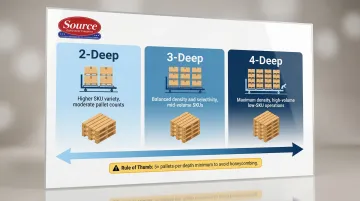
Industry guidance suggests push back rack is most efficient when you have at least five times the number of pallets as the lane depth. For a 4-deep system, you should have at least 20 pallets of that SKU to avoid "honeycombing"—empty slots that can't be filled without blocking other pallets.
Choosing the correct depth depends on:
- 2-deep: Best for higher SKU variety with moderate pallet counts per SKU
- 3-deep: Balanced density and selectivity for mid-volume SKUs
- 4-deep: Maximum density for high-volume, low-SKU operations
Pallet Compatibility
Push back systems are optimized for uniform pallet sizes. Carts are built to specific dimensions, and mixing pallet sizes in a single lane is not recommended.
Verify cart width and rail spacing against your actual pallet dimensions before ordering. Common configurations include:
- 48" × 40": Industry standard; widest availability
- 42" × 42": Available from select manufacturers with adjustable cart options
- 48" × 48": Requires custom rail spacing; confirm lead times upfront
Compliance and Certifications
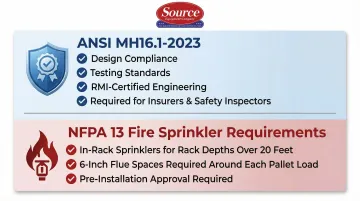
ANSI MH16.1-2023 is the U.S. standard for industrial steel storage racks, covering design, testing, and utilization. Verify that any system you purchase carries both ANSI MH16.1 compliance and RMI-certified engineering—insurers and safety inspectors will ask for both. All seven systems reviewed hold RMI membership and ANSI MH16.1 certification.
NFPA 13 fire sprinkler standards also apply to deep-lane storage. Key requirements to confirm with your local fire authority:
- Rack depths exceeding 20 feet may require in-rack sprinklers
- Flue spaces of at least 6 inches around each pallet load are typically required
- Approval must be obtained before installation, not after
Working with an Experienced Partner
Selecting the right push back configuration requires matching load requirements, floor space, and SKU profiles to the appropriate system. Source Equipment Company has supplied warehouses and distribution centers nationwide since 1989. Their team can help match your SKU profile and load requirements to the right configuration before you commit to a purchase.
Conclusion
The best push back rack system isn't a one-size-fits-all decision. The right choice depends on lane depth requirements, pallet uniformity, load capacity, and ANSI/RMI compliance—not just brand name or upfront cost.
Before committing, request engineered drawings and load certification documentation from any vendor. Factor in long-term cart maintenance, replacement part availability, and vendor support responsiveness. The upfront price is rarely the true cost of ownership.
If you need help matching the right system to your facility's layout and inventory profile, Source Equipment Company Inc. offers expert consultation and nationwide shipping. Contact the team at 1-800-743-5545 or email bfellows@sourceequipment.com to discuss your storage requirements.
Frequently Asked Questions
What is the difference between push back rack and drive-in rack?
Push back rack uses nested carts on rails and allows access to different SKUs per lane with no forklift entry required. Drive-in rack requires forklifts to drive into the structure and is better suited for single-SKU bulk storage. Push back significantly reduces rack damage risk since forklifts never enter the structure.
How many pallets deep can a push back rack system go?
Most push back systems are configured 2 to 4 pallets deep per lane, with 2-deep and 3-deep being most common. Some manufacturers offer up to 6 pallets deep, but beyond 4 deep, stacked cart height reduces available vertical clearance and retrieval efficiency drops.
Is push back rack FIFO or LIFO?
Push back rack operates on a LIFO (Last-In, First-Out) basis, making it unsuitable for perishable goods or products with expiration dates. For FIFO operations, pallet flow rack is the better choice.
How much does a push back rack system cost compared to selective rack?
Push back rack has a higher upfront cost ($151–$295 per pallet position) than selective rack ($55–$200 per pallet position) due to carts and rail components. However, it offers far greater storage density per square foot, often eliminating 1–2 aisles per bay and delivering 25–65% cubic density gains.
Can push back racks accommodate different pallet sizes?
Standard push back systems are designed for uniform pallet sizes since carts are built to specific dimensions. Some manufacturers offer adjustable configurations, but mixed pallet sizes in a single lane are generally not recommended due to cart width and rail spacing constraints.
What industries benefit most from push back rack systems?
Warehousing, food and beverage distribution, retail distribution centers, cold storage facilities, and manufacturing operations benefit most — particularly any operation storing multiple pallets of the same SKU that needs high-density, LIFO-based storage.