Introduction
Forklift impacts, overloading, and daily wear make pallet rack damage an inevitability in busy warehouses—not a rare exception. Industry research shows that 90% of pallet rack failures stem from forklift impacts, and between 2011 and 2017, forklift-related incidents resulted in 614 worker fatalities and more than 7,000 nonfatal injuries annually in the U.S.
The repair-vs-replace decision carries real financial weight, too. Workplace incidents involving "struck by object or equipment" cost U.S. businesses $5.14 billion annually.
This article covers:
- How to spot rack damage before it becomes a liability
- All four recognized repair solutions and when each applies
- A clear framework for choosing repair vs. replacement
- Practical steps to prevent recurring damage
Key Takeaways
- Damaged racks must be isolated immediately—never leave them unaddressed
- Repair works well for localized damage, but always requires a certified professional—and may void manufacturer warranties
- Replacement is the right call for structural damage, severe deformation, or compromised uprights
- Choose from four repair options: OEM replacement parts, repair kits, straightening, or field welding
- A qualified storage rack engineer must evaluate all damage before work begins
How to Identify Pallet Rack Damage
Visible Warning Signs
Even minor-looking dents can signal deeper structural compromise. Watch for these red flags:
- Bent or bowed uprights deviating from vertical alignment
- Cracked or broken welds at connection points
- Rust or corrosion that weakens structural integrity
- Misaligned or sagging beams that no longer sit level
- Damaged baseplates or anchor points showing cracks or separation
- Audible creaking or squeaking under load conditions
ANSI MH16.1 establishes strict tolerances for rack safety: a rack is unsafe once it exceeds a 1/240 out-of-plumb ratio—roughly 0.5 inches per 10 feet of height. Measuring those tolerances accurately requires a trained eye, which brings us to who should actually evaluate the damage.
Who Can Assess Damage?
Only a qualified storage rack design engineer can officially determine whether a damaged component is safe. Warehouse managers, forklift operators, and EHS teams—regardless of experience level—are not qualified to make that call.
Per RMI Guidelines, a supervising engineer holds a recognized degree, professional certification, or equivalent field expertise in rack systems. In practice, this means you need a licensed structural or rack engineer on-site before returning any damaged bay to service.
Initial Damage Response
When you discover damage:
- Cordon off the affected area immediately using barriers or caution tape
- Unload the bay if there's any risk of collapse
- Document with photographs and written records showing damage location and severity
- Contact a certified rack professional before resuming use of that section
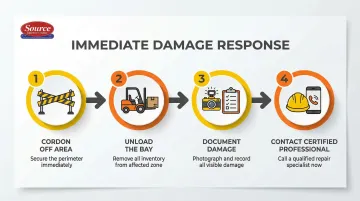
ANSI MH16.1 explicitly requires immediate isolation and unloading of damaged areas until a supervising engineer evaluates the system.
The 4 Pallet Rack Repair Solutions Explained
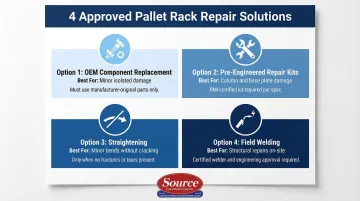
RMI's Guideline for the Assessment and Repair or Replacement of Damaged Rack (Version 2.0) recognizes four engineering-approved remediation options. Selecting the right one depends on damage severity, rack configuration, and engineer evaluation.
Repair Option 1: OEM Component Replacement
Replacing the damaged component with an identical part from the original equipment manufacturer is the most straightforward approach when original design documentation exists.
Critical requirement: "Similar-looking" parts from other manufacturers are not interchangeable. Precise engineering calculations determine load capacity, and mixing components can:
- Compromise structural integrity
- Void warranties from both manufacturers
- Create an unrateable capacity situation
When sourcing replacement components, confirm the part number and load ratings match your original specifications exactly. Source Equipment Company carries ANSI-compliant, UL Listed pallet rack systems and can help verify compatibility when original documentation is available.
Repair Option 2: Pre-Engineered Rack Repair Kits
Repair kits work by cutting away the damaged lower section of an upright and bolting or welding a heavy-steel replacement channel into place, then re-anchoring it to the floor.
Key advantage: Upper rack levels and product can often remain in place, minimizing operational disruption.
Requirements:
- A qualified rack engineer must verify configuration and loading before installation
- Kits must be engineered specifically for the rack system and load conditions
- Bolted kits are often preferred over welded solutions to avoid fire hazards and weld contamination risks
Repair Option 3: Straightening the Bent Component
Straightening is acceptable only when the repaired component can be confirmed to retain its original steel properties and load-bearing capacity.
Critical limitation: A supervising storage rack design engineer must make this determination. Bending metal back into place without engineering approval does not restore structural integrity and creates a serious safety risk.
RMI guidelines state this method should "not be considered unless expressly approved by the supervising engineer."
Repair Option 4: Field Welding with Steel Reinforcement
Field welding is the last-resort option when replacement components and repair kits are unavailable.
Strict requirements:
- Must be overseen by a qualified rack engineer
- Must comply with American Welding Society (AWS) D1.1 standards
- Requires certified welders
- Must follow OSHA fire safety protocols (29 CFR 1910.252(a))
Major drawback: Most manufacturers will void their warranty on any rack that has been field-welded or modified. AWS D1.1 Section 8.5.1 requires surfaces to be cleaned of all paint and foreign matter for at least 2 inches from the weld root—difficult to achieve in working warehouses.
When to Repair vs. When to Replace: A Decision Framework
The repair-vs-replace decision comes down to five key variables: damage severity, damage location, available documentation, operational disruption tolerance, and cost. No single factor is decisive—a certified engineer evaluates all of them together.
Factors That Favor Repair
Repair makes sense when:
- Damage is localized to a single upright or section
- Surrounding structure is sound with no additional compromise
- The rack is relatively new with years of useful life remaining
- Downtime must be minimized—the business cannot afford extended outages
- A qualified installer is available quickly to perform the work
Repair is often faster than waiting for new components—and in some cases, the repaired section ends up stronger at the repair point than the original.
Factors That Favor Replacement
Replacement is the better choice when:
- Damage is widespread across multiple bays or uprights
- Original documentation and manufacturer are identifiable—making direct replacement straightforward
- The rack is approaching end of useful life (20–30 years with proper maintenance)
- Existing seismic or local building codes would not be met after repair
- Repair cost approaches replacement cost, eliminating the value proposition
Warning: Never mix components from different manufacturers. Manufacturers like Ridg-U-Rak explicitly warn against interchanging components unless specifically designed and approved. This practice voids warranties from both parties and creates structural uncertainty.
The Role of ANSI MH16.1 and a Certified Engineer
Once you've weighed those factors, compliance requirements determine what any solution must achieve. ANSI MH16.1, Section 1.4.1(2) mandates:
- Immediately isolate damaged areas
- Have a storage rack design professional evaluate the damage
- Unload, repair, or replace any damaged structural components to restore original design capacity
This standard applies regardless of whether you repair or replace—both paths must restore the rack to its original rated capacity.
The Replacement Process: What to Expect
Standard Replacement Sequence
Follow this proven workflow:
- Procure matching OEM components from the original manufacturer or certified supplier
- Cordon off the affected aisle(s)—double-row racks may require both aisles closed simultaneously
- Unload all product from the affected bay, top-to-bottom
- Disassemble damaged uprights and beams carefully, preserving adjacent structure
- Install new components with correct footers, safety clips, and accessories
- Reload and verify that load plaques are updated if configuration has changed
Lead Time Advantages
Once the workflow above is mapped out, sourcing speed becomes the next variable. Source Equipment Company ships ANSI-compliant, UL Listed pallet rack systems nationwide from its Massachusetts headquarters. Standard components typically ship within 2-3 weeks, and popular sizes are available for 48-hour delivery—cutting the time between identifying damage and getting a bay back online.
Source Equipment's Invincible Rack systems are built for direct compatibility with most existing installations:
- Uprights up to 46 feet without splicing
- Universal teardrop punch design compatible with 93% of existing systems
- 100% U.S. sourced high-strength steel
- Bowlock safety clips for secure load retention
Documentation Requirements
After replacement, confirm that Load Application and Rack Configuration (LARC) drawings accurately reflect the restored system.
When LARC updates are required:
- ANSI MH16.1 requires LARC drawings to be updated after any modification, repair, or replacement
- Updated drawings must show repair details and certify load capacity
- LARC drawings provide the traceability needed to demonstrate compliance to OSHA or insurance auditors
When updates may not be needed:
- If identical OEM components were used and the configuration is unchanged, existing drawings typically remain valid
How to Prevent Future Pallet Rack Damage
Most Effective Prevention Strategies
Implement these proven measures:
- Install column guards and end-of-aisle protectors in high-traffic forklift zones to deflect impacts before they reach structural components
- Enforce load capacity limits strictly — overloading causes cumulative stress that leads to sudden failure, not gradual warning signs
- Implement formal forklift operator training that covers aisle clearance procedures and impact reporting protocols
- Schedule regular rack inspections at a minimum annually, with more frequent checks in high-traffic areas
For physical barrier protection, Source Equipment Company carries Rack Guard systems designed specifically for forklift impact zones, available for warehouses across the US.
The ROI of Proactive Maintenance
The financial case for scheduled maintenance becomes obvious when you look at what unplanned failures actually cost:
- "Struck by object or equipment" incidents cost U.S. businesses $5.14 billion annually
- Rack collapse costs include injury liability, product loss, regulatory fines, and extended downtime
- RMI notes that collapse costs "may far exceed the value of the entire rack structure"
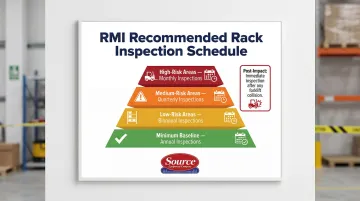
RMI recommends a risk-based inspection schedule based on traffic patterns and prior damage history:
- High-risk areas (high traffic, narrow aisles, prior damage): Monthly inspections
- Medium-risk areas: Quarterly inspections
- Low-risk areas: Biannual inspections
- Minimum baseline: Annual formal inspections
- Post-impact: Immediate inspection after any forklift collision
Frequently Asked Questions
How often should pallet racks be assessed for damage?
RMI recommends formal inspections at minimum annually by a qualified rack professional, with informal visual checks conducted by trained staff on a regular basis—weekly or after any known forklift impact. High-traffic areas should be inspected monthly.
How long do pallet racks last?
Pallet racks can last 20-30 years or more when properly maintained and not subjected to repeated impacts or overloading. Lifespan depends heavily on usage intensity, load conditions, and the quality of the inspection and maintenance program.
What are the OSHA rules for pallet racking?
OSHA does not have a dedicated pallet rack standard but enforces rack safety under the General Duty Clause (Section 5(a)(1)), which requires employers to maintain a workplace free of recognized hazards. ANSI MH16.1 is the industry-accepted standard used to demonstrate compliance.
What are the parts of a pallet rack called?
Key structural components include uprights (vertical columns), horizontal beams, base plates (footplates), anchor bolts, diagonal and horizontal bracing (struts), and beam connector clips.
Can I mix pallet rack components from different manufacturers during repair or replacement?
No. Mixing components—even teardrop-style parts marketed as "universal"—is not recommended. Manufacturers cannot certify capacity for mixed systems, warranties may be voided, and the structural integrity of the combined system cannot be reliably guaranteed.
Do I need an engineer to approve pallet rack repairs?
Yes. ANSI MH16.1 requires a qualified storage rack design professional to evaluate damage and approve any repair or replacement solution. Never attempt to repair, weld, or straighten rack components without certified engineering sign-off.
Need help deciding whether to repair or replace your pallet rack system? Contact Source Equipment Company — in business since 1989 — at 1-800-743-5545 or email bfellows@sourceequipment.com.
![Best Wire Decking for Pallet Racks [Complete Buyer's Guide]](https://file-host.link/website/sourceequipment-4q4q99/assets/blog-images/4402434f-d9df-486e-a8e5-281a5f1844c3/1772056904256134_cf9276408d18485ea3650a2e729af321/1080.webp)